


By April 20, spring no longer feels tentative. Gardens are moving with intention now: seedlings are pushing upward, fruit trees are setting the season’s promise, and gardeners are making choices that will shape not just May, but summer. It is a good date for an almanac entry because it sits right at that familiar threshold between caution and momentum.
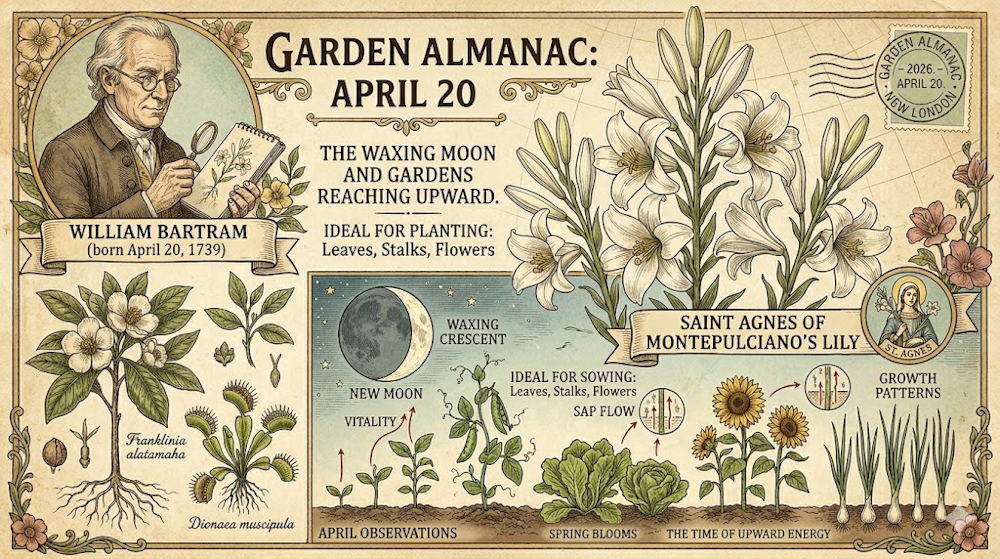
For this day, the strongest garden-linked threads are not random anniversaries but stories rooted in cultivation, observation, and plant symbolism. April 20 brings together the birth date of American botanist William Bartram, the feast day of Agnes of Montepulciano with her traditional lily imagery, and the practical old notion that the days after the new moon favor plants grown for their above-ground growth.
William Bartram and the art of paying attention
William Bartram was born on April 20, 1739, in Kingsessing, near Philadelphia, at the site of what became the oldest surviving botanical garden in North America. He was a botanist, naturalist, artist, and writer, and that combination makes him feel especially appropriate for a garden almanac. He did not look at plants merely as specimens. He watched them as living parts of whole landscapes.
That matters on a day like this. Late April is not only about tasks; it is about observation. What has truly taken hold? Which seedlings are racing ahead? Which corners of the garden are still holding cold? Bartram’s legacy fits the season because he reminds us that good gardening begins with looking closely before intervening too quickly.
The lily as a spring emblem
April 20 is also associated with Agnes of Montepulciano, who is traditionally represented with a lily. In an almanac sense, that image works beautifully even beyond its religious context. The lily stands for purity, but also for uprightness, clarity, and a kind of spring confidence.
In the garden, symbols matter because they help us notice what practical routines can hide. A productive garden is not only edible or efficient; it also carries rhythm, form, fragrance, and meaning. This is a good day to think about the ornamental side of spring planting, the part that feeds attention and spirit as much as it feeds pollinators.
A waxing moon and upward growth
Traditional moon-planting advice often treats the days after the new moon as favorable for annual flowers and for crops valued for leaves, stems, and fruits above the soil. April 20, 2026, falls in that waxing period, which makes it a natural fit for sowing or tending plants that are meant to rise, branch, bloom, or leaf out strongly.
Whether one follows moon gardening strictly or simply enjoys its seasonal poetry, the idea carries a useful truth: this is a time of upward energy. The garden is no longer storing itself. It is declaring itself.
What this day suggests in practical terms
April 20 is a fine day for light sowing, checking young growth, planning ornamental combinations, and making thoughtful decisions about structure in the garden. It is less a date for frantic catch-up than for aligning the garden’s next steps with what the season is already showing you.
Bartram gives the day its natural-history backbone. The lily gives it grace. The waxing moon gives it momentum. Together they make April 20 feel exactly like what a good almanac day should be: observant, practical, and slightly reflective.