
By the middle of July, the garden begins speaking in subtler ways. Spring’s dramatic bursts of growth have settled into steady abundance, fruits are swelling on the branches, seed heads are forming, and every sunrise offers quiet clues about what the coming weeks may bring.
July 15 has long been a day when people looked closely at both history and the weather. It brings together an old English weather tradition, one of archaeology’s greatest discoveries, and a modern reminder that our changing climate is reshaping the landscapes we cultivate. Although these stories come from different centuries, they all share a common lesson: nature is constantly leaving signs for those willing to observe them.
For gardeners, perhaps more than anyone else, paying attention has always been the first step toward understanding.
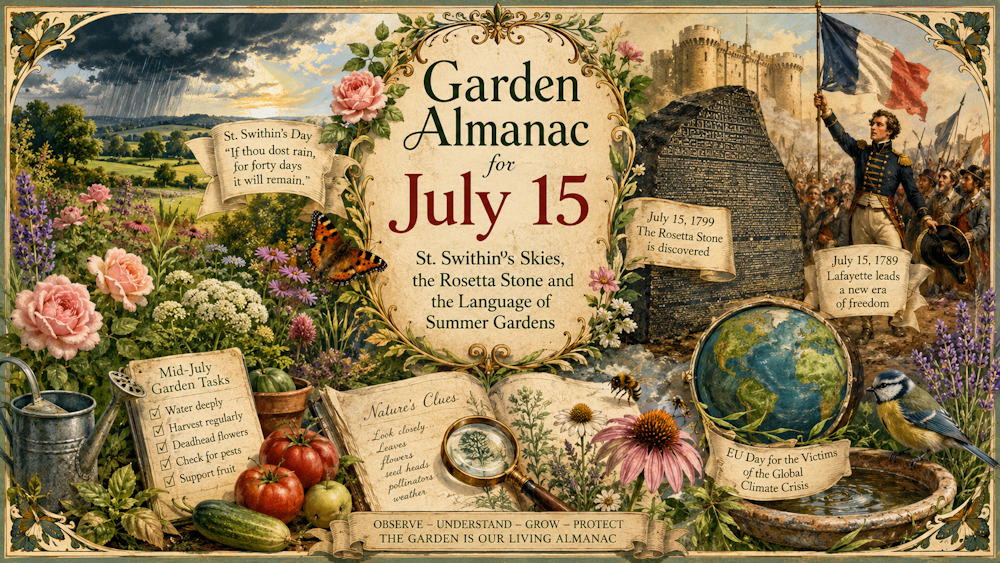
St. Swithin’s Day – Can One Summer Day Predict the Weather?
Few calendar traditions are as famous among gardeners as St. Swithin’s Day, observed every year on July 15. According to English folklore:
“St. Swithin’s Day, if thou dost rain, for forty days it will remain.”
The legend claims that the weather on July 15 determines the pattern for the following forty days. While modern meteorology has shown that no single day controls the rest of summer, the tradition reflects something far more valuable – generations of careful weather observation.
Before forecasts and satellites, farmers watched recurring seasonal patterns. Mid-July often marks a transition in the atmosphere across much of Europe, when stable high-pressure systems or unsettled Atlantic weather can persist for several weeks. The old saying exaggerates the effect, but it grew from centuries of practical experience rather than pure superstition.
For today’s gardeners, St. Swithin’s Day is a reminder to become observers again. Notice how quickly containers dry after a hot spell, how thunderstorms affect tomatoes, or how prolonged humidity encourages fungal diseases. Keeping even a simple garden diary can reveal patterns that matter far more than any proverb.
Garden Reminder – Mid-July Jobs Worth Doing
- Water deeply rather than lightly to encourage deeper root growth.
- Harvest beans, cucumbers and courgettes regularly to keep plants productive.
- Remove faded flowers from annuals and roses to encourage continued blooming.
- Check fruit trees for heavily laden branches that may need support.
- Inspect leaves after rainy periods for early signs of mildew or black spot.
The Rosetta Stone – Learning to Read Nature’s Hidden Messages
On July 15, 1799, French soldiers discovered the Rosetta Stone during Napoleon’s Egyptian campaign. Its inscription, written in three different scripts, eventually allowed scholars to decipher ancient Egyptian hieroglyphs and unlock thousands of years of forgotten history.
Gardeners also spend much of their lives deciphering hidden languages.
Yellowing leaves may reveal nutrient deficiencies. Curling foliage often signals drought stress or insect damage. Moss appearing in a lawn can point toward compacted soil or persistent shade. Every plant communicates, although rarely with words.
The Rosetta Stone reminds us that understanding begins with careful observation. Once we learn to recognise the signals, gardens become easier to manage because problems are often visible long before they become serious.
Garden Science – Why Do Leaves Tell Us So Much?
Plants cannot move away from difficult conditions, so they respond through visible changes.
- Nitrogen shortages often cause older leaves to turn pale green or yellow.
- Water stress may cause leaves to curl to reduce moisture loss.
- Heat can temporarily slow pollination in crops such as tomatoes.
- Nutrient imbalances frequently appear first in the youngest or oldest leaves, depending on which nutrient is limited.
Learning these visual clues allows gardeners to correct problems early instead of treating symptoms later.
The Day After the Bastille – Growing Freedom in Public Gardens
While Bastille Day is celebrated on July 14, the following day carries an important milestone of its own. On July 15, 1789, the Marquis de Lafayette was appointed commander of the newly formed National Guard as revolutionary France began reshaping public life after the fall of the Bastille.
The French Revolution would eventually influence far more than politics. Over the following decades, ideas about public access to parks, botanical collections and civic green spaces gradually spread across Europe. Gardens increasingly became places not reserved for aristocratic estates but shared spaces for education, recreation and scientific discovery.
Many of today’s botanical gardens continue this tradition by conserving rare species, introducing sustainable gardening practices and inspiring millions of visitors every year.
The lesson remains relevant: gardens flourish when knowledge is shared. Whether exchanging seeds, composting techniques or wildlife-friendly planting ideas, gardeners strengthen entire communities by growing together.
Wildlife Note – Summer Gardens Need More Than Flowers
By mid-July many pollinators face a hidden challenge. Early spring blossoms have disappeared, while late-summer flowers are only beginning to open.
To help bees, hoverflies and butterflies, allow plants such as lavender, oregano, marjoram, echinacea, verbena and scabious to flower fully before cutting them back. A continuous succession of blooms provides reliable food throughout the season.
A New Climate Memory – Honouring the Victims of Climate Change
July 15 is also observed as the EU Day for the Victims of the Global Climate Crisis, established to remember those whose lives have been affected by increasingly severe heatwaves, floods, droughts and wildfires.
For gardeners, climate change is no longer an abstract discussion. Longer dry spells, warmer winters, sudden cloudbursts and shifting flowering times are becoming familiar experiences in many regions.
Yet gardens are also part of the solution.
Healthy soils store carbon and retain water more effectively. Trees moderate local temperatures. Diverse planting supports resilient ecosystems that recover more easily from weather extremes. Even small home gardens contribute to cooling neighbourhoods and providing habitat.
Rather than trying to recreate the gardens of previous decades, many gardeners are learning to work with changing conditions by selecting resilient plants, improving soil health and harvesting rainwater whenever possible.
What to Observe Right Now
Take a slow walk through your garden today and look for signs that often go unnoticed:
- Which flowers still attract the greatest number of bees?
- Are your tomatoes producing flowers during this week’s temperatures?
- Have seed heads begun forming on ornamental grasses or perennials?
- Do birds visit shallow water more frequently during hot afternoons?
- Which corners of the garden stay surprisingly cool, even on warm days?
- These small observations often reveal more about your garden’s health than any single measurement.
Looking Ahead
July 15 reminds us that gardens are built on observation as much as cultivation. The old weather wisdom of St. Swithin’s Day, the decoding of the Rosetta Stone and today’s growing awareness of climate change all point toward the same enduring habit: learning to notice.
Every season teaches new lessons. Every unusual leaf, changing cloud pattern or visiting pollinator adds another line to the living story of a garden.
The more carefully we learn to read those signs, the better prepared we become – not only to grow healthier plants, but to create gardens that remain beautiful, resilient and full of life for many summers to come.