


July has a way of making a garden feel wonderfully alive. Bees move steadily from flower to flower, vegetables seem to grow overnight, butterflies drift across sunny borders, and every morning reveals something new. It is a season that rewards careful observation as much as hard work.
Interestingly, July 10 is also a day that reminds us how closely curiosity, science and nature have always been connected. From one of history’s most famous debates about evolution to the birthday of Nikola Tesla and the remarkable heat records that continue to shape conversations about climate, this date encourages us to look more carefully at the living world around us.
For gardeners, that curiosity is one of the most valuable tools we have. Every flower opening, every visiting insect and every changing weather pattern tells part of the same story.
July 10, 1925 – The Trial That Put Evolution in the Spotlight
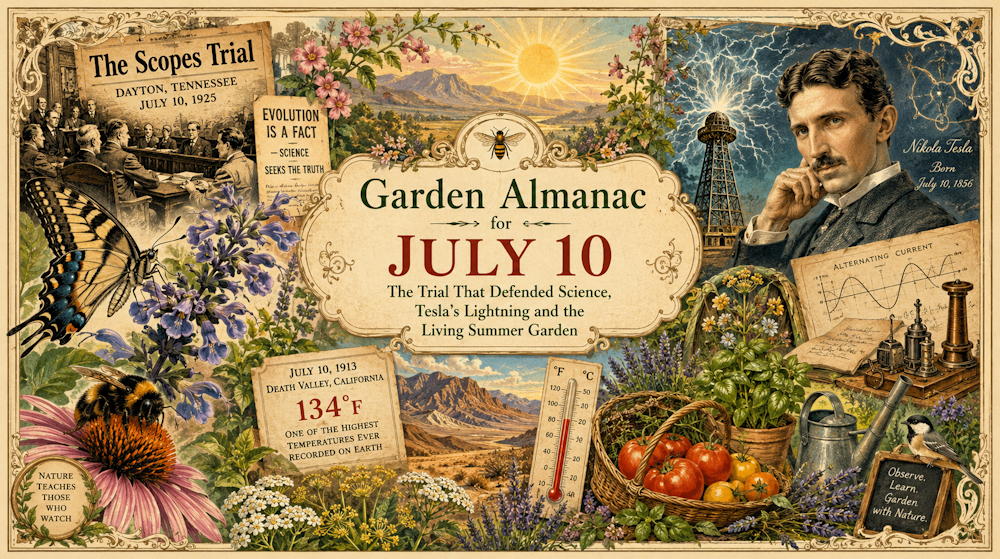
When the famous Scopes “Monkey Trial” opened in Dayton, Tennessee, on July 10, 1925, it was officially about whether a teacher had broken state law by teaching evolution. In reality, it became one of the twentieth century’s defining public conversations about science, education and how we understand nature.
For gardeners, the debate feels surprisingly familiar today.
Modern horticulture relies heavily on evolutionary science. Plant breeding, disease resistance, pollinator relationships and even our understanding of invasive species all depend on recognising that living organisms constantly adapt over time.
Every tomato variety, climbing rose or drought-tolerant lavender growing in today’s gardens is the result of generations of natural selection combined with careful human selection. Evolution is not merely a theory discussed in classrooms – it is visible every growing season.
A gardener who understands why fungi evolve resistance to fungicides or why pollinators prefer certain flower shapes is better equipped to work with nature rather than against it.
Garden Science – Why Do Plants Produce So Many Different Flowers?
Flower diversity is the result of millions of years of adaptation.
Different flower shapes have evolved to suit different pollinators:
- Tube-shaped flowers often favour long-tongued bees or butterflies.
- Flat, open flowers are easily visited by hoverflies and small native bees.
- Night-scented white flowers frequently attract moths after sunset.
Understanding these relationships helps gardeners create borders that support a wider range of beneficial insects instead of relying on a single pollinator species.
Nikola Tesla’s Birthday – Learning From Nature’s Energy
July 10 is also celebrated as Nikola Tesla Day, honouring the inventor born in 1856, whose work transformed the way electricity powers modern life.
Although Tesla is remembered for alternating current and electrical engineering, he often described nature as one of his greatest inspirations. He carefully observed lightning, energy flows and natural patterns long before many scientific ideas became everyday knowledge.
Gardeners, too, increasingly think in terms of energy rather than simply watering and fertilising.
Healthy soils store energy through organic matter. Trees cool their surroundings through transpiration. Living mulch reduces evaporation. Compost returns stored nutrients to the soil instead of letting them become waste.
A well-designed garden is, in many ways, an efficient energy system powered almost entirely by sunlight.
Rather than constantly adding external inputs, successful gardeners learn to encourage natural cycles that already exist.
July 10, 1913 – What Extreme Heat Can Teach Every Gardener
July 10 also marks one of the most famous weather records in history. In 1913, California’s Death Valley recorded an air temperature of 56.7°C (134°F), a measurement that remains among the highest ever observed on Earth. Although scientists continue to discuss the exact reliability of that historic reading, the event has become an enduring symbol of extreme heat.
Today’s gardeners are facing a different challenge.
Heatwaves that were once considered exceptional are becoming more frequent across many regions, changing planting schedules, irrigation needs and even the choice of suitable plant species.
The lesson is no longer simply how to survive a hot summer, but how to build gardens that remain resilient during repeated periods of heat stress.
Garden Reminder – How Can You Help Plants During Hot Weather?
- Water deeply rather than lightly to encourage deeper roots.
- Apply organic mulch to keep soil temperatures lower.
- Water early in the morning whenever possible.
- Avoid heavy pruning during prolonged heatwaves.
- Harvest vegetables regularly – mature fruits require considerable water and energy from the plant.
These simple practices help plants cope with stress while reducing unnecessary water loss.
A Midsummer Garden Is Full of Tiny Partnerships
By early July, many gardens are reaching one of the busiest periods of ecological activity.
Flowers are producing nectar, berries are beginning to ripen, beneficial insects are hunting aphids, and young birds are learning to forage independently. Every healthy garden becomes a network of thousands of small interactions.
Some of the most important work is carried out by creatures that rarely attract attention.
Wildlife Note – Why Are Hoverflies So Valuable?
Hoverflies are often mistaken for small wasps because of their yellow-and-black markings, but they cannot sting.
Their importance lies in two different life stages:
- Adults pollinate many summer flowers while feeding on nectar.
- Their larvae consume surprisingly large numbers of aphids.
Leaving a few nectar-rich flowers such as yarrow, fennel, oregano or marjoram in bloom can support hoverflies throughout midsummer while naturally helping to reduce aphid populations.
What to Observe Right Now – The Garden’s Midseason Balance
Instead of focusing only on jobs that still need doing, spend a few quiet minutes simply watching your garden.
You may notice:
- bees choosing different flowers at different times of day;
- butterflies preferring sunny, sheltered corners;
- seed heads beginning to replace early summer blossoms;
- dragonflies hunting over ponds;
- birds searching dense shrubs for insects to feed late broods.
These observations often reveal far more about the health of a garden than any fertiliser schedule.
They also help gardeners notice changes early, whether those changes involve pests, drought stress or simply the natural rhythm of the season.
Looking Ahead
July 10 reminds us that good gardening begins with careful observation. The Scopes Trial highlighted the importance of understanding the natural world through science. Nikola Tesla showed how closely innovation can grow from watching nature, while the history of extreme summer heat reminds us that resilient gardens will become increasingly valuable in a changing climate.
Every thriving garden is built on knowledge gathered season after season. The more closely we watch pollinators, weather, soils and plants working together, the more confidently we can garden with nature rather than against it – creating landscapes that are not only more productive, but also richer in life for years to come.