
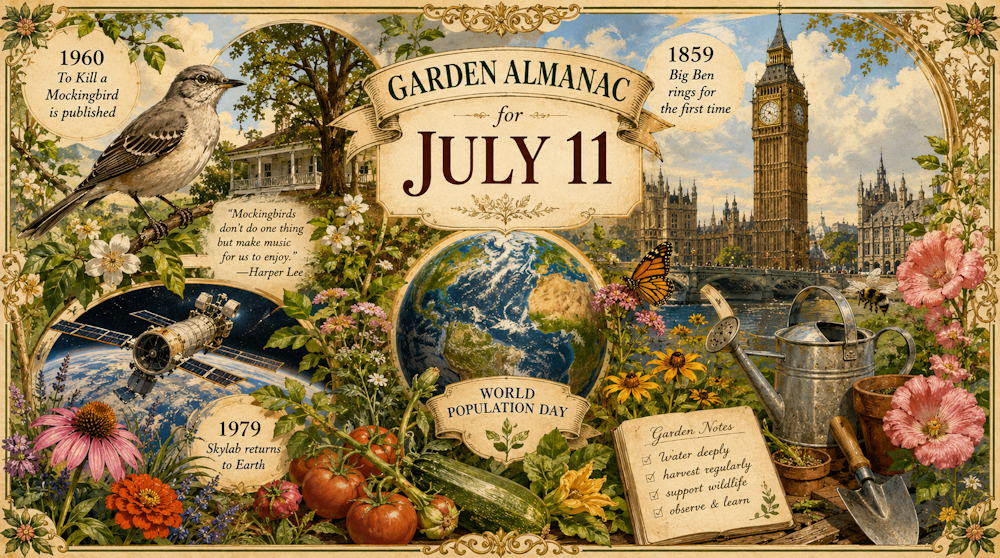

There are days when history seems to bloom in unexpected places. July 11 is one of them – a midsummer date where literature, science, public awareness and the rhythms of nature quietly intersect.
In gardens across the Northern Hemisphere, summer has reached its richest chapter. Tomatoes are swelling on the vine, butterflies drift above flowering borders, and every morning offers something new to harvest or observe. It is also a season that rewards careful attention. Small decisions made now – watering wisely, encouraging wildlife, harvesting at the right moment – shape the abundance of the weeks ahead.
Fittingly, several memorable events linked to July 11 remind us that lasting change often begins with observation. Whether it is paying attention to people, protecting ecosystems, or simply listening to the sounds around us, this date encourages us to become better caretakers of the living world.
Harper Lee’s To Kill a Mockingbird – Listening to the Quiet Voices of Nature
On July 11, 1960, Harper Lee’s To Kill a Mockingbird was published, becoming one of the most influential novels of the twentieth century. While celebrated for its themes of justice and compassion, its title draws on a simple natural symbol – the mockingbird, a bird that harms no one and fills the landscape with borrowed songs.
Mockingbirds belong primarily to North America, but nearly every region has birds that play a similar ecological role. Songbirds help control insects, disperse seeds and bring vitality to gardens simply through their presence.
Their needs are surprisingly modest. Native shrubs provide nesting sites, shallow water supports them during hot weather, and avoiding broad-spectrum insecticides preserves both the insects they feed on and the health of young chicks.
A healthy garden is rarely a silent one. Birdsong is often among the earliest signs that a diverse ecosystem is thriving.
Wildlife Note – Why do birds sing most in summer mornings?
Birds are especially vocal during the first hours after sunrise because cooler air carries sound more efficiently, while early morning offers the best opportunity to defend territories and communicate before the day’s heat reduces activity. If your garden seems quieter than usual, a lack of insects or nesting habitat may be part of the reason.
World Population Day – Growing More While Using Less
July 11 is also observed as World Population Day, established by the United Nations to encourage discussion about the challenges of a growing global population.
For gardeners, the question is remarkably practical. How can we produce healthier food, greener cities and richer biodiversity without placing greater pressure on land and water?
Many of today’s gardening practices provide part of the answer:
- compost returning nutrients to the soil,
- mulches reducing water loss through evaporation,
- rainwater harvesting easing demand on treated water,
- diverse plantings supporting pollinators and natural pest control,
- growing edible crops close to home to reduce transport.
Even a modest garden demonstrates an important ecological principle: healthy soils store water more effectively, support more microorganisms and require fewer external inputs than depleted soils.
As cities expand and climates become less predictable, resilient gardens become valuable pieces of environmental infrastructure rather than simply attractive landscapes.
The First Chimes of Big Ben – Nature’s Own Clock
On July 11, 1859, London’s famous Big Ben rang out for the first time. For generations its deep chimes became a symbol of reliable timekeeping.
Long before mechanical clocks, however, gardeners relied on living clocks.
Many flowers open and close at remarkably predictable times. Morning glories unfurl with the sunrise, while evening primroses wait until dusk. Bees begin foraging as temperatures rise, dragonflies become more active through warm afternoons, and many moths appear only after sunset.
These natural rhythms are controlled by circadian clocks inside plants and animals, synchronized by daylight and temperature rather than by hours and minutes.
Garden Science – Why do some flowers open only at certain times?
Flowers often bloom when their most effective pollinators are active. Day-opening flowers usually attract bees and butterflies, while species that open in the evening are commonly pollinated by moths or nocturnal insects. This timing increases pollination efficiency while conserving the plant’s energy.
A Sky Falling to Earth – What Skylab Reminded Us
July 11, 1979 also marked the dramatic return of Skylab, America’s first space station, whose remaining fragments re-entered Earth’s atmosphere after six years in orbit.
Looking down from orbit transformed how humanity viewed the planet. Satellites now monitor forests, drought, crop development, wildfires and changing vegetation across continents.
Modern gardeners benefit from the same technologies. Weather forecasts, rainfall maps, drought warnings and even many gardening apps rely on satellite observations that help us make better seasonal decisions.
The farther we look into space, the more clearly we understand the fragile systems that sustain life here on Earth.
Garden Reminder – What deserves attention in mid-July?
- Water deeply rather than frequently to encourage roots to grow downward.
- Harvest courgettes, cucumbers and beans regularly to keep plants producing.
- Remove faded flowers from annuals and many perennials to encourage continued blooming.
- Check tomatoes for early signs of blossom-end rot, often linked to inconsistent soil moisture rather than a simple calcium shortage.
- Continue observing leaves for the first symptoms of fungal diseases after humid weather.
What to Observe Right Now – Nature is Giving Plenty of Clues
Take a slow walk through your garden today and notice:
- which flowers attract the greatest variety of pollinators,
- where butterflies rest during the hottest part of the afternoon,
- whether birds are still feeding recently fledged young,
- which plants remain fresh despite the heat – a useful guide for future planting,
- how mulch affects soil moisture beneath the surface compared with exposed ground.
These quiet observations often reveal more about a garden than any single gardening book.
Looking Ahead
July 11 reminds us that the most meaningful changes often begin with careful observation. A novel teaches empathy through the image of a bird. A global awareness day asks how we can share the planet more wisely. A great clock reminds us that nature has always kept time in its own way, while a space station shows our gardens as tiny pieces of a much larger living world.
As summer continues, every visit to the garden offers the same invitation: watch closely, learn continuously and work with nature rather than against it. The healthiest gardens are not simply well maintained – they are well understood.