


By the middle of July, gardens are revealing both their generosity and their limits. Tomatoes begin to ripen, herbs fill the air with fragrance, and pollinators move tirelessly between blossoms. Yet this is also the season when heat, drought and careful watering remind us that every harvest depends on healthy ecosystems and thoughtful stewardship.
July 13 is a date that unexpectedly brings together two powerful stories. One celebrates humanity’s willingness to care for people in need across continents. Another begins with a small forest lake that gives rise to one of the world’s greatest rivers. Together, they remind us that both nature and human communities depend on countless small actions that grow into something much larger.
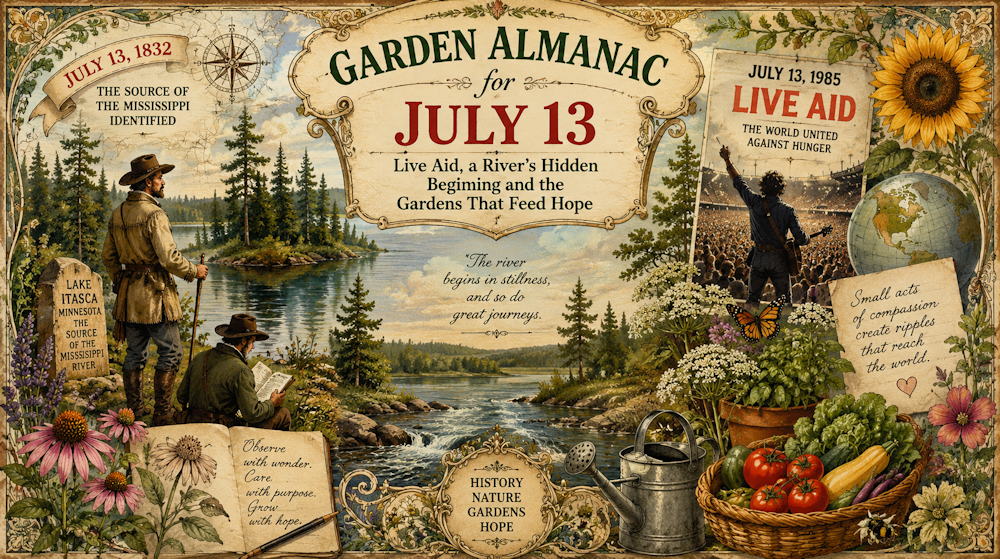
July 13, 1832 – Finding the Source of a Great River
On July 13, 1832, American explorer Henry Rowe Schoolcraft and his expedition reached what is now known as Lake Itasca in present-day Minnesota and identified it as the principal source of the Mississippi River. The discovery marked an important milestone in North American exploration and helped complete the understanding of one of the continent’s most influential river systems.
What makes this story remarkable is its scale. The mighty Mississippi, stretching nearly 2,350 miles (3,780 km) to the Gulf of Mexico, begins as water quietly flowing out of a relatively small forest lake. It is a reminder that enormous natural systems often have surprisingly modest beginnings.
For gardeners, this offers an important lesson about water. Healthy soils, wetlands, woodland ponds and even small rain gardens all contribute to storing, filtering and slowly releasing water. Across a landscape, countless small natural reservoirs help reduce flooding after storms while sustaining rivers during dry periods.
The same principle applies in our own gardens. Improving soil with compost, mulching vegetable beds and collecting rainwater do more than benefit individual plants – they help restore the natural water cycle on a local scale. Every garden becomes a tiny watershed where thoughtful choices influence how water moves through the landscape.
Garden Science – Why Does Healthy Soil Hold More Water?
One of the simplest ways to make a garden more resilient is to improve its soil.
Organic matter such as compost acts like a sponge. It increases the soil’s ability to absorb rainfall, reduces surface runoff and helps roots access moisture during dry spells. Well-structured soils also contain more air spaces, allowing roots and beneficial microorganisms to thrive.
This is why gardens rich in organic matter often stay productive longer during summer heat than compacted, depleted soils.
Live Aid – When the World Came Together for Hunger Relief
On July 13, 1985, millions of people around the globe watched the Live Aid concerts broadcast simultaneously from London and Philadelphia. Organized to raise funds for famine relief in Ethiopia, the event became one of history’s largest humanitarian efforts, reaching an estimated global television audience of more than one billion people.
Although remembered for unforgettable musical performances, Live Aid also focused international attention on food security, drought and the vulnerability of agricultural communities.
Those challenges remain highly relevant today. Around the world, gardeners, community allotments and urban farms increasingly contribute to local food resilience. While no home vegetable patch can solve global hunger, millions of small productive gardens collectively strengthen local food systems and reconnect people with where food comes from.
Even a modest kitchen garden can produce fresh herbs, beans, leafy greens or tomatoes throughout summer while reducing food waste and supporting biodiversity at the same time.
Garden Reminder – What Should You Prioritize in Mid-July?
If your garden is entering one of its hottest periods, focus on tasks that protect plants rather than encourage rapid new growth.
- Water deeply but less frequently to encourage deeper roots.
- Harvest beans, cucumbers and zucchini regularly to stimulate continued production.
- Remove diseased foliage from tomatoes and potatoes as soon as it appears.
- Keep a layer of organic mulch around vegetables to reduce evaporation.
- Avoid heavy fertilising during extreme heat, as stressed plants absorb nutrients less efficiently.
Small Actions Shape Larger Landscapes
The story of the Mississippi reminds us that major natural systems are built from countless smaller parts. A river depends on healthy forests, wetlands, streams and soils throughout its entire watershed. Remove enough of those pieces, and the whole system begins to suffer.
The same ecological principle applies in our gardens.
A pollinator-friendly border, a compost heap, a rain barrel or a patch of unmown grass may seem insignificant on its own. Yet when thousands of gardeners make similar choices, they collectively create valuable habitat, improve water retention and support biodiversity across entire regions.
Healthy landscapes are not created all at once. They emerge from many thoughtful decisions repeated year after year.
Wildlife Note – Why Are Bees Still Busy in July?
Many spring flowers have already faded, but July remains one of the busiest months for pollinators.
Look for bees visiting:
- lavender
- oregano
- thyme
- catmint
- echinacea
- single-flowered dahlias
- flowering herbs allowed to bloom
Leaving even a few herbs to flower provides valuable nectar during midsummer, when continuous food sources become increasingly important.
Looking Beyond the Flower Border
July is also a reminder that gardens exist within much larger landscapes.
Heatwaves, droughts and changing rainfall patterns influence farms, forests and home gardens alike. The choices made in individual gardens – planting drought-tolerant species, improving soil with compost, collecting rainwater and creating habitat for wildlife – become small but meaningful contributions to broader environmental resilience.
The journey of the Mississippi, from a quiet woodland lake to one of the world’s great rivers, mirrors the way countless small actions can combine into something far greater than their individual parts.
What to Observe Right Now
Before your next gardening task, spend five quiet minutes simply watching.
Notice:
- which flowers receive the most pollinator visits
- where butterflies prefer to rest during the hottest hours
- which parts of the garden dry out first after sunrise
- whether birds are collecting insects rather than seeds – a sign they are still feeding late broods
- how mulch changes soil moisture beneath your feet
These observations often become the most useful gardening lessons of the entire season.
Looking Ahead
July 13 reminds us that resilience often begins quietly. Great rivers rise from small springs, productive gardens grow from healthy soil, and stronger communities are built through countless individual acts of care. Whether we conserve water, enrich the soil or create space for wildlife, each decision contributes to something larger than our own garden.
As midsummer unfolds, let your garden become more than a place to work. Let it become a place that reflects how nature itself succeeds – through connection, patience and many small actions that, together, shape the landscape for generations to come.