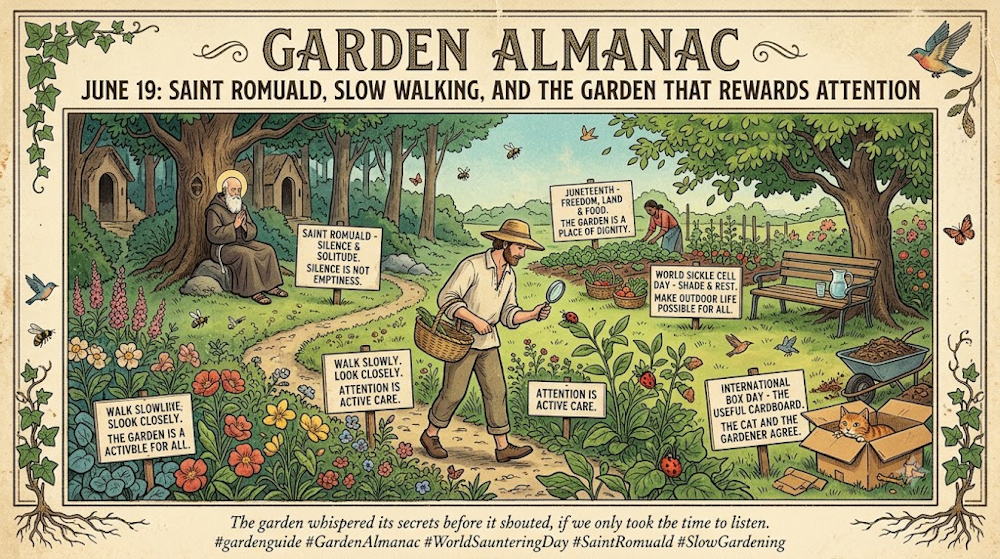

June 19 enters the Garden Almanac quietly.
It is associated with Saint Romuald, founder of the Camaldolese tradition, a figure of silence, solitude, discipline and wooded retreat. It is also World Sauntering Day, a modern observance that invites people to slow down, walk without hurry, and notice the world around them.
Together, these two threads create a perfect garden lesson: attention is a form of care.
Not every important garden task looks like work. Sometimes the most useful thing a gardener can do is walk slowly, look closely, and listen before acting.
Saint Romuald and the Discipline of Silence
Saint Romuald is remembered for shaping a form of monastic life that held solitude and community together. His world was one of hermit cells, prayer, forested places and disciplined attention.
For the Garden Almanac, that silence matters.
Gardens are full of sound, but they also require quietness: the quietness to observe before intervening, to understand before cutting, to notice before damage spreads. A gardener who is always rushing may miss what the garden is already saying.
Silence is not emptiness. In a garden, silence can be a method.
It allows small signs to become visible.
World Sauntering Day
World Sauntering Day is a celebration of slow, unhurried walking. It is almost comic in its simplicity: do not rush, do not race, do not turn every movement into exercise or efficiency. Wander. Notice. Be present.
The garden was made for this.
A slow garden walk reveals what a rushed chore list misses: the first aphids under a leaf, a tomato stem leaning too far, soil drying under mulch, a pea pod at its sweetest point, a slug trail near lettuce, bees working a flower, a forgotten glove, a birdbath running low, a compost pile that needs moisture.
Sauntering is not idleness if it sharpens attention.
The Daily Garden Walk
A daily garden walk can become one of the best habits of the season.
Look at the soil. Is it dry, compacted, cracked, moist, shaded, exposed?
Look at leaves. Are they yellowing, spotted, curled, chewed, dusty, too crowded?
Look at stems. Do they need tying, pruning, support, space?
Look at flowers. Are pollinators visiting? Are blooms fading? Are seeds forming?
Look at fruit. What is ripening, bruised, fallen, ready, or almost ready?
Look at water. Is there enough for birds, insects, containers, seedlings, compost?
Look at tools. What has been abandoned in the wrong place again?
The slow walk is not separate from garden work. It is the beginning of good garden work.
Early Attention Prevents Late Panic
In a garden, early attention often prevents late panic.
A small pest population is easier to manage than an outbreak. A leaning plant is easier to tie than a broken one. A dry bed is easier to water before collapse. A fungal problem is easier to reduce when air circulation improves early. An overgrown courgette is easier to eat before it becomes furniture.
The garden whispers before it shouts.
World Sauntering Day teaches the pace at which those whispers can be heard.
Juneteenth, Freedom, and Land
June 19 is Juneteenth in the United States, commemorating the end of slavery there. In an international Garden Almanac, this belongs with care and respect.
Freedom is not an abstract word when placed beside land, labor and food. The history of gardens and farms includes beauty, nourishment and skill, but also coercion, exploitation and stolen labor. To speak of gardens honestly is to remember that land can be a place of dignity or a place of injustice, depending on who controls it and who benefits from the work.
A garden today can become a small place of self-determination: growing food, reclaiming knowledge, sharing harvest, honoring heritage crops, building community and making space for rest as well as labor.
Juneteenth reminds us that freedom must reach the field, the kitchen, the table and the body.
World Sickle Cell Day
June 19 is also World Sickle Cell Day, an international observance raising awareness of sickle cell disease.
This may seem far from gardening, but outdoor spaces should be designed with health and access in mind. Heat, dehydration, overexertion and lack of shade can make outdoor activity difficult or unsafe for many people with health conditions.
A thoughtful garden offers shade, water, seating, rest, clear paths and permission to slow down.
Care is not only what we give plants. It is how we make outdoor life possible for people with different needs.
International Box Day
June 19 is also marked in some modern calendars as International Box Day, especially beloved by cat people. Cats and boxes need no explanation; the cat has already moved in before the human finishes asking why.
Gardeners, however, have their own relationship with cardboard.
Plain, clean cardboard can suppress weeds, serve as a layer under mulch, add carbon-rich material to compost, carry seedlings or help organize garden supplies. Remove tape and plastic coatings, avoid glossy or heavily printed materials, and use it thoughtfully.
For once, the cat and the gardener agree: the box is useful.
They may disagree only about who gets it first.
The Garden That Rewards Attention
The garden rewards attention more reliably than speed.
A rushed gardener may do many things and still miss the important one. A slow gardener may do fewer things but choose better. This is one of the quiet arts of gardening: knowing when to act, when to wait, when to cut, when to water, when to leave something alone.
Saint Romuald brings silence.
World Sauntering Day brings slowness.
The garden turns both into practice.
Walk slowly.
Look closely.
Notice patterns.
Respect limits.
Make room for rest.
Act where action matters.
What June 19 Teaches
June 19 teaches that attention is active care.
In the Garden Almanac on this day, Saint Romuald’s silence, World Sauntering Day, Juneteenth, World Sickle Cell Day and even International Box Day all point toward one shared idea: life is better protected when we slow down enough to notice it.
Notice the plant.
Notice the soil.
Notice the worker.
Notice the body.
Notice the history.
Notice the shade.
Notice the forgotten box, if the cat allows it.
The garden does not always need faster hands.
Sometimes it needs slower eyes.