
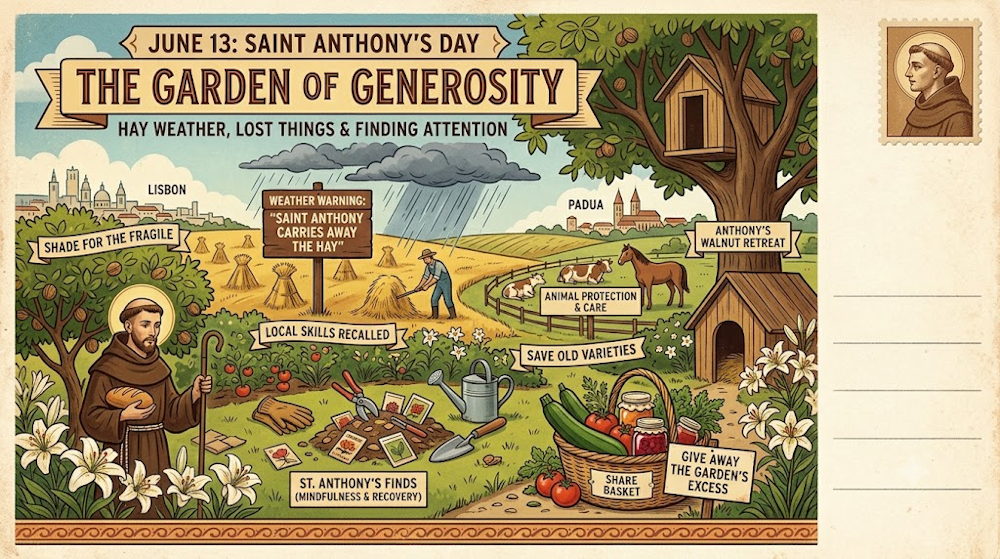

June 13 belongs to Saint Anthony of Padua, one of the most widely loved saints in the Christian calendar. He is remembered in Padua, celebrated in Lisbon, invoked for lost things, associated with lilies, bread for the poor, and — in rural calendars — with weather, hay, animals and protection.
In the Garden Almanac, Saint Anthony’s Day becomes a day for asking what can be lost, what must be protected, and what should be shared.
Saint Anthony Between Lisbon and Padua
Saint Anthony was born in Lisbon and died near Padua, and both cities remember him with special devotion. His feast day on June 13 is marked in different ways: processions, church celebrations, flowers, music, food, local customs, and public devotion.
In Lisbon, his feast belongs to the wider rhythm of June festivities, with streets, music, grilled sardines, flowers and popular celebration. In Padua, the day is closely tied to the basilica and to the memory of the saint who became one of the city’s great figures.
For a garden almanac, this international life matters. Anthony is not a local saint with a narrow meaning. He belongs to cities, villages, churches, households, farms, gardens and ordinary people who ask for help with very practical things: hunger, loss, danger, illness, storms, animals and poverty.
The Hay That Could Be Lost
In Hungarian rural tradition, Saint Anthony’s Day carried a weather warning: “Saint Anthony carries away the hay.” The saying refers to the danger of rain at haymaking time.
By mid-June, hay may already be cut or drying. If rain comes at the wrong moment, winter feed can lose quality. For rural households, hay was not scenery. It was stored summer. It fed animals through winter, and those animals supported the household with milk, manure, strength and continuity.
This makes the saying deeply practical.
A sudden storm does not merely interrupt a pleasant day. It can damage the work that future months depend on.
Saint Anthony’s Day therefore asks the farmer and gardener to look at the sky with seriousness. What is almost saved may still be lost.
Animals, Rest, and Protection
Some Hungarian traditions connected Saint Anthony’s Day with the care of livestock. In certain places, animals were not put to work on this day. Elsewhere, protective customs were performed for their health.
This may look like superstition from a distance, but it comes from a world in which animals were central to survival. A working animal was not replaceable machinery. A cow, ox, horse, pig, sheep or hen represented food, power, fertility, manure and future security.
To protect animals was to protect the household.
The garden still understands this principle. We depend on living systems. Soil organisms, pollinators, birds, worms, livestock, plants, trees and people all belong to the same web of care.
Lost Things and Found Attention
Saint Anthony is famously invoked for lost things. That makes him surprisingly at home in the garden.
Gardeners lose things constantly: pruning shears, gloves, twine, seed packets, plant labels, hand tools, watering cans, the one trowel that was absolutely just here a moment ago.
But gardens also help us notice deeper forms of loss. We lose old varieties. We lose local skills. We lose the habit of sharing surplus. We lose patience with slow processes. We lose the knowledge of weather, soil, animal care and seasonal timing.
Saint Anthony’s Day can become a day for finding some of these things again.
Find the tool.
Find the old seed.
Find the recipe.
Find the habit of giving away what the garden has produced in excess.
Find the attention that makes a garden more than a task list.
A Walnut Tree at the End of Life
Near the end of his life, Anthony withdrew near Camposampiero, where tradition remembers a small cell built among the branches of a walnut tree. It is a striking image: a saint associated with preaching, cities and crowds retreating into the shelter of a tree.
For the Garden Almanac, the walnut tree matters.
It reminds us that trees are not only background. They are places of shade, silence, rest, thought and shelter. A tree can become a room without walls. It can hold a human being between earth and sky.
Anthony’s walnut tree brings the saint back into the landscape.
Lilies, Bread, and Generosity
Saint Anthony is often shown with lilies, symbols of purity and simplicity. In June, lilies are not only symbols; they are garden presences. Strong, upright, fragrant and luminous, they give the saint a living floral language.
He is also associated with bread for the poor. This tradition makes June 13 a day of generosity.
A garden has its own version of Saint Anthony’s bread. It may be a basket of extra courgettes, herbs tied in a bunch, fruit shared with a neighbor, seedlings passed along, a jar of jam, a packet of saved seed, or a meal made from what the garden gives.
Generosity does not always arrive as money. Sometimes it arrives as produce.
International Albinism Awareness Day
June 13 is also International Albinism Awareness Day, a global observance that calls attention to the dignity, safety, rights and visibility of people with albinism.
In a garden almanac, this may seem distant at first, but there is a careful connection through light, shade and protection. The garden teaches that light is not the same for every living thing. Some plants thrive in full sun. Others burn without shade. Some need shelter, filtered light, moisture, or a gentler position.
Human beings, too, have different needs for safety and protection. To make outdoor spaces welcoming, we must think about shade, exposure, dignity and care.
A generous garden is not only generous with food. It is generous with shelter.
The Garden of Generosity
Saint Anthony’s Day gathers many garden lessons.
Protect hay before rain spoils it.
Care for animals before exhaustion or illness takes hold.
Search for what has been lost.
Honor trees as places of retreat.
Let flowers carry meaning.
Share what exceeds your own need.
Make shade for those who need it.
This is not a sentimental list. It is a practical ethic.
The garden is never only production. It is protection, memory, attention, rest, beauty and giving.
What June 13 Teaches
June 13 teaches that abundance is fragile and responsibility is seasonal.
What feeds us can be damaged.
What works for us must be cared for.
What is lost may still be found.
What grows in excess can be shared.
What lives under harsh light may need shade.
In the Garden Almanac on this day, Saint Anthony stands between hayfields, cities, walnut branches, lilies, lost tools and the table of the poor.
He asks a simple garden question:
What do you need to protect, what do you need to find, and what can you give away?