
May 31 brings one of the strangest and most charming pieces of household weather lore into the Garden Almanac: bacon as a rain predictor.
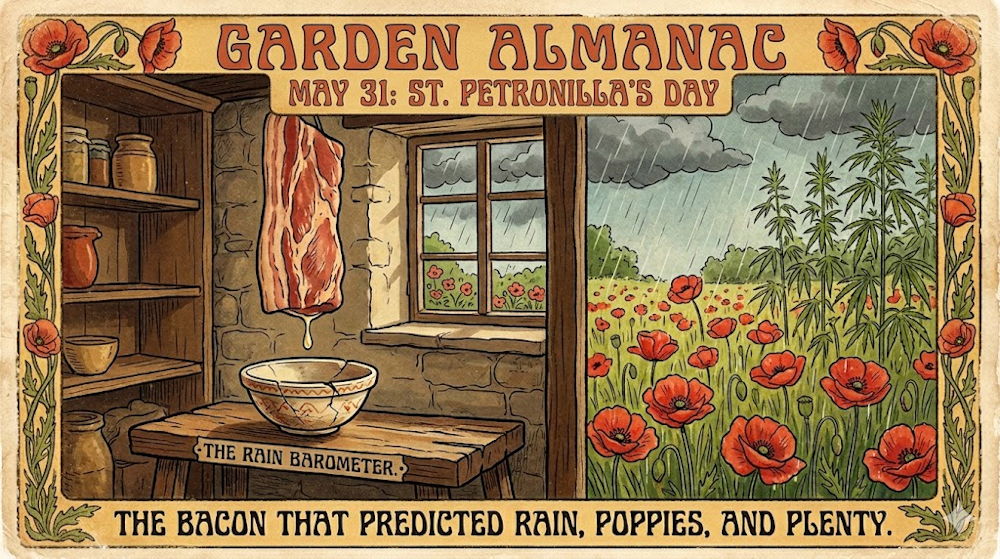
In the old calendar, Saint Petronilla’s Day was linked with weather signs, crop hopes and household abundance. In Hungarian folk tradition, a bright Petronilla Day could promise a good hemp crop. A rich flowering of poppies could be read as a sign of bacon and fat in the household. And if the bacon hanging in the pantry began to drip, rain was thought to be on the way.
It sounds funny because it is funny. But it also tells us something serious: the old household was an observatory.
Saint Petronilla and the Calendar of Signs
Saint Petronilla is traditionally associated with Saint Peter, often described in older tradition as his daughter, though later interpretations tend to understand this relationship in a spiritual rather than biological sense. Her feast is kept on May 31, and in folk calendars the day gathered weather and harvest meanings around it.
In the Garden Almanac, Petronilla’s importance lies less in formal biography and more in the way her day became a marker. By late May, crops were no longer only promises under the soil. They were visible. Hemp was growing. Poppies were flowering. The household was beginning to read the season ahead.
A calendar day became a question: what does the world seem to be telling us now?
Hemp, Weather, and Household Cloth
In the Muravidék tradition, a clear Petronilla Day was said to promise a good hemp crop. This matters because hemp was once a crucial household fiber plant. It could become cloth, rope, string, sacks, bedding, working garments and everyday material security.
A good hemp crop was not a decorative success. It meant future cloth. It meant things could be made, repaired, carried, tied and stored.
Only a few days earlier in the folk calendar, hemp sowing had already passed its proper time. By Petronilla’s Day, the question was no longer whether to sow, but what kind of year the crop might have.
Poppy Flowers and the Hope of Bacon
The poppy also entered the household imagination. A generous flowering of poppies could be taken as a sign that bacon and cooking fat would be plentiful.
Botanically, of course, poppies do not produce bacon. But folk calendars are not botany textbooks. They are languages of hope.
A rich flowering crop suggested abundance. Abundance in the field became abundance in the pantry. A flower became a sign of future food security.
The poppy did not grow bacon. It grew confidence.
Bacon as a Pantry Barometer
The most memorable Petronilla Day sign is the dripping bacon. According to folk observation, if bacon hanging in the pantry began to drip, rain would soon come.
This was not magic in the modern sense. It was likely an observation of humidity, temperature and the behavior of preserved food in changing air. Before weather apps and household sensors, people watched what they had: smoke, salt, wood, animals, food, clouds, wind and skin.
The pantry was part of the weather station.
Dripping bacon may sound absurd, but it belongs to a world where everyday materials were read carefully. If the air changed, the house noticed. If the house noticed, people paid attention.
Food, Medicine, and Memory
Bacon also had a place in folk healing. Fatty household materials were sometimes used in traditional remedies for burns, cracks or minor wounds. These practices belong to folk medical history rather than modern healthcare advice. Serious burns or wounds need proper medical treatment.
Still, the old use shows how flexible household materials once had to be. Food could be fuel, medicine, weather sign and symbol of security all at once.
The pantry was not only storage. It was insurance.
Kaamatan and the Gratitude of Harvest
May 31 also falls during Kaamatan, the harvest festival celebrated in Sabah and Labuan in Malaysia, with major celebrations on May 30 and 31. The festival is especially associated with rice harvest, thanksgiving, community and cultural celebration.
This gives Petronilla’s Day a wider echo. In one place, people read poppies, hemp and bacon as signs of household security. In another, communities gather around rice harvest and gratitude.
Different crops, different landscapes, different languages — but the same ancient human concern: will there be enough, and how do we honor the work of earth, weather and community?
World Parrot Day and the Living Places Behind Color
May 31 is also World Parrot Day, established in 2004 to celebrate parrots and raise awareness of threats including habitat loss, illegal trade and the problems connected with keeping wild creatures as exotic pets.
This may seem far from Petronilla’s pantry, but it adds a useful reminder. A parrot is not only a colorful bird. It belongs to a habitat, a forest, a social world, a set of ecological relationships.
The same lesson appears throughout the Garden Almanac: living things are never just objects. A plant is not only a crop. A bird is not only decoration. A pantry is not only storage. Each belongs to a wider web.
What May 31 Teaches
May 31 teaches that old weather lore can be funny and wise at the same time.
The image of bacon predicting rain is wonderfully comic. Yet behind it is a serious habit of attention. People watched their surroundings closely because they had to. Weather shaped crops. Crops shaped food. Food shaped survival.
In the Garden Almanac on this day, Saint Petronilla’s Day becomes a pantry window onto the season. Hemp promises cloth. Poppies suggest abundance. Bacon listens to the air.
And somewhere between the garden and the pantry, the old household becomes a weather station with a smoky smell.