
May 21 is a curious day in the Garden Almanac. In one corner of the calendar, it belongs to saints, cities, historic memories and global observances. In another, quieter corner, it belongs to seeds, leaves, kitchen rituals and the old rural belief that plants were never just plants.
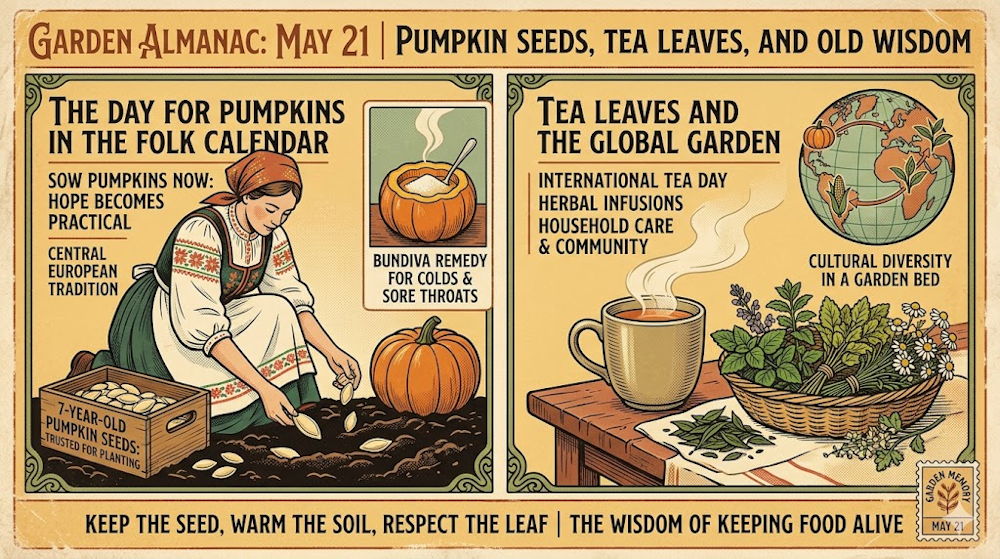
In Central European folk tradition, May 21, the feast day associated with Constantine and Helena, was remembered in some communities as a good time to sow pumpkins. By late May, the soil had usually warmed, the danger of frost was fading, and heat-loving plants could finally begin their real work. In the garden, this is the season when hope becomes practical: a seed is no longer a promise kept in a drawer, but a decision placed into the earth.
A Day for Pumpkins in the Folk Calendar
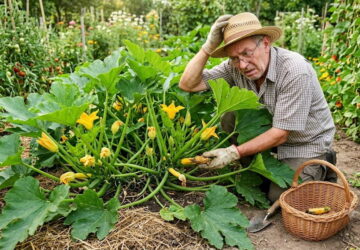
Pumpkins have always carried more than culinary value. They are generous plants, sprawling across the ground, producing large fruits that can be stored, cooked, shared and saved. In older rural households, a pumpkin could mean a winter meal, animal feed, roasted sweetness from the oven, a handful of seeds for the next season, and sometimes even a home remedy.
Folk calendars often worked this way. They did not separate weather, religion, agriculture and household life into neat categories. A saint’s day could also be a sowing day. A date could carry a memory, a warning, a habit, a joke, a superstition and a practical instruction all at once.
May 21, as a pumpkin-sowing marker, belongs to that older logic. It says: look at the warmth, look at the soil, look at what your grandparents did, and do not miss the moment.
The Strange Wisdom of Old Seeds
In the village traditions of Doroszló, in today’s Vojvodina, one striking belief held that seven-year-old pumpkin seeds were especially good for planting. Taken literally, this may sound surprising, because seeds gradually lose viability over time. Yet the belief preserves something important: rural people paid close attention to how seeds aged, how they were stored, and which ones were worth trusting.
Pumpkin and squash seeds can remain viable for several years when kept dry, cool and protected. They do not last forever, but they often endure longer than more delicate garden seeds. Behind the folk saying, one can hear an older respect for seed-keeping: the careful saving of good seed, the testing of memory against weather, and the quiet confidence that next year’s food may begin in this year’s handful of saved kernels.
Seed-saving is one of the oldest forms of household resilience. It is not dramatic. It happens in envelopes, jars, cloth bags and kitchen corners. But without it, there is no continuity between one season and the next.
Pumpkin as Food, Remedy, and Charm
In Doroszló folk practice, pumpkin, or “bundiva,” was not only food. Its hollowed interior could be filled with sugar, and the sweet liquid that formed inside was used as a home remedy for colds and sore throats. Roasted pumpkin was valued as nourishing, appetite-warming and comforting, especially in colder months.
Pumpkin seeds also had their place in folk healing, especially in remedies associated with children’s stomach troubles and intestinal worms. These uses should be read as traditional knowledge rather than modern medical advice, but they reveal how deeply the garden was connected to household care.
The same plant could cross many boundaries. It could be eaten, stored, roasted, fed to animals, used symbolically, or turned into a small piece of practical magic. Decorative gourds could even be placed in hens’ nests as dummy eggs, encouraging poultry to lay in the desired place. In that small trick, we see rural intelligence at work: not abstract theory, but close observation of animals, plants and habits.
Tea Leaves and the Global Garden
May 21 is also International Tea Day, and this gives the date a wider, global rhythm. Tea may seem far from the pumpkin patch, yet both belong to the same human story: the transformation of plants into nourishment, comfort, culture and community.
True tea comes from Camellia sinensis, the plant behind black, green, white and oolong teas. Around the world, tea is agricultural work, trade, hospitality, ceremony and everyday pause. It is also a reminder that leaves can carry culture just as seeds do.
In many home gardens, especially outside traditional tea-growing regions, the tea connection appears through herbal infusions: mint, lemon balm, chamomile, thyme, elderflower, sage and other plants gathered for the cup. Strictly speaking, these are not true teas, but they share the domestic ritual of hot water, fragrance, rest and care. The garden enters the kitchen not only as food, but as steam rising from a mug.
Cultural Diversity in a Garden Bed
May 21 is also the World Day for Cultural Diversity for Dialogue and Development. In the Garden Almanac, this is not an abstract idea. Gardens are living archives of cultural diversity.
A pumpkin in a Balkan or Central European village, tea leaves in Asia or Africa, herbs drying in a European kitchen, maize, beans, peppers, basil, coriander, sorrel, dill: each plant carries routes of migration, memory and adaptation. What grows in a garden often tells a story of trade, family, climate, poverty, abundance, celebration and survival.
The garden is one of the most democratic museums in the world. It does not need glass cases. It preserves culture in seeds, recipes, smells, tools and gestures.
Saint Helena, Constantine, and the Map of May 21
The date also carries the names of Constantine and Helena through Christian calendars, and Saint Helena’s name reaches even further across the map, including the remote South Atlantic island traditionally linked with her feast day. These layers of history remind us that calendar dates travel. They gather meanings as they move through languages, churches, empires, islands, villages and kitchens.
By the time a date reaches the garden, it has often become something more intimate. It may still belong to history, but it also belongs to sowing, cooking, watering and waiting.
What May 21 Teaches the Gardener
The lesson of May 21 is simple and generous: keep the seed, warm the soil, respect the leaf, remember the people who found use and meaning in ordinary plants.
A pumpkin seed and a tea leaf may look like small things, but both hold long human histories. One spreads across the ground and fills the winter store. The other unfolds in hot water and brings people to the table. One is carved, roasted, saved and sown. The other is picked, dried, brewed and shared.
Together, they make May 21 a day of plant memory. A day when the garden speaks through food, folk belief, household care and the quiet ritual of a cup held in both hands.