

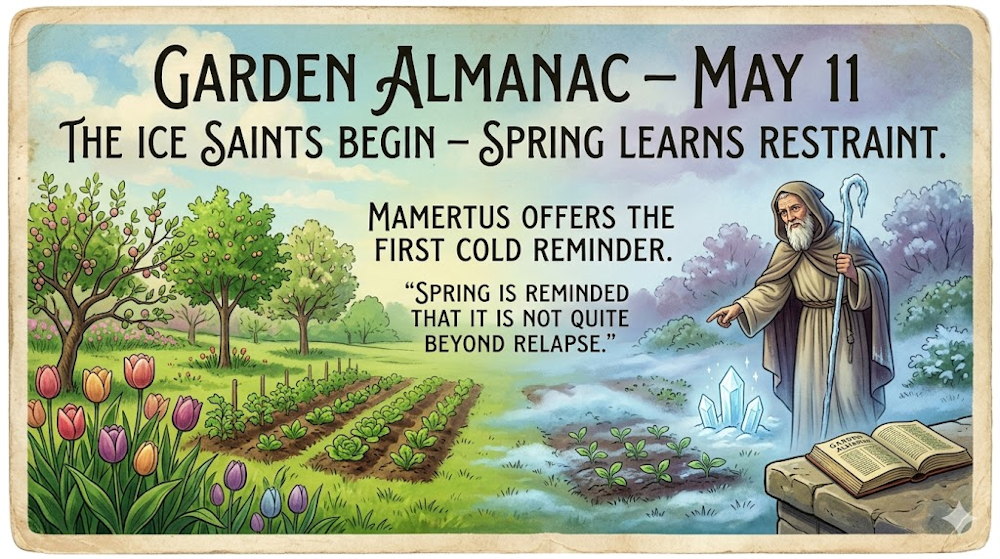

May 11 is one of the most useful cautionary dates in the spring almanac. By this point the season can look fully convincing: beds are greening, tender crops are tempting the gardener forward, and the whole landscape seems to promise settled warmth. Yet tradition places a warning here. With Mamertus, the first of the Ice Saints, spring is reminded that it is not quite beyond relapse.
This is what makes the day so valuable. It teaches not fear, but restraint. A gardener may feel ready to trust the season completely, while the almanac quietly suggests one more pause, one more glance at the night forecast, one more respect for local cold.
Mamertus and the First Cold Reminder
In European garden lore, Mamertus opens the sequence of the Ice Saints, those May dates associated with the risk of late chill. Whether one treats the tradition literally or as seasonal memory, its practical wisdom is easy to understand. Many tender plants respond badly to cold not only through dramatic frost damage, but through slowed growth, stress, and a season that never quite recovers its momentum.
This is why May 11 matters in the almanac. The danger is not only what can be seen at once. It is also what sets the garden back quietly.
Spring That Is Real, but Not Yet Safe
One of the hardest things for gardeners to learn is that a warm season and a safe season are not always the same. A string of sunny days can persuade the eye long before the soil, the air at dawn, or the lowest parts of the garden have truly stabilized.
May 11 belongs to that lesson. The season is real enough to work in, enjoy, and even celebrate. But it is not yet free from testing what has only recently begun to thrive.
The Garden’s Cold Pockets
This date is also a reminder that no garden behaves evenly. Walls hold warmth. Hollow ground gathers chill. Exposed corners lose heat more quickly than sheltered ones. A gardener who pays attention to these details is already thinking like the almanac.
That is why the Ice Saints are not only about a weather event. They are about local knowledge. They ask us to read not just the season, but the place.
Celebration at the Edge of Caution
Early May is often still touched by festive spring customs: green branches, flowering signs, communal memory, and the confidence that the season has arrived. The Ice Saints do not cancel that mood. They complicate it in a useful way.
This makes May 11 especially rich. It is a day where celebration and care stand side by side. The garden is opening, but it has not stopped being vulnerable.
What This Day Suggests in Practice
May 11 is a good day to review tender plantings, protect what would still suffer from a cold night, and notice where the garden’s warm and cool zones truly are. It rewards gardeners who act with confidence tempered by patience.
In the Garden Almanac, this is the day when spring proves itself not by enthusiasm alone, but by steadiness.