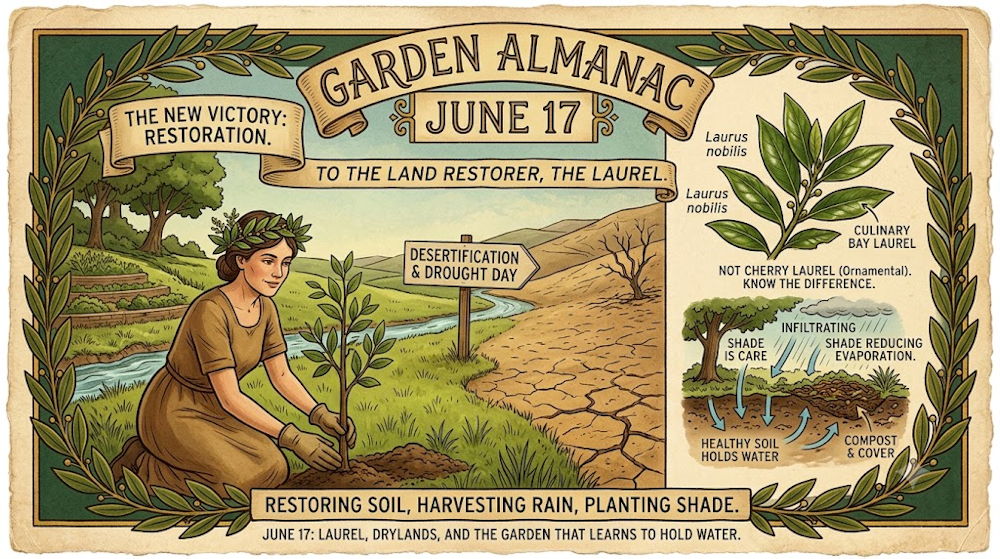

June 17 brings laurel, Laura, drought, drylands and the meaning of victory into the Garden Almanac.
The name Laura is linked to the Latin laurus, the laurel tree and the laurel crown. In the ancient world, laurel honored poets, victors, leaders and those considered worthy of public recognition.
But on June 17, the old laurel crown meets a modern global concern: Desertification and Drought Day. This day reminds us that soil, water, drylands, grasslands and rural communities are not background to life. They are the basis of it.
So the question changes.
Who deserves the laurel now?
Perhaps not the one who conquers land, but the one who restores it.
Laura and the Old Laurel Crown
Laurel has long been a plant of honor. Its evergreen leaves suggested endurance. Its crown suggested achievement. To be “crowned with laurel” was to be recognized.
In the Garden Almanac, the laurel crown can still speak — but not only of ancient victory. It can speak of another kind of excellence: the patient care that keeps gardens alive under heat, dryness and stress.
A garden in June reveals its strengths and weaknesses. Where soil is bare, it dries fast. Where roots are shaded, life lasts longer. Where water runs off, the garden loses resilience. Where organic matter has been built, the ground holds more moisture.
The laurel crown today may belong to those who protect what is easy to overlook: soil structure, shade, water, humus, cover and biodiversity.
Laurel as a Living Plant
Bay laurel, Laurus nobilis, is not only a symbol. It is also a real evergreen plant, native to the Mediterranean region and widely used as a culinary herb.
Its leaves flavor soups, stews, sauces, pickles, marinades and slow-cooked dishes. Laurel is not a loud herb. It works in the background, giving depth rather than brightness.
Gardeners in cooler climates often grow bay laurel in containers and protect it from severe frost. It prefers good drainage, light, moderation and care. It may seem tough, but it is not beyond need.
This is one of the quiet lessons of Mediterranean plants: drought tolerance is not the same as neglect.
Not Every Glossy Leaf Is Bay Laurel
One practical garden note matters: culinary bay laurel is not the same as cherry laurel, often planted as a hedge. Cherry laurel is an ornamental shrub, not a kitchen herb.
This distinction is worth repeating because both plants have glossy evergreen leaves, and names can mislead. A leaf in the garden is not automatically a leaf for the pot.
The true bay leaf belongs in cooking.
The hedge belongs in the landscape.
Good gardening begins with knowing the difference.
Desertification and Drought Day
June 17 is Desertification and Drought Day, a global observance focused on land degradation, drought resilience and the restoration of vulnerable landscapes.
Desertification does not always begin with dramatic sand dunes. It can begin quietly: with bare soil, lost vegetation, overuse, erosion, declining organic matter, compacted ground, poor water retention and landscapes that can no longer recover after stress.
For gardeners, this global issue becomes local very quickly.
A garden can lose its ability to hold water. A lawn can burn out faster when cut too short. Soil can become hard and lifeless when left uncovered. Rain can run off instead of soaking in. Heat can become more severe where there is no shade.
The small garden is not separate from the planet’s larger dryland story. It is a small version of the same lesson.
Drylands and Rangelands Are Not Empty
Drylands, rangelands, grasslands and pastoral landscapes are often misunderstood as empty or marginal. In reality, they can be rich living systems. They support grazing animals, hold soil, protect biodiversity, store carbon, maintain cultural knowledge and help communities survive in difficult climates.
A dry landscape is not automatically a dead landscape.
The difference lies in care, pressure, restoration and respect. When managed well, grasslands and rangelands can be resilient. When degraded, they become fragile.
This matters to gardens too. A lawn, meadow strip, orchard floor, herb border or dry bed can either become exhausted ground or living cover. The choice depends on how we manage it.
The Garden That Holds Water
A drought-resilient garden is not built in one afternoon. It grows from many small decisions.
Cover the soil. Add compost. Keep roots shaded. Harvest rainwater where possible. Water deeply rather than constantly sprinkling the surface. Choose plants suited to the site. Let some areas be more meadow-like. Avoid cutting grass too short in heat. Use mulch. Plant trees and shrubs for future shade. Reduce exposed hard surfaces where they intensify heat.
Water wisdom is not only about how much water we use. It is about how much water the garden can keep.
The best watering can is often healthy soil.
Shade Is a Form of Care
Shade is sometimes treated as a garden problem, especially by those who want sun-loving flowers and vegetables everywhere. But in a warming climate, shade becomes a resource.
A tree can cool soil, protect people, reduce evaporation, shelter insects, soften wind and create a microclimate. Shrubs, pergolas, climbing plants and layered planting can make a garden more livable.
The laurel crown was once worn above the head. Today, perhaps, the real crown is the living canopy itself: leaves that protect soil and people from extremes.
The New Meaning of Victory
The old laurel crown honored triumph. But triumph over what?
In an age of drought, heat and soil loss, the garden may need a new idea of victory.
Victory is not bare, weedless soil baking in the sun.
Victory is not a lawn cut so short it cannot defend itself.
Victory is not a thirsty garden kept alive only by constant rescue.
Victory is not extracting beauty until the soil is exhausted.
Victory is soil that improves.
Rain that infiltrates.
Shade that deepens.
Compost that returns.
Plants that fit their place.
Surplus that does not become waste.
A garden that survives summer with dignity.
What June 17 Teaches
June 17 teaches that the laurel crown belongs to care.
Laura brings the memory of the laurel: honor, endurance, recognition.
Desertification and Drought Day brings the warning: land can be lost quietly if we stop protecting it.
The garden brings the practical answer: cover, shade, compost, water wisdom, diversity and patience.
In the Garden Almanac on this day, the true victory is not defeating nature. It is learning how to keep life possible within it.
Give the laurel to the soil keeper.
Give it to the rainwater collector.
Give it to the gardener who mulches before the ground cracks.
Give it to the one who plants shade for a future summer.
The old crown was made of leaves.
The new victory is keeping those leaves alive.