

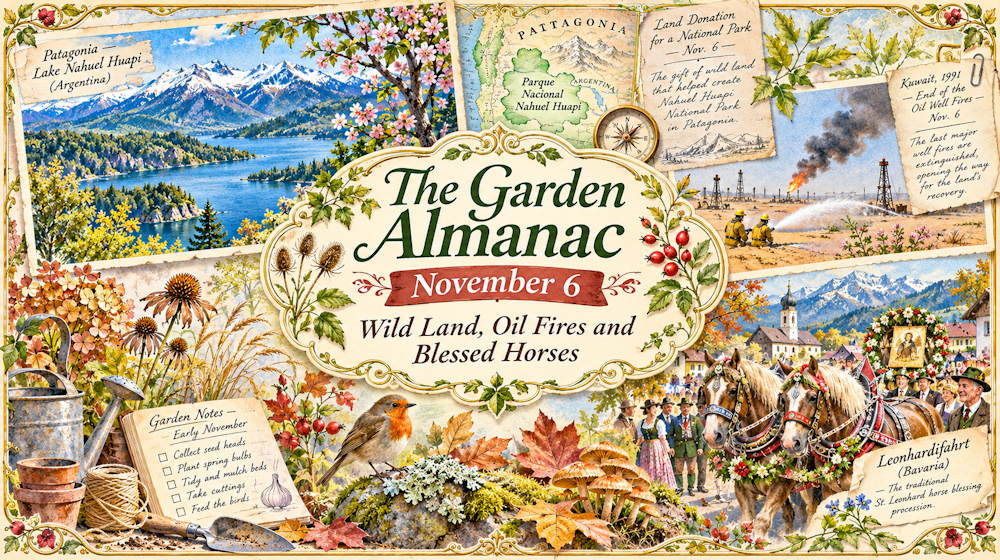

On a November morning in the Bavarian Alps, decorated horses gather for a centuries-old procession. Thousands of kilometres away, spring is unfolding across Patagonia, where a remarkable gift of land helped establish a national park system. And in the deserts of Kuwait, this date recalls the day an extraordinary environmental catastrophe finally came to an end.
November 6 is a day of striking contrasts. Its stories take us from protected forests and farming traditions to damaged landscapes and their recovery, revealing just how many different forms our relationship with the natural world can take.
November 6, 1903 – The Extraordinary Gift That Helped Create Argentina’s National Parks
What if someone offered a country an enormous piece of land on one condition – that its natural beauty should be preserved for future generations? On November 6, 1903, Argentine explorer, geologist and naturalist Francisco Pascasio Moreno did precisely that. He donated approximately 7,500 hectares near Lake Nahuel Huapi in Patagonia to the Argentine state, requesting that the land become a public natural park.
The gift had an unusual history. Moreno had received extensive land holdings in recognition of his work helping establish the border between Argentina and Chile. Rather than keeping all of this property, he returned a portion to the nation for conservation. At a time when forests, rivers and mountains were widely viewed as resources awaiting development, setting aside land for its beauty and public enjoyment was a remarkably forward-looking decision.
The donation eventually became the foundation of Nahuel Huapi National Park, formally established under its present name in 1934. Today, the protected landscape encompasses Andean lakes, mountain forests, wetlands and habitats supporting remarkable biodiversity. It also demonstrates why conservation cannot be reduced to preserving a beautiful view: protecting a landscape means safeguarding the ecological relationships that sustain it.
There is another delightful seasonal contrast. While gardeners across much of the Northern Hemisphere are preparing for winter, November brings spring to Patagonia. Native forests are awakening, plant growth is accelerating and wildlife is entering a new breeding season. In any garden, the same principle applies on a smaller scale: a mature tree, a patch of undisturbed vegetation or a connected strip of native planting can protect an entire community of living organisms.
Wildlife Note – Can a Small Garden Become a Wildlife Refuge?
A garden does not need to be enormous to provide valuable habitat. Its usefulness depends on the resources and shelter it offers.
- Native flowering plants provide food for locally adapted pollinators.
- Shrubs and hedges offer nesting sites, protective cover and seasonal berries.
- Leaf litter and dead wood shelter insects, fungi and other organisms involved in decomposition.
- Connected planting areas help wildlife move between neighbouring gardens and green spaces.
A garden with several layers of vegetation often supports more wildlife than an equally sized area dominated by closely mown grass.
November 6, 1991 – The Day Kuwait’s Burning Oil Fields Finally Fell Silent
For months in 1991, enormous columns of black smoke rose above Kuwait’s desert. Retreating Iraqi forces had set hundreds of oil wells ablaze during the Gulf War, creating one of the most severe oil-related environmental disasters ever recorded. On November 6, the final extinguishing operation was marked by a ceremony at the Burgan oil field, bringing the immense firefighting campaign to its symbolic conclusion.
The smoke was only part of the damage. Burning oil released pollutants into the atmosphere, while escaping crude accumulated in vast pools across the desert. Soot and oily deposits contaminated soils and vegetation, and some affected areas faced serious threats to groundwater and fragile desert habitats. The international firefighting effort succeeded much sooner than initially feared, but extinguishing the flames did not mean the environment had recovered.
This distinction remains important wherever contaminated land needs restoration. Soil is not simply a substance that holds plant roots upright. It contains microorganisms, air spaces, water pathways and countless biological interactions. Oil pollution can interfere with these processes, making vegetation recovery difficult even after visible contamination has been addressed. For gardeners, the practical connection is clear: healthy soil is a living system, and preventing pollution is far easier than repairing its consequences.
Garden Science – Why Can Contaminated Soil Remain Damaged for Years?
Soil health depends on several interacting conditions. Pollutants can disturb them in different ways.
- Water movement: Oil can coat soil particles and alter how water enters and moves through the ground.
- Root development: Contaminants may damage roots or interfere with water and nutrient uptake.
- Microbial activity: Pollution can disrupt organisms responsible for decomposition and nutrient cycling.
Not all contaminated soils recover at the same rate. The type and concentration of pollutants, soil conditions and suitable remediation methods all influence the outcome.
In an ordinary garden, avoid pouring oil, paint, solvents or unwanted chemicals onto the ground. Suspected contaminated soil should be assessed rather than simply covered with fresh compost.
November 6 – Why Bavarian Farmers Once Placed Their Horses Under a Saint’s Protection
Imagine a procession of magnificent horses, polished harnesses, colourful decorations and traditional carriages moving through an Alpine village. This is the Leonhardifahrt, a custom associated with the feast of Saint Leonard on November 6. Celebrated in parts of Bavaria and Austria, the tradition preserves a fascinating connection between farming, religious belief and the animals that once powered rural life.
Its origins contain an unexpected twist. Saint Leonard was originally associated with the liberation of prisoners, and chains became one of his traditional symbols. Over time, these chains were also interpreted as those used to tether livestock, helping establish his reputation as a protector of horses and cattle. Farmers sought his blessing because the health of their working animals could determine whether fields were cultivated, harvests transported and households sustained.
Historical horse processions are documented in Bavaria from the fifteenth century, and some continue today with elaborately decorated wagons and ceremonial blessings. Their modern appearance can obscure an important agricultural reality: before mechanisation, horses were essential partners in managing the land. Their manure also contributed organic matter to cultivated soils, making animal husbandry and crop production closely connected. The festival offers a reminder that farming has always depended on relationships between soil, plants, animals and people.
Garden Reminder – Making Good Use of Autumn’s Organic Materials
Early November is an excellent time to improve garden soil in temperate regions of the Northern Hemisphere.
- Collect fallen leaves from lawns and paths and store them separately to produce leaf mould.
- Mulch established beds with approximately 5 cm of well-rotted compost or suitable organic material, keeping it away from plant stems.
- Compost healthy plant remains, but keep diseased material out of ordinary home compost if it cannot be safely processed.
- Avoid walking on saturated soil, which can compact easily and lose the air spaces needed by roots.
Well-rotted animal manure can also improve soil structure, but fresh manure should not be applied indiscriminately, particularly around edible crops.
What to Observe Right Now – The Garden’s Quiet Seasonal Changes
In many temperate Northern Hemisphere gardens, November is a month of transition rather than complete inactivity. Shorter days, falling temperatures and changing food supplies are quietly reshaping the landscape.
Look for the differences between deciduous trees that have already shed their leaves and those still holding their autumn colours. Notice where fallen leaves gather naturally, how birds investigate seed heads and berries, and whether insects remain active during occasional mild afternoons.
One particularly revealing observation is how differently plants respond to the same autumn weather. Some enter dormancy early, while others continue flowering or producing fresh growth until frost arrives. These differences reflect species characteristics, local conditions and the changing balance between daylight and temperature.
Looking Ahead
November 6 offers several ways to reconsider familiar landscapes: the value of land protected from development, the complexity of restoring damaged soil and the agricultural relationships preserved in traditional celebrations. Each suggests opportunities for more thoughtful gardening, whether through habitat-friendly planting, careful soil management or better use of organic materials. As the Northern Hemisphere moves towards winter and spring advances south of the equator, gardens everywhere continue responding to their own seasonal rhythms. Learning to recognise and support those rhythms is one of the most rewarding ways to care for the living world.