


In the northern autumn, November 3 often arrives quietly. Leaves gather beneath trees, the last flowers fade, and migrating birds follow ancient routes towards warmer country. Yet some of nature’s most remarkable stories begin when someone notices what others have overlooked.
Today’s Garden Almanac travels from a Pennsylvania mountain where birds of prey were once shot by the thousands to an eighteenth-century laboratory that revealed a hidden ingredient of life. Our final destination is a Caribbean island where volcanic mountains, tropical forests and living traditions make independence a celebration of nature as well as nationhood.
November 3, 1877 – The Woman Who Turned a Killing Ground into a Bird Sanctuary
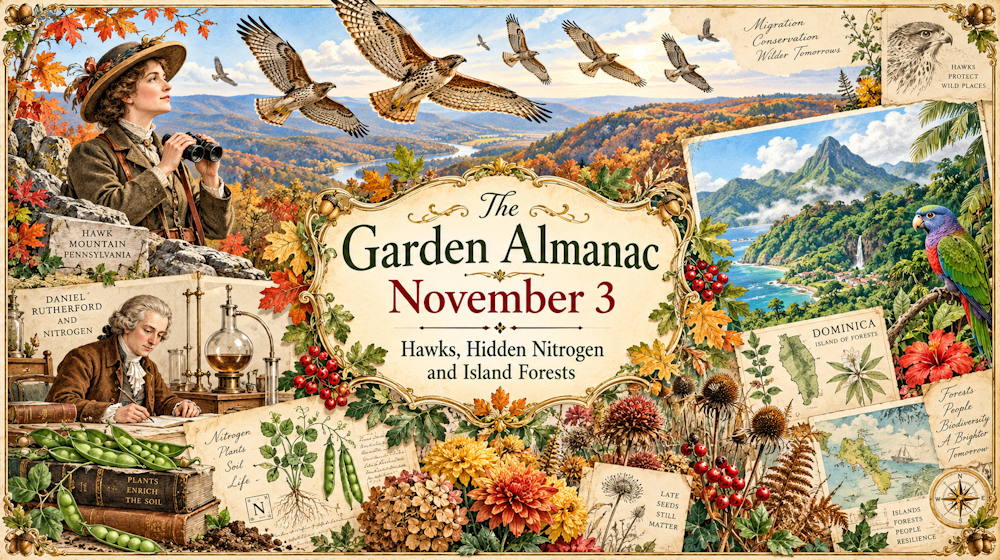
On November 3, 1877, Rosalie Edge was born in New York City. Decades later, she would become one of America’s most determined conservationists, challenging an attitude that seems astonishing today: even people who loved birds sometimes believed that hawks and eagles deserved little protection. Birds of prey were widely regarded as competitors, stealing game and threatening farm animals.
In the early 1930s, photographer Richard Pough documented the slaughter of migrating hawks along Pennsylvania’s Kittatinny Ridge. Hunters gathered at a place known as Hawk Mountain, where the birds followed the mountain slopes on their autumn journeys. Thousands were killed during migration seasons. When Edge learned what was happening, she decided that protests alone were not enough. In 1934, she leased approximately 1,400 acres of the mountain and appointed wardens to protect the birds. Almost overnight, a shooting ground became a refuge.
The transformation produced something nobody had originally set out simply to create: a remarkable opportunity for scientific observation. Instead of shooting the hawks, people began counting them. These systematic migration records eventually became valuable evidence for understanding changes in bird populations. Hawk Mountain grew into an internationally recognised centre for raptor conservation, demonstrating that protecting a landscape could also reveal how its wildlife behaved.
Edge’s achievement changed the question from which birds were useful to which birds deserved to survive. That change remains relevant in gardens, where predators are sometimes unwelcome guests. A sparrowhawk hunting small birds, for example, is not evidence that a garden’s ecology has failed. It is part of a wider food web. Shrubs, trees, varied planting and sheltered spaces give smaller birds places to escape, while a healthy habitat supports insects, seed-eaters and predators alike.
Wildlife Note – Why Are Birds of Prey Important in a Garden?
Birds of prey help maintain natural relationships among animal populations. Their presence can also indicate that a landscape offers suitable hunting grounds, food and shelter.
- Sparrowhawks hunt small birds and may appear around garden feeding areas.
- Kestrels often hunt small mammals and large insects in open countryside and rough grassland.
- Owls benefit from habitats that support rodents and other prey, including field edges, grassland and hedgerows.
If a hawk visits your garden, observe rather than intervene. Dense native shrubs and evergreen cover can help smaller birds find shelter.
November 3, 1749 – The Botanist Who Discovered What Plants Cannot Take from the Air
A garden is surrounded by an enormous supply of nitrogen. In fact, approximately 78 percent of Earth’s atmosphere consists of this gas. Yet most plants cannot use it directly. This curious contradiction has a connection to Daniel Rutherford, born in Edinburgh on November 3, 1749.
In 1772, while investigating the composition of air, Rutherford demonstrated the existence of a gas that would not support breathing or combustion. His experiments involved removing other known components of air and examining what remained. Although the chemistry of the period was still shaped by theories later abandoned, he had isolated what we now recognise as nitrogen. Rutherford subsequently became Professor of Botany and keeper of the Royal Botanic Garden Edinburgh, bringing together two fields that would eventually prove inseparable.
The connection to gardening emerged more clearly through later discoveries about plant nutrition and soil microorganisms. Nitrogen is essential for chlorophyll, proteins and vigorous leafy growth, but atmospheric nitrogen must first be converted into usable compounds. Certain bacteria can perform this conversion, including those living in association with legumes such as peas, beans and clover. Other soil organisms help release nitrogen from decomposing organic matter. The apparently ordinary soil beneath a vegetable bed is therefore a busy chemical workshop, constantly transforming nutrients between different forms.
Garden Science – Why Can Plants Be Nitrogen-Deficient When the Air Is Full of It?
Plants generally absorb nitrogen through their roots as nitrate or ammonium. Atmospheric nitrogen molecules are exceptionally stable, and ordinary plant roots cannot break them apart.
- Legumes: Peas, beans, clover and vetch can form partnerships with nitrogen-fixing bacteria when suitable bacteria are present.
- Compost: As organic material decomposes, microorganisms gradually make some of its nitrogen available to plants.
- Cold soil: Low temperatures slow many microbial processes, reducing the rate at which nutrients become available.
This explains why adding extra fertiliser is not always the answer to pale leaves. Waterlogging, poor root development, cold conditions and unsuitable soil pH can also interfere with nutrient uptake. Understanding the soil is often more useful than feeding the plant immediately.
November 3, 1978 – Dominica and the Island Where Forests Shape a Nation
On November 3, 1978, Dominica gained independence from Britain. The small Caribbean nation celebrates the anniversary with music, traditional dress, Creole cultural events and community festivities. Yet one of the island’s most distinctive national treasures is not a monument or historic building. It is the extraordinary natural landscape surrounding its communities.
Dominica’s mountainous interior contains dense tropical forests, waterfalls, volcanic landscapes and remarkable biological diversity. Morne Trois Pitons National Park, established before independence and later recognised as a UNESCO World Heritage Site, protects nearly 7,000 hectares. Its steep slopes and changing elevations create different habitats within surprisingly short distances. Among the island’s distinctive wildlife are endemic parrots, while its forests shelter plant communities rarely found elsewhere in the Caribbean.
There is another side to the island’s lush appearance. Tropical forests are not simply collections of beautiful plants: their roots help hold soil on steep slopes, their vegetation slows the movement of rainfall, and their layered canopies create habitats at different heights. These relationships matter especially on an island exposed to intense tropical storms. Dominica’s landscape offers gardeners everywhere a useful design principle: instead of treating trees, shrubs, groundcovers and soil as separate elements, consider how they work together. In a small garden, layered vegetation, permanent soil cover and well-placed planting can improve water infiltration, reduce erosion and create more varied habitats.
Garden Reminder – What Should You Do in the Garden in Early November?
In temperate Northern Hemisphere gardens, early November is a good time to prepare for colder weather without removing everything that wildlife needs.
- Protect the soil: Spread mature compost or leaf mould around established plants, keeping it clear of stems and trunks.
- Manage fallen leaves: Clear slippery paths and thick layers from lawns, but use healthy leaves beneath shrubs or in a leaf-mould pile.
- Check drainage: Empty saucers beneath outdoor pots and raise containers on feet where necessary to prevent waterlogging.
- Protect tender plants: Move frost-sensitive containers to suitable shelter before freezing temperatures arrive.
- Leave some seedheads: Echinacea, teasel and ornamental grasses can provide winter interest, food and shelter.
In warmer Southern Hemisphere gardens, where November brings spring growth, concentrate instead on mulching, checking irrigation and protecting newly established plants from drying out.
What to Observe Right Now – The Garden’s Changing Winter Habitat
Early November is an excellent time to watch how a garden prepares for the next season. Its most interesting changes are often subtle rather than spectacular.
Look beneath fallen leaves and you may discover earthworms, woodlice and other small creatures involved in decomposition. Watch birds moving between open feeding spaces and dense shrubs. Examine the buds on deciduous trees: many already contain the structures that will develop into next spring’s leaves or flowers.
Also notice where rainwater collects after a shower. A puddle that remains for days, a slope where soil washes away, or a bed that dries unusually quickly can reveal more about garden conditions than appearances alone. These observations can guide future planting and soil improvements.
Looking Ahead
A garden becomes more interesting when we begin to notice the relationships that sustain it. Rosalie Edge’s mountain reminds us that wildlife protection can transform a landscape, while nitrogen reveals the invisible processes beneath every healthy plant. Dominica shows how forests, soil, water and cultural identity can belong to the same living landscape. As the seasons change, even a small garden offers opportunities to protect habitats, understand its soil and make thoughtful choices that will benefit both plants and wildlife in the years ahead.