

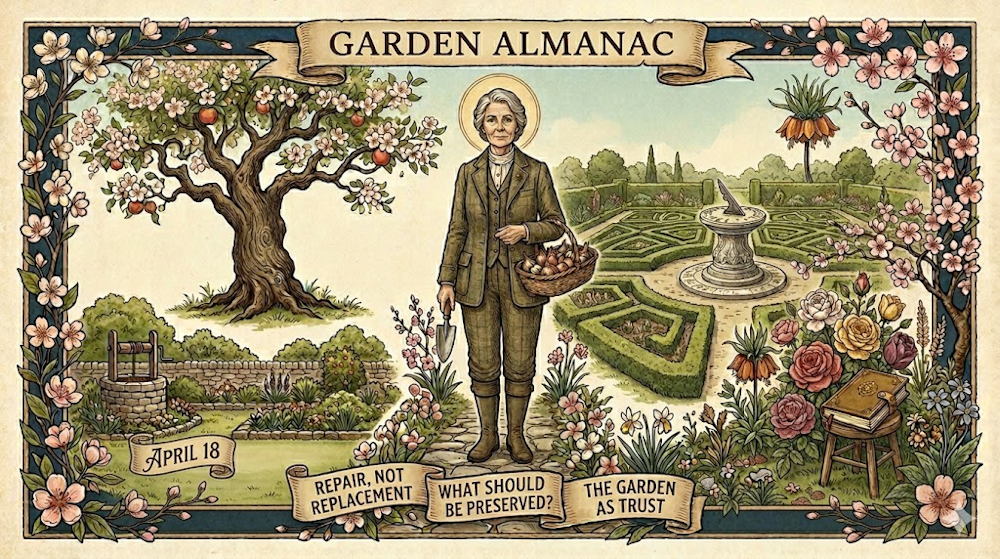

A Date for Remembering What Deserves to Last. April 18 is observed internationally as the International Day for Monuments and Sites, also known as World Heritage Day. At first glance this may seem to belong only to buildings, ruins, archaeological remains, or historic cityscapes. But for a garden almanac, the date opens toward a richer idea: gardens, orchards, old paths, wells, walls, and planted landscapes are also forms of living heritage.
That makes April 18 especially resonant in spring. The season pushes toward renewal, yet renewal can become shallow if it forgets what should be preserved.
The Garden as a Place of Inherited Meaning
A garden is not valuable only because of what has just been planted. It also gains meaning through what has endured. An old fruit tree, a traditional border, a family planting pattern, a hedge shaped over decades, or even a half-worn footpath can carry memory as powerfully as a written record.
This is why April 18 belongs so naturally in a Garden Almanac. It asks a gardener to think not only like a grower, but like a steward. What has been entrusted to this place? What would be lost if it disappeared? What should be repaired, and what should be respected in its age?
Saint Peter’s Basilica and the Idea of Foundations
On April 18, 1506, the cornerstone of the new Saint Peter’s Basilica was laid in Rome. Whether one thinks of it primarily as architecture, devotion, history, or cultural ambition, it offers a useful almanac theme: foundations matter.
A garden also depends on foundations, though they are quieter ones. Soil structure, long-established root systems, inherited layout, remembered timing, and accumulated care all form the hidden base on which a season stands. Spring growth may look immediate, but it rarely begins in the present moment alone.
April 18 is therefore a good day to think about what in a garden is foundational rather than merely visible.
Saint Kateri Tekakwitha and Reverence for Creation
In some Christian and ecological traditions, April 18 is associated with Saint Kateri Tekakwitha as a figure of care for creation, Indigenous memory, and reverence toward the natural world. Whether approached devotionally or culturally, her presence adds a valuable dimension to the date.
A garden is not only a managed space. It is also a relationship. It asks not only what can be taken from the land, but how the land is encountered, honoured, and kept alive. April 18 is a fitting moment for that kind of reflection.
What To Notice In The Garden Today
April 18 is an especially good day to walk through the garden as if it were part archive, part living promise.
- What in the garden is oldest, and why has it lasted?
- Which feature carries memory as well as beauty?
- What inherited structure still shapes today’s growth?
- What deserves repair instead of replacement?
- What in the garden feels less like property and more like trust?
A true almanac date does more than mark anniversaries. It changes how we see the place in front of us.
The Meaning Of April 18
April 18 gathers together heritage, foundations, reverence, and stewardship. Through World Heritage Day, Saint Peter’s Basilica, and the ecological reading of Saint Kateri Tekakwitha, it becomes a date about what must be kept alive if renewal is to mean anything.
That is one of spring’s deeper lessons. Not everything valuable begins this year. Some things matter because they survived into it.