
By November 22, gardens across much of the Northern Hemisphere have entered their quieter season. Fallen leaves cover the paths, bare branches reveal the shapes of trees, and the first frosts may have already arrived. Yet beyond these familiar autumn scenes, the calendar opens onto some surprisingly different landscapes.
On this date, a navigator encountered extraordinary islands in the Pacific, European governments took an important step towards environmental protection, and an American composer brought one of the world’s greatest natural landscapes into the concert hall. Each story offers a different way of looking at the living world – including the small patch of it outside our own door.
November 22, 1574 – The Islands Where Evolution Created a Garden Like No Other
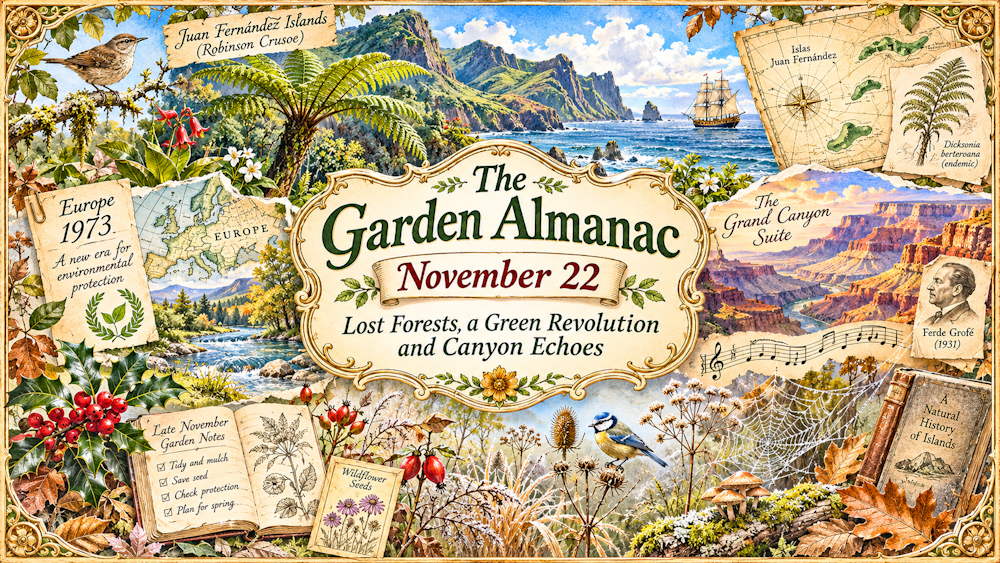
When the Spanish navigator Juan Fernández sailed off the western coast of South America in 1574, he was looking for a faster route, not a botanical paradise. By steering away from the coast, he hoped to avoid the northward-flowing Humboldt Current. On November 22, his voyage brought him to islands hundreds of kilometres from mainland Chile. The discovery was remarkable enough, but the real surprise lay in the plants that had evolved there over millions of years.
Today, the Juan Fernández Archipelago is famous partly because one of its islands inspired the setting associated with Robinson Crusoe. Its botanical story is even more extraordinary. Isolation allowed plants to develop into species found nowhere else on Earth. Researchers have identified around 129 endemic vascular plant species, including unusual ferns and flowering plants belonging to evolutionary lineages almost entirely confined to these islands. Some represent botanical histories that have survived in very few places.
But isolation also made these ecosystems vulnerable. Following human contact, introduced animals and plants began changing habitats that had developed without them. Goats damaged native vegetation, while invasive plants such as blackberry and maqui spread into areas occupied by endemic forests. The surprising reversal is that familiar garden plants, useful or attractive in their original surroundings, can become serious ecological threats when introduced elsewhere.
For gardeners, the islands offer a particularly valuable perspective on plant selection. A species is not automatically beneficial simply because it produces flowers, fruit or greenery. Its behaviour in the local environment matters just as much. Choosing locally appropriate plants, avoiding potentially invasive species and protecting established native vegetation can make an ordinary garden part of a much larger conservation effort.
Wildlife Note – Why Do Native Plants Matter to Garden Wildlife?
Native plants often support insects that have evolved alongside them. Some caterpillars, for example, depend on particular host plants, even when adult butterflies visit many different flowers. A garden with suitable native trees, shrubs and wildflowers can therefore provide more than nectar – it can offer food, breeding sites and shelter throughout an animal’s life cycle.
Invasive plants, by contrast, may crowd out the vegetation on which specialised wildlife depends. Before planting an unfamiliar vigorous species, check whether it is invasive in your region.
November 22, 1973 – When Europe Began Treating Nature as a Shared Responsibility
For much of the twentieth century, industrial growth was widely celebrated as a measure of prosperity. Polluted rivers, smoky air and damaged landscapes were often accepted as unfortunate consequences. By the early 1970s, however, a different understanding was gaining ground: economic development could not be considered successful if it steadily undermined the environment supporting human life.
On November 22, 1973, the European Communities adopted their first Environmental Action Programme. One of its most significant ideas was remarkably straightforward – preventing pollution at its source was preferable to repairing the damage afterwards. The programme also promoted the principle that polluters should bear the costs of the pollution they caused. These ideas helped establish a foundation for the environmental policies that would develop across Europe in subsequent decades.
The implications extend well beyond factories and legislation. A garden is also a place where decisions have consequences for soil, water and surrounding ecosystems. Preventing fertiliser runoff is more effective than trying to restore a polluted pond. Maintaining healthy soil can reduce the need for corrective treatments, while choosing plants suited to local conditions can limit unnecessary watering and chemical intervention. The principle that entered European environmental policy in 1973 remains surprisingly practical at garden scale: prevent avoidable damage rather than continually repairing it.
Garden Reminder – What Should You Do in the Garden in Late November?
In temperate Northern Hemisphere gardens, this is a useful time for preventive maintenance before winter becomes established.
- Check drainage: Clear fallen leaves from drains and channels, but avoid walking on waterlogged beds, where footsteps can compact the soil.
- Protect vulnerable roots: Apply a layer of compost or suitable organic mulch around established plants, keeping it away from trunks and crowns.
- Inspect tree supports: Check that stakes remain secure and ties are not cutting into expanding stems.
- Plant while conditions allow: Many hardy deciduous trees and shrubs can still be planted if the soil is neither frozen nor waterlogged.
- Avoid unnecessary chemicals: Remove diseased plant material where appropriate, but leave healthy vegetation and undisturbed habitat for beneficial wildlife.
November 22, 1931 – The Grand Canyon Becomes a Symphony
Can a landscape be translated into music? On November 22, 1931, American composer Ferde Grofé offered an extraordinary answer when his Grand Canyon Suite received its premiere in Chicago. Rather than simply celebrating the canyon’s immense scale, Grofé constructed five musical scenes representing a day in the landscape: Sunrise, Painted Desert, On the Trail, Sunset and Cloudburst. The result was a landscape experienced through sound rather than sight.
The canyon itself contains an even more fascinating composition of living environments. Its great differences in elevation, temperature and available water create habitats ranging from desert scrub to pine forests and cool, high-elevation woodlands. Along the Colorado River, riparian vegetation supports wildlife that could not survive on the surrounding dry slopes. What appears from a distance to be one enormous rocky landscape is actually a collection of ecological communities, each responding to different conditions.
This diversity has a direct parallel in garden design. A sunny wall, a sheltered courtyard, a damp corner and a dry raised bed can support very different plants, even within a relatively small space. Instead of attempting to make every part of a garden behave identically, gardeners can work with these natural differences. A moisture-loving fern may flourish in a shaded, sheltered position, while drought-tolerant herbs such as thyme prefer open sunlight and freely draining soil. The most successful planting schemes often begin by recognising the garden’s existing microclimates.
Garden Science – Why Can Two Parts of the Same Garden Have Different Climates?
A garden’s microclimate is shaped by sunlight, wind, moisture, slope and surrounding structures. Even a small difference in position can affect growing conditions.
South-facing walls in the Northern Hemisphere often absorb more solar energy, creating warmer, drier conditions nearby. Low-lying areas may collect cold air on calm nights, increasing frost risk. Trees and hedges can reduce wind exposure while also creating shade and competition for water.
Observing these differences before planting helps gardeners select species more accurately and avoid repeated problems with drought, frost or poor growth.
What to Observe Right Now – The Hidden Activity of Late Autumn
November can appear almost motionless in a garden, but several important seasonal processes are still underway. The next time you step outside, look for these quiet signs of change.
- Leaf colour and leaf fall: Notice which trees are still holding their foliage. Species, temperature and local exposure all influence the timing of leaf drop.
- Winter buds: Look closely at bare twigs. Many deciduous trees have already formed the buds containing next spring’s developing shoots and leaves.
- Fungi and decomposition: Mushrooms may appear in damp lawns, mulch or decaying wood. Their visible structures are only part of larger fungal networks involved in breaking down organic matter.
- Bird feeding behaviour: Watch birds searching among fallen leaves, seedheads and bark, where insects, seeds and other food may remain available.
- Frost patterns: Compare open lawns with sheltered areas beneath shrubs. Differences in frost formation can reveal where cold air collects and where nearby vegetation provides protection.
These observations are particularly relevant in temperate Northern Hemisphere regions. In the Southern Hemisphere, where November marks late spring, the same principle of careful observation applies to flowering sequences, pollinator activity and the approach of summer heat.
Looking Ahead
The living world is shaped by countless interactions, from the survival of an isolated island plant to decisions about protecting rivers and the subtle changes in climate across a single garden. Understanding those relationships gives gardeners more opportunities to work with nature rather than against it. As the Northern Hemisphere approaches winter, protecting healthy soil, preserving wildlife habitat and planning more resilient planting can all begin with simple observations made today. Sometimes the most important change in a garden starts not with planting something new, but with noticing what is already there.