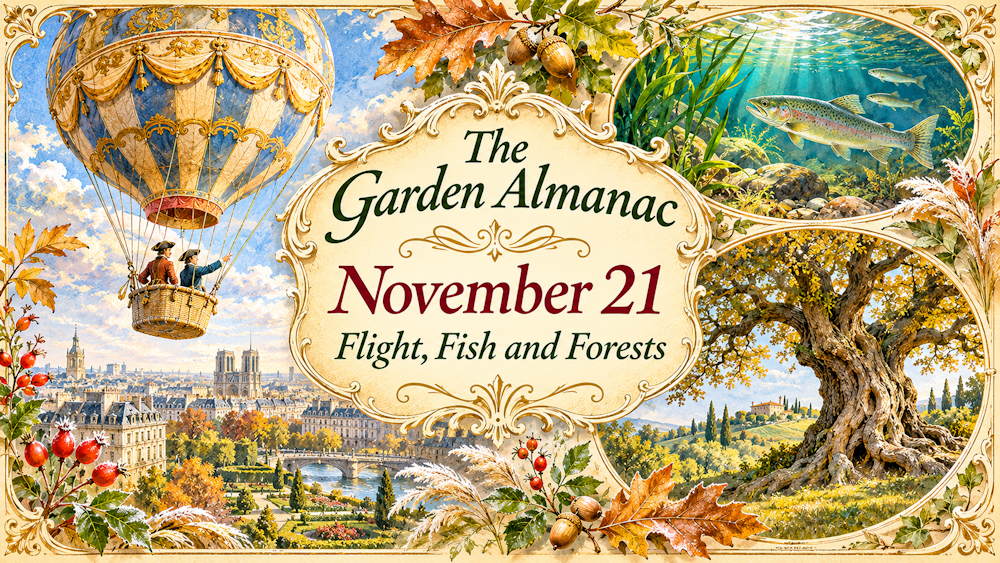

By late November, many northern gardens have settled into their quiet season. Bare branches reveal the shapes of trees, fallen leaves gather along paths, and ponds reflect a sky that seems larger without summer foliage. Yet November 21 has an unusually adventurous history – one that takes us above the rooftops of Paris, into the world’s fishing waters, and beneath the canopies of Italy’s trees.
These three stories offer remarkably different ways of looking at the natural world. One begins with the extraordinary experience of seeing a familiar landscape from above. Another asks what happens when people depend on a living resource that cannot replenish itself indefinitely. The third reminds us that even a single tree can be far more important than its appearance suggests.
November 21, 1783 – The First Free Flight That Changed Our View of the Landscape
Imagine standing in a Parisian garden in 1783 and watching two men prepare to rise into the sky beneath an enormous balloon. On November 21, Jean-François Pilâtre de Rozier and the Marquis d’Arlandes made the first successful untethered human flight in a hot-air balloon designed by the Montgolfier brothers. They departed from the grounds of the Château de la Muette, leaving the safety of solid ground behind in a machine that had no steering system and depended entirely on heated air to remain aloft.
Their journey lasted approximately 25 minutes, carrying them several kilometres across Paris. Only two months earlier, the Montgolfiers had sent a sheep, a duck and a rooster into the air at Versailles to demonstrate that living creatures could survive such an adventure. Now, for the first time, people were moving freely above the landscape rather than observing it from towers, hills or church steeples. Streets, gardens, fields and waterways could be seen together from a moving viewpoint that had previously been beyond human experience.
The flight did not immediately transform landscape science, but ballooning eventually opened new possibilities for studying the atmosphere, making observations from above and photographing the Earth’s surface. Looking down at a landscape reveals relationships that can be difficult to recognise at ground level: the winding course of a river, the arrangement of fields, the boundaries between woodland and farmland, and the way settlements spread across the land. Today, aerial photography and satellite images make such views ordinary, allowing researchers to monitor vegetation, drought, urban expansion and environmental change.
There is a smaller version of this change in perspective available to every gardener. View a garden from an upstairs window, balcony or elevated path, and its structure becomes easier to understand. You may discover that a large lawn separates two otherwise connected planting areas, that rainwater naturally collects in one corner, or that a hedge could provide a sheltered route between habitats. Sometimes the most useful garden improvement begins not with a spade, but with a different viewpoint.
Garden Science – Why Is a Garden Warmer in Some Places Than Others?
A garden contains small differences in temperature known as microclimates. South-facing walls in the Northern Hemisphere can absorb sunlight and release stored warmth, while low-lying hollows may collect cold air on calm nights. Buildings, hedges, slope and soil moisture also influence local conditions. In late autumn, compare frost patterns across your garden: areas that remain frost-free longer may offer better conditions for slightly less hardy plants.
November 21, 1997 – When Fishing Communities Demanded a Different Future
A fish caught in the ocean may seem far removed from a vegetable garden, but both depend on the health of complex living systems. On November 21, 1997, representatives of fishing communities from 18 countries gathered in New Delhi, India, to establish the World Fisheries Forum. Their meeting helped give rise to World Fisheries Day, now observed annually on November 21 to draw attention to sustainable fishing, aquatic ecosystems and the livelihoods of people who depend on them.
The gathering carried an important message: protecting fish stocks is not simply a matter of catching fewer fish. Healthy fisheries require functioning habitats, clean water and breeding populations capable of replenishing themselves. Destruction of coastal wetlands, pollution, excessive harvesting and damage to river ecosystems can undermine even carefully managed fishing communities. The surprising connection is that the health of a fish population often depends as much on what happens around the water as on what happens within it.
That relationship extends directly into gardens, farms and urban landscapes. Rainwater can carry excess fertiliser, pesticides and loose soil into drainage systems, streams and eventually larger bodies of water. Nutrients from fertilisers may encourage excessive algal growth, reducing oxygen levels when the algae decompose. Gardeners can help by avoiding unnecessary fertiliser applications, maintaining vegetated areas that slow runoff, and keeping soil covered during rainy periods. A garden hundreds of kilometres from the sea can still belong to the same connected water system.
Wildlife Note – Is a Garden Pond Still Important in Winter?
Absolutely. Even when insects are less active, a garden pond remains a valuable habitat. Aquatic invertebrates, amphibians and other small creatures may spend the colder months in or around the water, depending on the local climate.
Avoid completely clearing a pond in late autumn, as this can disturb overwintering animals. Leave some aquatic vegetation where appropriate, and provide a shallow, accessible edge so wildlife can enter and leave safely. Fallen leaves can be removed gradually before excessive amounts decompose in the water.
November 21 – Italy’s National Tree Day and the Forest Hidden in a Single Tree
In Italy, November 21 is dedicated to trees. The country’s National Tree Day, formally recognised under legislation adopted in 2013, celebrates the importance of forests, urban greenery and individual trees in protecting the environment. Although planting a tree may appear to be a simple gesture, the observance draws attention to something easily overlooked: a tree is not merely an object occupying space, but a living structure supporting numerous other organisms.
Consider an old tree standing beside a village road. Its bark may support lichens and mosses, cavities in its trunk can provide nesting places, and its branches offer shelter to birds and insects. Underground, its roots interact with fungi and soil organisms, while fallen leaves contribute organic matter to the soil. Trees also intercept rainfall, reduce surface runoff and provide shade that helps moderate temperatures during hot weather. Even a relatively small tree can create several distinct habitats within a limited area.
For gardeners, the most interesting question is not always which tree will grow fastest or produce the most spectacular flowers. It is which tree will continue to benefit its surroundings decades from now. A well-chosen native or locally adapted species can provide food and shelter for wildlife, while a tree planted in the wrong position may struggle with restricted root space, drought or unsuitable soil. In many temperate regions, late autumn is an excellent planting season because deciduous trees are entering dormancy and the soil may remain moist enough for roots to establish before spring.
Garden Reminder – What Should You Do in the Garden in Late November?
For gardens in temperate Northern Hemisphere climates, these practical jobs are worth considering:
- Plant deciduous trees and shrubs: November is often suitable for bare-root plants, provided the ground is neither frozen nor waterlogged.
- Mulch around newly planted trees: Apply approximately 5–8 cm of composted organic material or bark mulch, leaving a gap around the trunk.
- Protect exposed soil: Use fallen leaves, suitable mulch or winter cover crops to reduce erosion and nutrient loss.
- Check young trees: Inspect stakes, ties and protective guards before winter storms arrive.
- Avoid unnecessary fertilising: Many outdoor plants need little or no additional feeding as active growth slows.
What to Observe Right Now – Small Signs of the Changing Season
Late November can be one of the most revealing times to examine a garden. With less foliage obscuring the view, details that escaped attention throughout summer become easier to recognise.
- Buds on bare branches: Many deciduous trees already carry the buds that will develop into next spring’s leaves and flowers. Their shape and arrangement can help identify trees even without foliage.
- Frost patterns: Notice where frost appears first and where it disappears last. These differences reveal local temperature variations that can influence planting choices.
- Bird activity: Watch for birds searching bark, seed heads and leaf litter for food. Their behaviour can reveal where winter resources remain available.
- Fallen leaves: Observe how leaves accumulate beneath hedges and shrubs. Over time, fungi and other decomposers help turn this material into nutrients and organic matter.
- Rainwater movement: After heavy rain, look for puddles, channels of flowing water and areas where exposed soil has washed away. These are useful clues for improving drainage and preventing erosion.
These observations are particularly valuable because they require no special equipment. A short walk after a cold night or an autumn shower can reveal more about the conditions in a garden than weeks of casual summer observation.
Looking Ahead
The first balloon flight showed how a change in viewpoint could reveal a familiar landscape in an entirely new way. World Fisheries Day encourages us to consider the connections between human activities and the health of aquatic ecosystems, while Italy’s celebration of trees draws attention to the living communities supported by our green spaces. As winter approaches in the Northern Hemisphere, there is an opportunity to put these ideas into practice by observing the land more carefully, protecting soil and water, and choosing plants for their long-term ecological value. Even the quietest garden can become a place where thoughtful decisions today help create a richer, more resilient landscape tomorrow.