
By November 10, the garden is beginning to reveal its winter character. Bare branches expose the shapes of trees, damp soil holds the memory of autumn rain, and the wind moves more freely through thinning hedges. It is a season when the forces shaping our landscapes become easier to notice.
Today’s almanac travels from the oil-affected forests and waterways of Nigeria to a devastating storm on North America’s Great Lakes. It also celebrates a day devoted to scientific discovery – including the remarkable living world beneath the garden’s surface.
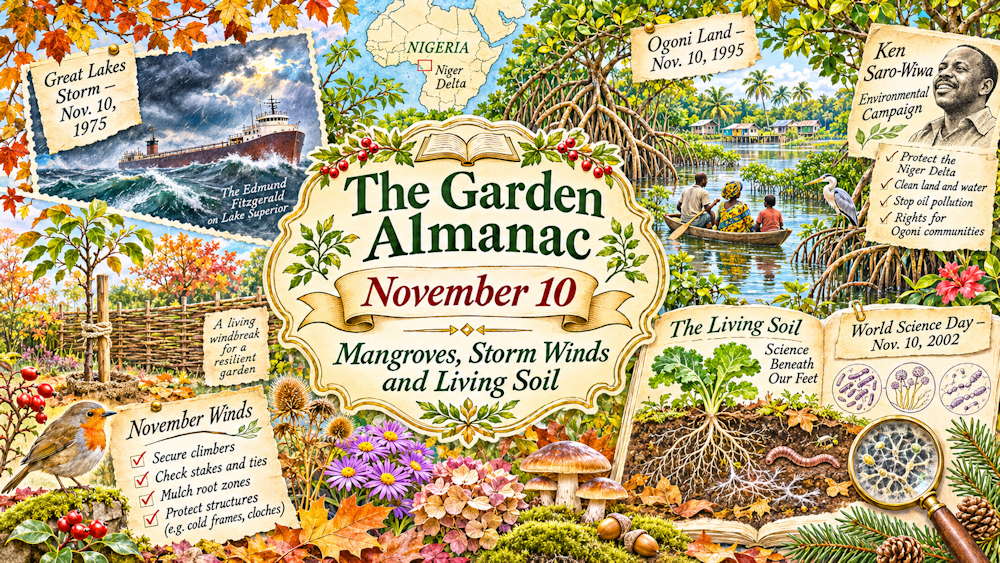
November 10, 1995 – The Environmental Campaigner Who Fought for a Living Landscape
In the Niger Delta of southern Nigeria, land and water are inseparable. Rivers wind through tropical forests and mangrove swamps, while fertile soils and coastal waterways have supported farming and fishing communities for generations. Yet beneath this rich landscape lie enormous oil reserves, and decades of extraction brought widespread pollution to parts of the region.
One of the most determined voices opposing this damage was Nigerian writer and environmental campaigner Ken Saro-Wiwa. He helped lead a movement demanding environmental protection and greater rights for the Ogoni people, whose traditional lands had been affected by oil operations. His campaign brought international attention to contaminated waterways, damaged farmland and the destruction of ecosystems on which local communities depended.
On November 10, 1995, Saro-Wiwa and eight fellow activists were executed by Nigeria’s military government following trials widely condemned as unfair. Their deaths provoked international outrage, but the environmental problems they had highlighted remained. A major investigation published in 2011 revealed extensive contamination of soil and groundwater in Ogoniland. In some locations, petroleum pollutants had penetrated more than five metres into the ground. The assessment also documented damaged mangrove habitats and the enormous challenges involved in restoring them.
What makes this story especially relevant to gardeners is the relationship between healthy soil, clean water and living plants. Mangroves, for example, stabilise muddy shorelines with their specialised roots, provide nursery habitats for fish and help protect coasts from erosion. When pollution destroys such vegetation, an entire network of ecological relationships can suffer. The same principle operates on a smaller scale in gardens: soil is not simply material that holds roots upright. Its biological activity, structure, drainage and freedom from harmful contamination determine what can thrive there. Where pollution is suspected, proper testing and remediation are essential – adding compost alone cannot make contaminated soil safe.
Garden Science – What Makes Soil a Living Ecosystem?
A handful of healthy garden soil may contain enormous numbers of microorganisms, alongside fungi, tiny invertebrates and larger soil-dwelling animals.
These organisms perform important functions:
- Bacteria and fungi break down organic matter and release nutrients into forms plants can use.
- Earthworms create channels that improve water movement and soil aeration.
- Mycorrhizal fungi form associations with the roots of many plants, helping them obtain water and nutrients.
- Decomposers gradually transform fallen leaves and other organic material into substances that contribute to soil fertility.
Healthy soil depends on these interacting organisms, as well as suitable moisture, oxygen and mineral conditions. Avoiding unnecessary disturbance and compaction helps protect this underground ecosystem.
November 10, 1975 – The Storm That Revealed the Power of the Great Lakes
The Great Lakes of North America may be freshwater, but their storms can rival those of open seas. On November 10, 1975, a powerful autumn storm swept across Lake Superior, bringing violent winds and enormous waves. That evening, the American cargo ship SS Edmund Fitzgerald sank with all 29 crew members aboard.
The disaster became one of the most remembered events in Great Lakes maritime history. It also drew attention to the extraordinary weather patterns of the region. During autumn, cold air moving across relatively warm lake water can contribute to unstable atmospheric conditions, while intense low-pressure systems generate powerful winds. The long distances over which those winds blow across open water allow large waves to develop. Lake Superior’s immense size makes it particularly vulnerable to dangerous storm conditions.
For gardeners, the significance of November storms becomes apparent in exposed landscapes. Strong winds increase moisture loss from evergreen foliage, damage branches and can loosen the roots of newly planted trees. A solid wall or fence may seem the best defence, but it can create turbulent air on its sheltered side. A semi-permeable hedge or windbreak is often more effective because it filters and slows the wind rather than abruptly stopping it. In suitable climates, mixed hedges containing hawthorn, hornbeam or other locally appropriate shrubs can combine practical shelter with valuable wildlife habitat.
Garden Reminder – Preparing the Garden for November Winds
Before winter storms arrive, a few simple checks can prevent avoidable damage.
- Inspect tree stakes and ties. Make sure young trees are supported without restricting natural trunk movement or damaging bark.
- Secure climbing plants. Tie loose stems of climbing roses and other climbers to strong supports.
- Check garden structures. Stabilise trellises, temporary covers and lightweight containers before strong winds.
- Protect vulnerable roots. Apply suitable organic mulch around newly planted shrubs, leaving a gap around the stems.
- Avoid waterlogged soil. Do not walk or work unnecessarily on saturated ground, where compaction and root damage are more likely.
Established trees with damaged or unstable branches may require professional inspection rather than amateur pruning.
November 10, 2002 – The Day Science Became a Worldwide Celebration
What does a garden have in common with a scientific laboratory? More than we might imagine. Every time a gardener compares two planting methods, observes the appearance of pests or records the first frost, a small experiment is taking place. Careful observation is at the heart of both gardening and scientific discovery.
On November 10, 2002, the first World Science Day for Peace and Development was celebrated under UNESCO’s auspices. The international observance grew from a wider effort to strengthen the relationship between scientific knowledge and society. Its purpose was not simply to celebrate discoveries, but to encourage people to understand how science influences everyday decisions, environmental protection and sustainable development.
Gardening offers an accessible introduction to this way of thinking. Soil testing can explain why certain plants struggle despite careful watering. Recording flowering dates over several years can reveal seasonal shifts. Comparing mulched and unmulched beds can show how soil temperature and moisture differ. Even a small garden can become a valuable place for learning, particularly when observations are recorded consistently rather than relying on memory. Scientific curiosity turns familiar gardening routines into opportunities for discovery.
Garden Inspiration – Turn Your Garden into a Living Laboratory
You do not need specialist equipment to explore the science of gardening. Choose one simple question and follow it through the seasons.
For example, compare soil moisture beneath a mulched bed with that of an uncovered bed. Check both at the same depth and at similar times, especially after rain and during dry spells. Record the results alongside temperature and rainfall observations.
Another useful project is to track flowering dates for a few familiar plants. Note when the first flowers open each year, then compare your observations with local weather records. Over time, these notes may reveal how strongly individual species respond to changing seasonal conditions.
Wildlife Note – Where Do Garden Animals Go as Winter Approaches?
As temperatures fall across temperate Northern Hemisphere gardens, many animals become less visible. Some migrate, others reduce their activity, and many seek sheltered places to survive colder conditions.
Hedgehogs may begin hibernating in suitable nests made from leaves and other vegetation, although timing varies with weather and location. Ladybirds often gather in protected crevices, while many solitary bees spend winter as larvae or pupae inside hollow stems, soil cavities or other nesting sites.
This is one reason to avoid clearing every corner of the garden in autumn. A few undisturbed areas containing dry leaves, standing stems and natural debris can provide shelter without requiring elaborate wildlife structures.
What to Observe Right Now – Reading the November Garden
Early November offers a wonderful opportunity to notice how plants and landscapes respond to shorter days and colder weather.
Look at the shape of deciduous trees. As leaves fall, branch structures become easier to examine. You may notice crossing branches, damaged wood or the distinctive natural form of different species.
Watch how rain moves through the garden. After heavy showers, observe where water collects and where it drains quickly. Persistent puddles can reveal compacted soil, inadequate drainage or low-lying areas that deserve attention before future planting.
Examine fallen leaves. Compare the speed at which different leaves begin to break down. Soft leaves generally decompose more quickly than tough, waxy or leathery ones, although moisture, temperature and decomposer activity also matter.
Listen for birds among hedges and seed heads. Robins, tits, finches and other resident or wintering birds may become easier to spot as foliage thins. Their movements reveal which parts of the garden provide food, cover and safe resting places.
Looking Ahead
The stories of November 10 reveal very different ways of understanding our relationship with the natural world. Protecting land from pollution, preparing for powerful weather and asking better questions about how plants grow are all part of caring for the environments around us. A gardener cannot control every natural force, but careful observation and informed decisions can make a meaningful difference. As winter approaches, this is an excellent time to look beyond individual plants and consider the soil, water, weather and wildlife that make a garden a living system.