
By November 19, the garden has begun revealing its winter architecture. Bare branches expose the shapes of trees, fallen leaves settle into the soil, and the last seed heads stand above fading borders. In the Northern Hemisphere, the growing season may be drawing to a close, but the stories behind our gardens remain wonderfully alive.
Today’s Garden Almanac takes us to a Caribbean island where Indigenous farmers had mastered a remarkable method of growing food, to an American battlefield transformed through landscape design, and to a worldwide campaign revealing an unexpected connection between sanitation, healthy rivers and productive gardens.
November 19, 1493 – The Caribbean Gardens That Were Already Flourishing
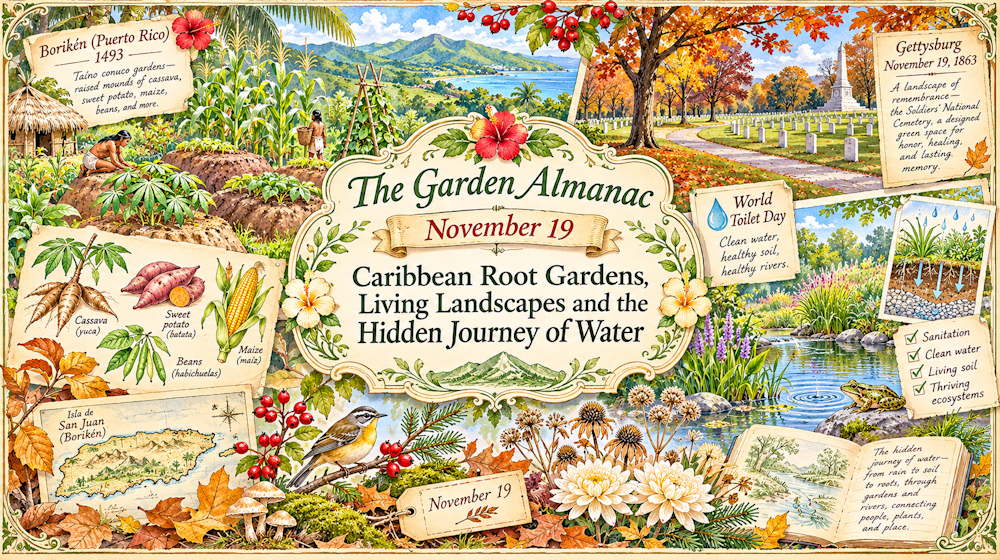
When Christopher Columbus reached the island of Puerto Rico on November 19, 1493, during his second Atlantic voyage, he encountered a landscape that Europeans had never previously recorded in their own geographical accounts. But the island, known to its Indigenous inhabitants as Borikén, was neither unknown nor undeveloped. The Taíno people had established communities, cultivated important food crops and developed agricultural methods suited to the tropical environment long before European ships appeared.
One of their most distinctive techniques was the conuco, a system of cultivated earth mounds particularly associated with cassava production. Farmers shaped the soil into raised planting areas that provided loose growing conditions for root crops while improving drainage in a region where intense rainfall could quickly saturate the ground. Cassava, sweet potatoes, maize, beans and other crops formed part of the Taíno food system. The mounds were not simply convenient planting beds. They represented generations of practical knowledge about tropical soils, rainfall and food security.
Cassava was especially important because its starchy roots could be transformed into bread after careful processing. Some varieties contain potentially dangerous cyanogenic compounds, so traditional preparation methods were essential for making them safe to eat. The Taíno also cultivated crops with different growth habits, making productive use of limited space. Their agricultural knowledge contrasts sharply with older European accounts that portrayed the Caribbean primarily as a newly encountered tropical wilderness. Spanish colonisation subsequently brought profound disruption, including forced labour, disease and major changes to Indigenous communities and landscapes.
The conuco remains a fascinating example of gardening shaped by local conditions rather than imposed upon them. Raised planting areas are still useful where drainage is poor, although their design must suit the climate and soil. In cool, wet gardens, raised beds can help prevent winter waterlogging; in hot, dry regions, however, elevated soil may lose moisture more quickly and require additional irrigation or mulching. The deeper value of traditional agricultural knowledge lies in understanding why a method works before adopting it elsewhere.
Garden Reminder – Should You Prepare Raised Beds Before Winter?
Late autumn is a useful time to assess drainage and prepare growing areas for the next season.
- Check for waterlogging. If water remains on the surface long after rainfall, examine drainage before adding more plants.
- Improve soil gradually. Add mature compost or other suitable organic matter to support soil structure, rather than repeatedly digging wet ground.
- Protect empty beds. Use leaf mould, compost or an appropriate cover crop to reduce erosion and nutrient losses.
- Consider the local climate. Raised beds can improve drainage in wet conditions but may dry out faster during summer.
Good soil management begins with understanding how water behaves in a particular garden.
November 19, 1863 – When a Battlefield Became a Designed Landscape of Remembrance
A few months after the devastating Battle of Gettysburg, the Pennsylvania countryside still carried the scars of the American Civil War. On November 19, 1863, thousands gathered for the dedication of the Soldiers’ National Cemetery. The occasion became famous for Abraham Lincoln’s remarkably brief Gettysburg Address, but behind the ceremony was another story: the deliberate transformation of a battlefield into a landscape designed to honour the dead.
The cemetery was planned by William Saunders, a landscape gardener and horticulturist who created a semicircular arrangement of burial plots centred on a monument. Instead of dividing the grounds into elaborate individual memorial gardens, his design used simple, orderly rows of graves, open lawns, curving paths and carefully placed trees. Officers and enlisted soldiers received a deliberately uniform treatment. The landscape itself helped express the idea of collective remembrance, while its restrained arrangement allowed visitors to experience the site as a coherent whole.
Today, historic cemeteries and memorial landscapes can also provide valuable green spaces. Mature trees, undisturbed grassy areas and established shrubs may support birds, insects and other wildlife, especially in heavily developed surroundings. Their management must balance ecological benefits with historical character and the needs of visitors. A thoughtful garden can do something similar on a smaller scale: its paths, planting structure and preserved trees can create a sense of place while providing living habitat. The most meaningful landscapes are not always the most elaborate ones.
Garden Inspiration – What Makes a Garden Feel Timeless?
Some of the principles used in historic landscape design remain valuable in modern gardens.
A clear path can guide visitors towards a significant tree, a quiet bench or a carefully framed view. Repeated planting shapes create rhythm, while open spaces allow important features to stand out.
Mature trees are particularly valuable because they provide scale and continuity that newly planted specimens cannot immediately reproduce.
When redesigning an established garden, consider which existing features deserve to remain. Preserving a healthy old tree or an attractive natural contour may give the new design more character than replacing everything.
November 19 – World Toilet Day and the Water That Connects Us
A global day dedicated to toilets might seem an unusual subject for a gardening almanac. Yet World Toilet Day, observed every November 19, addresses one of the most important relationships between human settlements, water and the environment. First established in 2001 and recognised as an official United Nations observance in 2013, it highlights the need for safe sanitation and the protection of communities from untreated human waste.
The connection to nature is immediate. Without adequate sanitation, harmful microorganisms can enter rivers, groundwater and agricultural water supplies. Contaminated water may spread disease, damage aquatic ecosystems and make food production less safe. According to international water and sanitation organisations, billions of people still lack safely managed sanitation. The problem is therefore not simply about constructing toilets but also about ensuring that wastewater is safely collected, treated and managed.
For gardeners, World Toilet Day offers a useful reminder that water quality matters as much as water quantity. Rainwater collected from suitable, well-maintained surfaces can be useful for ornamental plants and many garden tasks, while water intended for edible crops requires careful consideration of contamination risks. Untreated sewage must never be used for watering vegetables. Responsible wastewater treatment can protect waterways and, under properly controlled conditions, allow water and nutrients to be recovered. A productive garden depends on healthy soil, but also on the quality of the water moving through it.
Garden Science – How Does Soil Help Clean Water?
As water moves through healthy soil, several natural processes can improve its quality.
Soil particles can trap suspended material, while microorganisms break down some organic substances. Roots and soil organisms also influence nutrient cycling and water movement.
However, soil is not a guaranteed purification system. Disease-causing microorganisms and some dissolved pollutants can travel through soil and reach groundwater. The degree of filtration depends on soil texture, depth, biological activity and the type of contamination.
This is why garden drainage should be designed to manage rainwater rather than untreated sewage. Rain gardens, vegetated swales and permeable surfaces can help slow stormwater runoff and reduce some pollutants before water reaches streams.
Wildlife Note – Why Do Small Garden Ponds Matter in Autumn?
Even as November temperatures fall, garden ponds remain important habitats.
Aquatic insects, snails and microorganisms continue to occupy the water and bottom sediments. Frogs and other amphibians may shelter nearby or overwinter in suitable aquatic or terrestrial locations, depending on the species and climate.
Avoid removing all vegetation or disturbing pond sediments during cold weather. If leaves accumulate excessively, gently remove some before they decompose and consume oxygen.
A pond with gently sloping edges, varied depths and surrounding vegetation can provide more ecological value than a bare ornamental basin.
What to Observe Right Now – Following Water Through the November Garden
Late autumn is an excellent time to notice how rainfall, soil and vegetation interact, particularly in temperate Northern Hemisphere gardens.
- Rainwater movement: During a shower, observe where water runs off paths, collects in depressions or disappears into the soil.
- Soil protection: Compare bare ground with soil covered by leaves or low-growing vegetation. Notice differences in surface erosion and splashing.
- Decaying vegetation: Look for softened leaves, fungal growth and other signs of decomposition in moist, sheltered places.
- Winter shelter: Observe how evergreen shrubs, dense hedges and fallen leaves create protected spaces for birds and invertebrates.
These small observations reveal connections that are often hidden during the busy growing season.
Looking Ahead
November 19 brings together very different examples of how people shape the environments around them. Indigenous Caribbean farming demonstrates the value of understanding local conditions, historic landscape design shows how places can preserve meaning, and modern sanitation reminds us that healthy ecosystems depend on responsible water management. In our own gardens, these ideas become practical choices: protecting soil, preserving valuable trees, managing rainwater and creating space for wildlife. As winter approaches, thoughtful decisions made now can help the garden become healthier, more resilient and more rewarding in the seasons to come.