
In a November garden, time seems to move differently. The sun disappears earlier, the last leaves fall, and plants that were growing vigorously only weeks ago settle into winter dormancy. But beneath the quiet surface, the natural world holds stories that reach far beyond the changing season.
November 18 takes us from an extraordinary botanical connection between Asia and America to the day railway clocks changed how people measured time. It also marks a decision that helped protect a great river running through the heart of a modern city. Together, these stories reveal some surprising ways to understand plants, seasons and the landscapes around us.
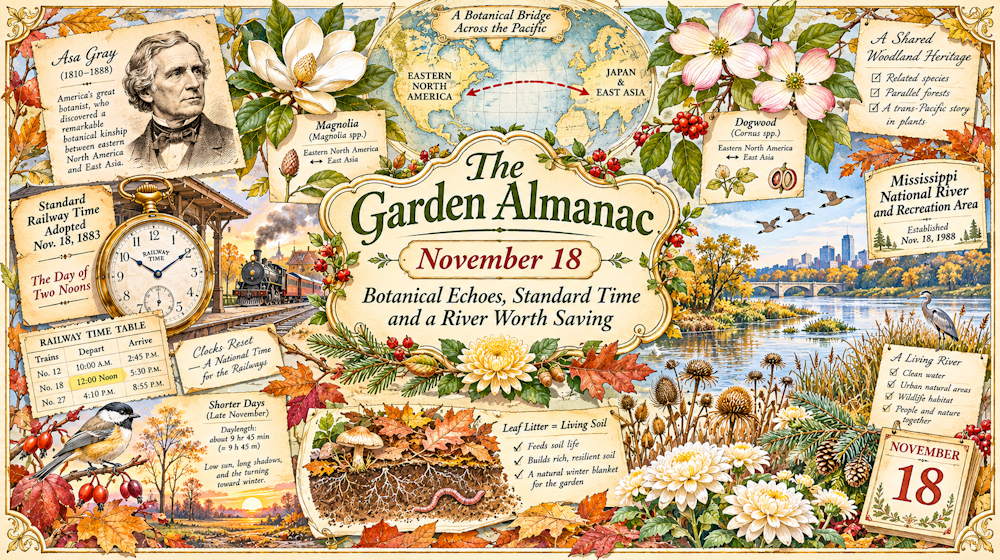
November 18, 1810 – The Botanist Who Found Japan in an American Forest
Imagine walking through a forest in eastern North America and discovering plants whose closest relatives grow thousands of miles away in Japan or China. The similarities are too striking to dismiss as coincidence, yet the Pacific Ocean separates these landscapes. This botanical puzzle fascinated Asa Gray, born on November 18, 1810, in New York State, who became one of the nineteenth century’s most influential botanists.
Gray spent decades studying plant specimens, exchanging observations with scientists abroad and investigating the geographical distribution of species. By comparing the flora of eastern North America with collections from East Asia, he identified remarkable similarities between regions that seemed geographically disconnected. In an influential 1859 study, he listed 134 plant species shared by eastern North America and Japan. His work helped establish an important question in plant geography: why do distant continents sometimes possess such closely related plants?
The answer reaches deep into Earth’s history. Many plant lineages once occupied much wider areas across the Northern Hemisphere, when climates and geographical connections were different. As temperatures changed and populations disappeared from some regions, related plants survived in separated refuges. Fossils, modern genetic studies and geological evidence have since helped scientists reconstruct these ancient distributions. Gray’s observations also contributed to discussions about evolution and the geographical history of species, including his correspondence with Charles Darwin.
Gardeners can still encounter evidence of these ancient connections. Eastern North American and East Asian forests share related lineages of magnolias, dogwoods and other familiar ornamental plants. Comparing their flowers, leaves and growth habits reveals more than decorative similarities. Their natural habitats also offer clues about cultivation: many woodland plants benefit from organic-rich soil, consistent moisture and protection from intense afternoon sun, although individual species differ. A garden containing plants from distant continents can sometimes resemble a living exhibition of Earth’s botanical past.
Garden Reminder – Protecting Woodland Plants Before Winter
Late autumn is a useful time to care for shade-loving plants, shrubs and young ornamental trees.
- Keep a natural leaf layer: Healthy fallen leaves can protect soil organisms and gradually contribute organic matter to woodland borders.
- Mulch newly planted shrubs: Apply approximately 5–7 cm of suitable organic mulch, leaving a clear gap around trunks and stems.
- Water before the ground freezes: Newly planted evergreens may need moisture during dry autumn weather, especially where rainfall has been insufficient.
- Check planting conditions: Plants adapted to woodland habitats often struggle in exposed, dry positions, even when they are otherwise hardy.
Understanding where a plant evolved can be just as valuable as knowing its name.
November 18, 1883 – The Day Some Towns Had Two Noons
For much of human history, noon was a local event. When the sun reached its highest point in the sky, it was midday. But as railways expanded across North America during the nineteenth century, this simple arrangement became a serious problem. Neighbouring towns could keep different times, while railway companies operated according to competing schedules. Travelling across the continent meant travelling through a confusing patchwork of clocks.
On November 18, 1883, North American railroads introduced Standard Railway Time, replacing numerous local railway times with a coordinated system of time zones. Some clocks were moved forward, others backward, and the change became remembered as the Day of Two Noons. The new system made railway operations safer and timetables more practical. Gradually, the public adopted standard time too, although the sun continued following exactly the same path across the sky.
Plants, of course, never adjusted their biological schedules to railway timetables. Their seasonal rhythms depend heavily on environmental signals, especially the changing duration of daylight and darkness. Many plants use these signals to regulate flowering, growth and dormancy. In the Northern Hemisphere, shortening autumn days help prepare numerous trees and shrubs for winter. This explains why a warm November afternoon does not necessarily persuade a deciduous tree to begin growing again. Its seasonal response involves more than temperature alone.
Garden Science – How Do Plants Know Winter Is Coming?
Many plants possess an internal biological clock that helps them interpret daily changes in light.
Specialised light-sensitive molecules allow plants to detect differences between day and night. In some species, the duration of uninterrupted darkness is particularly important for regulating flowering or seasonal growth.
As autumn advances, these signals interact with temperature and other environmental conditions. Deciduous trees may stop producing new shoots, form protective buds and begin processes leading to leaf senescence and dormancy.
Garden observation: Two plants growing in the same bed may enter dormancy at different times because their species respond differently to daylength and temperature. This is why seasonal behaviour is often a more reliable guide to plant care than the calendar alone.
November 18, 1988 – The River That Became a National Park Without Leaving the City
A national park usually brings to mind remote mountains, ancient forests or vast wilderness. Yet on November 18, 1988, the United States established the Mississippi National River and Recreation Area, protecting an extraordinary 72-mile (116-kilometre) river corridor through the Minneapolis–Saint Paul metropolitan region of Minnesota.
What makes this landscape unusual is that it includes industrial areas, neighbourhoods, historic sites and natural habitats within the same protected corridor. The Mississippi changes character dramatically along this stretch. It passes through wooded valleys and over St. Anthony Falls before widening into the floodplain landscapes farther downstream. Wetlands, floodplain forests, oak savannas and remnants of tallgrass prairie support a diversity of wildlife alongside one of the region’s major urban centres. Protection depends on cooperation among local authorities, organisations and landowners rather than the federal government owning every part of the landscape.
The river’s importance extends beyond its visible banks. Floodplain vegetation helps slow flowing water, stabilise soil and provide habitats for birds, insects and aquatic organisms. Connected green spaces also allow wildlife to move through landscapes fragmented by roads and buildings. These relationships have a direct parallel in gardens: a native hedge, a rain garden or a planted strip beside a drainage channel may seem small in isolation, but together such features can improve habitat connectivity and help manage stormwater. Conservation is not always about keeping people away from nature. Sometimes it is about making space for functioning ecosystems within places where people already live.
Wildlife Note – Why Are Fallen Leaves Valuable to Garden Wildlife?
A thick layer of autumn leaves may look like garden waste, but it can provide an important seasonal refuge.
Many invertebrates shelter beneath leaves, among plant stems and within the upper layers of soil. Some insects overwinter as adults, while others survive as eggs, larvae or pupae. Birds may search these sheltered areas for food when conditions allow.
Rather than clearing every border, leave some healthy leaf litter beneath shrubs and around suitable perennials. Keep paths, drains and heavily covered lawns clear where necessary, and avoid disturbing established wildlife shelters.
Even a modest garden can contribute to a wider network of habitats.
What to Observe Right Now – Reading the November Landscape
In temperate Northern Hemisphere gardens, the second half of November offers a fascinating opportunity to observe seasonal changes.
- Daylight and shadows: Notice how low the midday sun stands and which parts of the garden now remain shaded for most of the day.
- Winter buds: Look closely at deciduous shrubs and trees. Many have already formed the buds that will open next spring.
- Persistent foliage: Compare species that retain their leaves with those that have already become bare.
- Leaf decomposition: Examine how fallen leaves gradually soften and break apart, especially in damp, sheltered places.
These observations reveal the quiet processes that continue long after the garden’s most colourful season has passed.
Looking Ahead
November 18 invites us to look at familiar landscapes with fresh curiosity. A magnolia may carry traces of ancient botanical history, a bare tree can reveal its response to changing daylight, and a small patch of garden habitat can contribute to the ecological health of an entire neighbourhood. As winter approaches, there is value in preserving what already works, learning from the natural rhythms of plants and making room for wildlife. The most resilient gardens often begin with careful observation rather than constant intervention.