

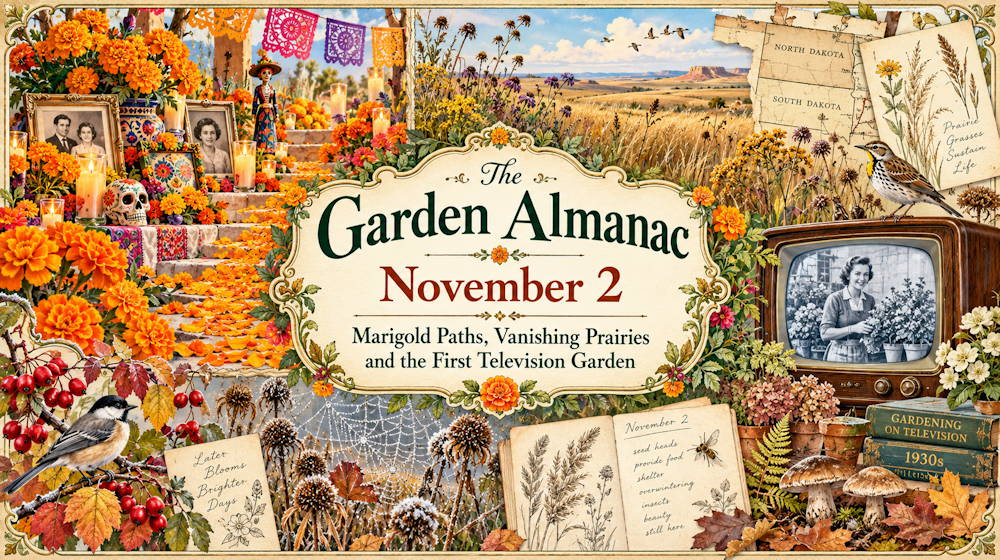

On November 2, a trail of golden petals may lead to a family doorway in Mexico, while thousands of miles away, autumn winds move through the dry grasses of the North American plains. In Britain, meanwhile, the date marks an unexpected milestone in the history of gardening – the beginning of a technology that would eventually bring gardens into millions of living rooms.
It is a day when flowers become symbols of remembrance, grasslands reveal the hidden value of their roots, and a television experiment opens an entirely new way of sharing horticultural knowledge. Each story offers a different reason to look more closely at the living world.
November 2 – Why Marigolds Guide the Dead Home in Mexico
Imagine a pathway made entirely of orange flower petals. It begins at a doorway, crosses a courtyard and leads towards a family altar filled with candles, photographs and favourite foods. In Mexico, such a pathway is more than decoration. During Día de Muertos, or the Day of the Dead, marigold petals traditionally help guide the spirits of departed loved ones home.
November 2 is especially associated with remembering deceased adults, although celebrations and local customs extend across several days. The tradition combines Indigenous Mexican beliefs about death and ancestry with Catholic observances introduced during the colonial period. Rather than treating death only as an occasion for sorrow, families celebrate continuing bonds with those who have died. Flowers play a central role in this remarkable meeting of memory, agriculture and seasonal abundance.
The most recognisable flower is Tagetes erecta, known in Mexico as cempasúchil. Its golden-orange blooms and distinctive scent are traditionally believed to help returning spirits find their way. The plant belongs to the daisy family and is native to Mexico and Central America, despite often being called the African marigold in English gardening catalogues. In the weeks before the celebration, growers harvest enormous quantities of flowers, transforming a familiar garden annual into one of the country’s most culturally significant crops.
There is a fascinating horticultural dimension to this tradition. Marigolds are warm-season plants that thrive in full sun and well-drained soil, flowering generously when conditions are favourable. In regions with cold autumns, frost ends their display just as the Mexican celebrations reach their peak. Gardeners elsewhere can preserve a little of this golden spectacle by collecting mature seed heads before prolonged wet weather, drying them thoroughly and storing the seeds in a cool, dry place for spring sowing.
Garden Science – Why Are Marigolds So Strongly Scented?
The distinctive smell of marigold foliage comes from aromatic compounds produced by the plant, including terpenes. These chemicals contribute to the plant’s interactions with insects and other organisms.
Some Tagetes species also produce substances in their roots that can suppress certain plant-parasitic nematodes. However, this does not mean that planting any marigold beside vegetables automatically protects them from every pest. The effect depends on the species, cultivar, target organism and growing conditions.
November 2, 1889 – When Two New States Inherited a Sea of Grass
On this day in 1889, North Dakota and South Dakota officially entered the United States. President Benjamin Harrison reportedly shuffled their admission documents to conceal which state he had signed into existence first. The unusual gesture left a historical mystery, but the landscape beneath the newly established states was already undergoing a far more consequential transformation.
For thousands of years, the northern Great Plains had supported extensive grasslands shaped by grazing animals, periodic fires, seasonal drought and the land-management practices of Indigenous peoples. During the nineteenth century, expanding settlement, railways and commercial agriculture dramatically changed these ecosystems. Native grasslands were ploughed for crops, particularly in fertile areas where their extraordinarily rich soils offered opportunities for farming. The same underground plant systems that had helped build and protect the soil were increasingly removed.
Prairie grasses are considerably more complex than their modest appearance suggests. Species such as big bluestem, little bluestem and switchgrass support deep, extensive root systems that hold soil together, improve infiltration and store carbon underground. Across North America, less than four percent of the original tallgrass prairie remains intact. For gardeners, the prairie offers a different model of planting: a mixture of locally appropriate perennial grasses and wildflowers, with varied heights and flowering seasons, can create resilient habitats without demanding the uniform appearance of a conventional lawn.
Garden Reminder – Early November Jobs Worth Doing
In temperate Northern Hemisphere gardens, early November is a useful time to prepare for winter without removing every trace of autumn.
- Protect bare soil: Apply approximately 5–8 cm of leaf mould, compost or suitable organic mulch, keeping it away from plant crowns and woody stems.
- Save healthy leaves: Use them beneath shrubs or in garden beds rather than sending them all away as waste.
- Check drainage: Move vulnerable container plants out of persistently wet conditions and raise pots slightly to help excess water escape.
- Leave selected seed heads: Coneflowers, ornamental grasses and other sturdy perennials can provide food, shelter and winter structure.
In frost-free or Southern Hemisphere gardens, adjust these tasks to local growing conditions.
November 2, 1936 – The Day Gardening’s Future Appeared on a Screen
When the BBC launched its regular high-definition television service from Alexandra Palace in London on November 2, 1936, few viewers could have imagined what the new medium would eventually mean for gardening. Early television was expensive, technically complicated and available to only a small audience. Yet within weeks, it would begin showing something remarkably ordinary: how to grow plants.
On November 21, 1936, the BBC broadcast its first television gardening programme, featuring horticultural broadcaster C. H. Middleton, widely known as Mr Middleton. An outdoor television garden was established near the Alexandra Palace studios, providing a place where practical gardening demonstrations could be filmed. This was an important departure from radio instruction. Viewers could now watch techniques, examine plants and follow demonstrations rather than relying entirely on spoken descriptions.
The development helped establish a form of gardening education that remains familiar today, from television programmes to online tutorials. Yet there is a useful distinction between watching a gardening technique and understanding why it works. A pruning demonstration, for example, becomes much more valuable when viewers can recognise a branch collar, distinguish healthy growth from dead wood and understand how a particular plant responds to cutting. The most useful gardening advice still combines clear visual instruction with careful observation of the plant itself.
Wildlife Note – Why Leaving a Garden Untidy Can Help Wildlife
An autumn garden may look quiet, but many animals are preparing to survive winter in ways that are easy to overlook.
- Hollow and pithy stems can provide nesting or overwintering sites for certain solitary bees and other insects.
- Fallen leaves shelter invertebrates and help protect the soil surface.
- Standing seed heads provide food for seed-eating birds.
- Dense shrubs and undisturbed corners offer refuge during cold or windy weather.
A garden does not need to be completely untouched. Keeping paths clear while leaving selected borders and sheltered corners undisturbed can combine practical maintenance with valuable habitat.
What to Observe Right Now – The Garden’s Quiet November Changes
Early November is an especially revealing time in gardens across much of the temperate Northern Hemisphere. As deciduous trees lose their leaves, structures that summer foliage concealed become visible again.
Look closely at the garden over the next few days:
- Leaf colour: Some trees retain golden foliage long after neighbouring species have become bare.
- Winter buds: Many woody plants already carry the buds that will open next spring.
- Fungi: Damp, mild conditions can bring mushrooms and other visible fungal fruiting bodies to lawns, woodland edges and mulched beds.
- Bird activity: Blackbirds, thrushes and other birds may search for berries, fallen fruit and soil-dwelling invertebrates.
- Frost patterns: Grass, bare soil, raised beds and sheltered corners can cool at different rates, revealing small but important microclimates.
These observations can help explain why plants growing only a few metres apart sometimes develop, flower or suffer frost damage at noticeably different times.
Looking Ahead
November 2 reminds us that gardens can preserve cultural traditions, restore fragments of threatened habitats and provide a place where knowledge passes from one generation to another. A handful of saved marigold seeds, a small planting of native grasses or a closer look at an overwintering insect can each begin something worthwhile. As the growing season slows in northern gardens, there is still plenty to discover above and below the soil. The next season’s garden is already taking shape, even when much of its life is hidden from view.