


By late October, a garden can look as though it is slowly retreating from the world. Leaves gather beneath trees, perennial stems turn brown, and the last flowers compete with increasingly chilly mornings. Yet beneath this quieter appearance, life is preparing for another season.
October 27 offers three very different stories about our relationship with nature: a president who helped protect wilderness, a revolutionary material that changed everyday life, and a European landscape where conservation became a shared community project. Each invites us to look differently at the spaces we cultivate, protect and sometimes take for granted.
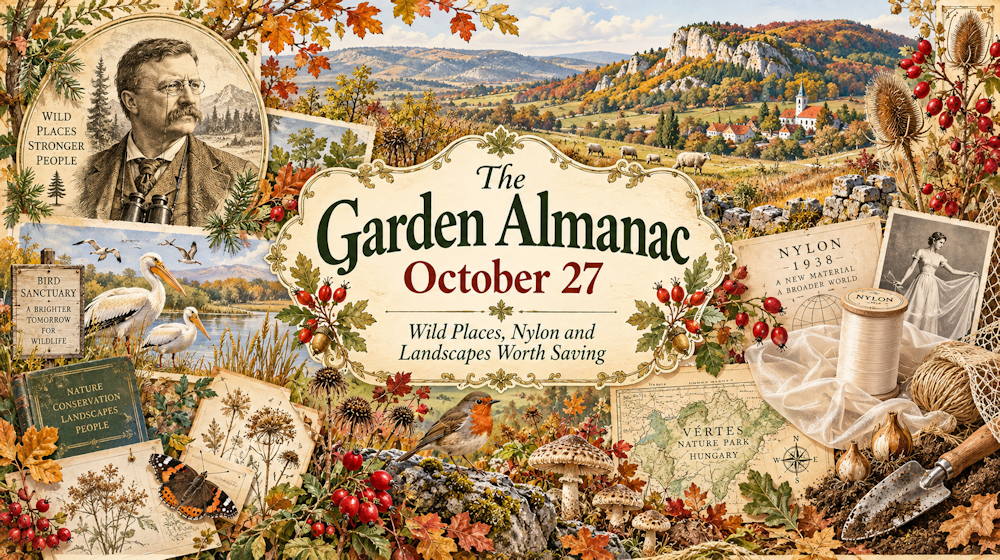
October 27, 2005 – The Hungarian Landscape That Became a Nature Park
Imagine protecting a landscape without removing the people who live and work there. Not just forests and rare flowers, but villages, grazing animals, traditional orchards, farmland and centuries of local knowledge. That was the vision behind the Vértes Nature Park in Hungary, which received official recognition on October 27, 2005, becoming the country’s first officially designated natúrpark.
Covering approximately 35,800 hectares across 17 communities, the park embraces the Vértes Mountains and much of the surrounding Zámoly Basin. Its landscapes include woodlands, grasslands, rocky hillsides and agricultural areas shaped by generations of human activity. Rather than treating the countryside as a museum exhibit, the project recognised that responsible land use could help preserve its ecological and cultural character.
The achievement was years in the making. Local authorities, conservation organisations and land managers had begun cooperating long before the official designation, recognising that neither wildlife protection nor rural development could succeed entirely on its own. What made the initiative distinctive was its emphasis on cooperation across an inhabited landscape, where conservation, farming, education and tourism could support one another.
There is a surprisingly practical lesson in this approach. Not every valuable habitat needs to become dense woodland, and not every garden benefits from being left entirely untouched. Some species-rich meadows depend on appropriate mowing or grazing to prevent shrubs from taking over. In smaller gardens, a similar balance can mean keeping a patch of flowering grassland while cutting paths through it, removing invasive plants, and allowing native wildflowers to set seed before their final seasonal cut.
Garden Reminder – What Should You Do in the Garden in Late October?
In temperate Northern Hemisphere gardens, this is a useful time to prepare for colder weather without stripping the garden of everything that makes it alive.
- Leave some fallen leaves in borders. A light layer helps protect soil, while decomposing leaves contribute organic matter. Remove thick, wet layers from lawns where they could smother grass.
- Plant suitable spring-flowering bulbs. Daffodils and crocuses can often still go into the ground while the soil remains workable. Tulips are commonly planted later in autumn, depending on local conditions.
- Protect tender container plants. Move frost-sensitive specimens into suitable shelter before damaging temperatures arrive.
- Check drainage. Clear blocked outlets and avoid working waterlogged soil, which compacts easily.
October 27, 1858 – Theodore Roosevelt and the Wilderness That Almost Disappeared
Long before Theodore Roosevelt became the 26th president of the United States, he was a young naturalist fascinated by birds, animals and the outdoors. Born on October 27, 1858, in New York City, he developed an enthusiasm for natural history that would eventually influence conservation on an extraordinary scale. As a boy, he even assembled a small natural history collection in his bedroom.
By the time Roosevelt entered the White House in 1901, large areas of American forest and grassland had already experienced intense logging, hunting and agricultural expansion. Wildlife populations were declining, and the idea that natural resources required national protection was still politically contested. During his presidency, Roosevelt helped protect approximately 230 million acres of public land, established 150 national forests and created 51 federal bird reserves, alongside national parks, game preserves and national monuments.
One particularly revealing example was Pelican Island in Florida. In 1903, Roosevelt designated this small island as a federal bird reservation, helping protect a breeding site threatened by plume hunting. The decision demonstrated that conservation did not always require vast, spectacular landscapes. A relatively small place could be enormously important if it provided the habitat wildlife needed to survive. Gardeners can recognise the same principle today: a native hedge, a flowering border or a patch of undisturbed ground may be modest in size, yet become valuable when connected to other habitats nearby.
Wildlife Note – Why Leave Some Stems Standing Through Winter?
Many insects survive winter not as adults, but as eggs, larvae or pupae hidden in vegetation, soil or sheltered crevices.
- Hollow or pithy plant stems can provide nesting or overwintering sites for certain solitary bees and other insects.
- Seedheads of coneflowers, teasels and other suitable plants can provide food for seed-eating birds.
- Leaf litter beneath shrubs creates shelter for numerous small invertebrates.
Leave selected perennial stems standing through winter and postpone cutting them back until spring, when conditions are warmer. Avoid assuming every hollow stem is occupied, but remember that an immaculate winter border may offer fewer shelter opportunities.
October 27, 1938 – When Nylon Changed More Than Women’s Stockings
On October 27, 1938, a new synthetic fibre called nylon was publicly announced in the United States. Developed through research at DuPont, it represented an extraordinary breakthrough: a strong, flexible material could be manufactured chemically rather than obtained from traditional natural fibres. The initial excitement centred on textiles, particularly the possibility of replacing expensive silk in women’s stockings.
Nylon’s influence soon extended far beyond clothing. It found uses in brushes, ropes, industrial products and, eventually, numerous outdoor applications. Synthetic fibres and plastics transformed gardening too, although today’s garden netting, twines, fleece and protective fabrics are made from several different polymers, not nylon alone. Lightweight, durable materials made it easier to support plants, protect crops and work efficiently in difficult weather.
But durability has another side. Materials designed to resist degradation can become persistent waste when abandoned outdoors. Loose plastic netting may entangle birds and other animals, while weathering and fragmentation contribute to plastic pollution. This does not mean every synthetic garden product should be discarded. A well-maintained cover used for many seasons may be more practical than repeatedly purchasing disposable alternatives. The important questions are whether a material is genuinely needed, how safely it is installed, and what happens when its useful life ends.
Garden Science – Why Does Autumn Leaf Litter Improve Soil?
Fallen leaves are more than seasonal debris. They form part of the natural process through which nutrients and organic matter return to the soil.
Fungi, bacteria and soil invertebrates gradually break down dead leaves. Earthworms can draw fragments underground, where the material contributes to soil structure and biological activity. The rate of decomposition depends on temperature, moisture, oxygen and the type of leaves involved.
Shredded leaves usually decompose faster because they offer a larger surface area for microorganisms. A loose layer around established shrubs can help reduce evaporation and buffer temperature fluctuations, although excessive wet material piled against stems may encourage decay.
For gardeners, this creates an opportunity to turn an annual clean-up job into a useful soil-building practice: collect surplus leaves and allow them to decompose separately into leaf mould.
What to Observe Right Now – The Quiet Signs of Seasonal Change
Late October is an excellent time to notice the small differences that are easily missed during the busy growing season. Timing varies considerably with latitude, altitude and local weather, so these observations are especially relevant to temperate Northern Hemisphere gardens.
- Which trees are still holding green leaves? Different species respond differently to shortening days and falling temperatures.
- Where does frost appear first? Low-lying areas and sheltered pockets can develop their own microclimates.
- Are birds investigating remaining berries? Hawthorn, rowan and other fruiting plants can provide seasonal food, depending on the species and location.
- Which flowers are still attracting insects? Late-flowering asters and other autumn blooms may remain valuable during mild spells.
One useful experiment is to photograph the same tree or garden border every few days. Over time, these simple records reveal seasonal patterns more clearly than memory alone.
Looking Ahead
The stories behind October 27 point towards several practical possibilities for tomorrow’s gardens. A protected landscape can show us how thoughtful management supports biodiversity, a bird sanctuary reminds us that even small habitats matter, and the history of nylon encourages more careful choices about the materials we use outdoors. This autumn, leaving a little more shelter for wildlife, improving the soil with fallen leaves or choosing longer-lasting garden supplies can all make a difference. The most promising gardens of the future may be those that combine human ingenuity with a deeper understanding of how nature works.