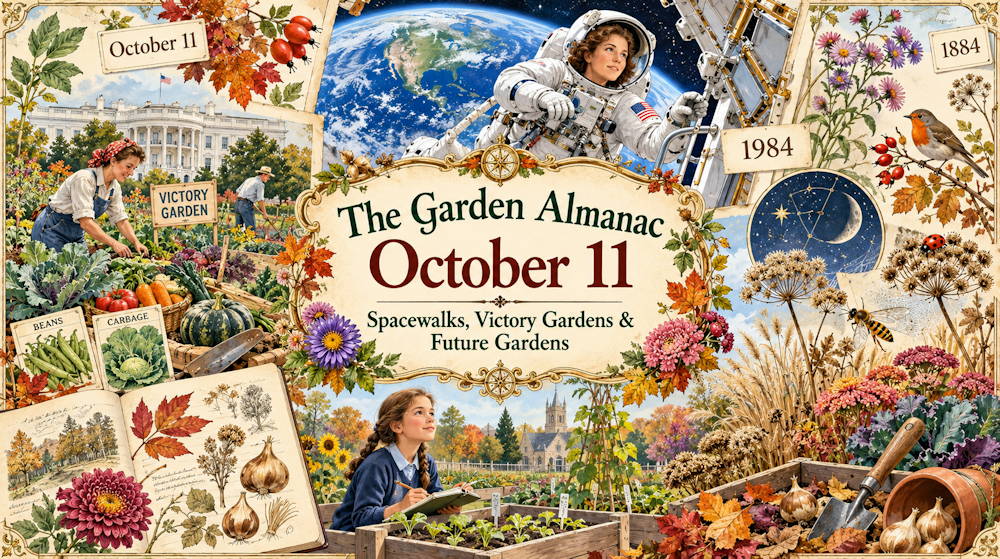

By October 11, the garden has begun to show what it has learned from the year. The late flowers are fewer but more precious, the soil holds last night’s coolness longer, and every falling leaf seems to ask a practical question: what should be protected, gathered, planted or simply left alone?
This date opens three very different doors. One leads into orbit, where a woman stepped outside a spacecraft and looked back at Earth as a living surface. Another opens onto a wartime lawn turned vegetable garden. The third belongs to girls whose education, confidence and access to land may shape the gardens, farms and food systems of the future.
October 11, 1984 – The Spacewalk That Made Earth Feel Like a Garden
On October 11, 1984, astronaut Kathryn D. Sullivan became the first American woman to walk in space. The moment was historic, but it was also practical: she and fellow astronaut David Leestma worked outside the space shuttle Challenger during mission STS-41-G, testing equipment connected with the idea that satellites might one day be serviced and refueled in orbit.
What makes the story more interesting than a single “first” is the work itself. Sullivan was not floating outside the spacecraft as a symbol; she was helping test how humans might maintain the tools that observe Earth. Satellites were already changing weather forecasting, mapping, ocean science and agriculture. A machine that could keep watching from orbit was not just a space achievement – it was part of a growing system for understanding drought, vegetation, storms, snow cover and the patterns that gardeners feel first at ground level.
For gardeners, the connection may seem distant until we think about how much modern growing depends on observation. The same principle links a satellite image and a hand pushed into garden soil: look carefully before acting. A gardener who notices which corner dries first, where frost settles, where leaves yellow early, or where rain runs off instead of soaking in is practicing the same basic habit at a human scale.
Sullivan’s October 11 spacewalk reminds us that Earth is not an abstract blue marble but a layered, living place. From above, fields, forests, rivers and cities form patterns; from below, those patterns become tomato beds, hedgerows, compost heaps and trees under stress. In autumn, this is especially useful: before clearing everything away, pause long enough to read the garden’s map – the wet patches, the sheltered pockets, the plants still feeding insects, and the bare soil that may need cover before winter.
Garden Science: Why Microclimates Matter in Autumn
A garden is rarely one climate. Walls, fences, slopes, paving, trees and water all create small local differences.
- South-facing walls can keep soil and pots warmer for longer.
- Low spots often collect cold air, making frost damage more likely.
- Bare soil loses heat and moisture faster than mulched or planted soil.
- Wind-exposed beds dry out even in cool weather.
In October, these details help decide where to move tender pots, where to plant spring bulbs, and which areas need mulch before the first hard frosts.
October 11, 1884 – Eleanor Roosevelt and the Vegetable Garden as Public Gesture
Eleanor Roosevelt was born on October 11, 1884, in New York City. Decades later, as First Lady of the United States, she helped change the public meaning of a garden during the Second World War. In 1943, a Victory Garden was planted on the White House grounds, turning one of the most visible lawns in America into a small but powerful food-growing statement.
Victory gardens were not invented at the White House, and millions of ordinary people had already begun growing vegetables in yards, school grounds, vacant lots and community spaces. The striking part was the location. A formal national lawn, usually associated with ceremony and display, was asked to do something useful. Food growing was no longer hidden at the back of the property; it became civic, visible and shared.
Today, the story still has bite because many gardens are once again being asked to do more than look pleasant. A front garden can cool a street, feed pollinators, absorb rainwater, grow herbs, offer seeds to birds or produce salad leaves close to the kitchen. The most modern garden may be one that politely refuses to be only decorative.
Garden Reminder: What Can Still Be Done Around October 11?
- Plant spring-flowering bulbs while the soil is cool but workable.
- Add compost around hungry perennials, but keep it away from crowns and stems.
- Leave some seed heads standing for birds and winter structure.
- Collect healthy fallen leaves for leaf mould.
- Move tender container plants to a sheltered wall, porch or greenhouse before cold nights become regular.
October 11 – International Day of the Girl and the Gardens of the Next Generation
October 11 is the International Day of the Girl, a United Nations observance first marked in 2012 after years of advocacy by Plan International’s Because I am a Girl campaign and support from Canada at the UN. It was created to draw attention to the barriers that still limit girls’ education, safety, health and opportunity in many parts of the world. Its message is simple, but far-reaching: when girls are denied knowledge, protection or a voice in decisions that affect their lives, whole communities lose part of their future strength.
That idea reaches the garden more naturally than it may first seem. Food growing, soil care, water use, seed saving and climate resilience are all forms of knowledge that shape daily life, especially in rural and farming communities. When girls are able to learn science, take part in school gardens, understand where food comes from and see themselves as capable observers of the living world, practical garden knowledge becomes part of something larger.
For today’s gardener, this date is a reminder that the future of food and biodiversity will depend on shared knowledge, not selective opportunity. A school garden, a community plot or a few pots of herbs can teach more than planting and watering: it can show a child how to notice, test, care and contribute. The stronger the circle of learners, the stronger the gardens and food systems that grow from it.
Wildlife Note: Leave a Little Shelter
In mid-October, many helpful garden creatures are looking for winter cover. A perfectly cleared garden can remove the very places they need.
Leave a small undisturbed corner with dry stems, leaves and hollow plant material. Ladybirds, lacewings, solitary bees and other beneficial insects may use these spaces as shelter. A tidy garden can still be wildlife-friendly if it includes a few deliberate refuges.
October 11 in the Garden – Observation Before Intervention
The three stories of October 11 do not need to be forced into one neat lesson. An astronaut’s view of Earth, a wartime vegetable garden and a day dedicated to girls’ futures belong to different worlds. Yet each one rewards the same habit: looking carefully enough to understand what kind of action is needed.
That is a useful October discipline. The season tempts gardeners to rush – to clear, cut, store, protect and finish. But the garden is still giving information. Which plants are holding up after cool nights? Which flowers are still visited by insects? Which beds stayed damp after rain? Which trees coloured early, perhaps from stress rather than beauty alone?
What to Observe Right Now
- Notice which late flowers still attract bees, hoverflies or butterflies.
- Watch where fallen leaves gather naturally; these spots often reveal wind patterns.
- Check whether lawns or beds stay wet after rain, which may show compaction or poor drainage.
- Look for berries, seed heads and hips before pruning shrubs too hard.
- Compare plants of the same species in different parts of the garden to spot microclimate effects.
Observation is not passive. It is the beginning of better timing. The gardener who waits a few days before cutting back a seed-rich border may feed birds. The person who studies frost pockets before moving pots may save tender plants. The child who learns to watch a bean sprout may one day ask larger questions about food, weather and fairness.
Looking Ahead
October 11 suggests that the future of gardening will belong to people who can move between scales: the whole Earth, the public landscape, the school plot, the balcony pot. It asks us to treat gardens not as isolated patches, but as living places connected to weather, food, education and ecological care. The practical work is beautifully ordinary – mulch the soil, save leaves, shelter wildlife, teach someone younger how to notice. From those small acts, a more observant and generous gardening culture can grow.