


By early October, a garden begins to reveal what the bright months have hidden. Paths grow damp in the morning, leaves show their structure as colour drains into them, and the low sun makes every hedge, wall and seed head cast a longer shadow.
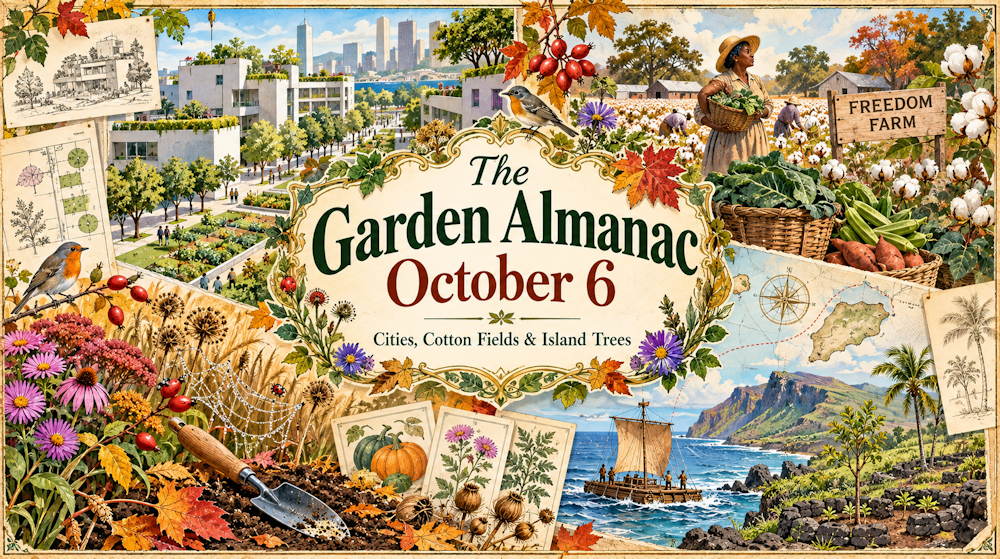
October 6 leads us into three very different landscapes: a Swiss watchmaking town that helped shape modern architecture, the cotton fields of the Mississippi Delta, and the fragile island world of the Pacific. Together they ask a surprisingly practical garden question: how do we design places where people, plants and living systems can actually endure?
October 6, 1887 – Le Corbusier and the Dream of a City with Space to Breathe
Charles-Édouard Jeanneret, later known as Le Corbusier, was born on October 6, 1887, in La Chaux-de-Fonds, Switzerland. The town was known for watchmaking, precision and ordered design, and it is tempting to see something of that early landscape in his later architecture: measured lines, repeated forms, a fascination with systems that could be planned from above.
Le Corbusier became one of the most influential and controversial figures of 20th-century architecture and urban planning. His ideas about towers, open ground, sunlight and rationally organised cities helped shape modern housing debates across the world. He imagined cities where dense buildings would free space below for air, light and greenery. To many later critics, these visions could feel too abstract, too clean, too detached from the messy life of streets. Yet the question he forced into public view has not gone away: in crowded cities, who gets access to light, trees and open space?
For gardeners, this is more than architectural history. A balcony, a courtyard, a school garden, a street tree pit or a planted roof is never just decoration. It is part of the living equipment of a city. Soil catches rainwater. Trees cool hard surfaces. Climbing plants soften glare and provide shelter for insects. Even a narrow planting strip can become a corridor if it connects with other patches of green.
The useful lesson is not that every city should look like a modernist drawing. It is almost the opposite. Good green space cannot be added as an afterthought once all the important decisions have been made. Plants need depth of soil, water, continuity, maintenance and time. The best urban gardens are not empty open space with a few trees placed in it. They are designed as living systems from the beginning.
Garden Science – Why Urban Green Space Cools More Than It Decorates
Plants change the microclimate around them in several ways:
- Leaves shade walls, paving and soil, reducing stored heat.
- Transpiration releases water vapour, which can cool the surrounding air.
- Healthy soil absorbs rain more effectively than sealed surfaces.
- Mixed planting creates shelter for insects, birds and soil organisms.
- Connected green areas work better than isolated decorative patches.
In October, this becomes easier to notice. A paved corner may still hold the day’s warmth after sunset, while a planted bed cools faster and smells of damp soil. Small gardens teach the same lesson as large parks: living surfaces behave differently from dead ones.
October 6, 1917 – Fannie Lou Hamer and the Politics of a Vegetable Garden
Fannie Lou Hamer was born on October 6, 1917, in Mississippi, into a world shaped by cotton, poverty and racial injustice. As a child, she worked in the fields; as an adult, she became one of the clearest and most powerful voices of the American civil rights movement. But one of her most practical ideas was rooted not in a speech hall, but in farmland.
In the late 1960s, Hamer helped create the Freedom Farm Cooperative in the Mississippi Delta. It grew food, supported families and used land as a tool of independence. The point was simple and radical: if people could grow vegetables, raise animals and share resources, they were less vulnerable to hunger, debt and intimidation. A garden, in this context, was not a hobby. It was security.
That gives today’s gardener a sharper way to think about food growing. A vegetable bed is not only a place for tomatoes, beans or greens. It is also a small lesson in resilience. Diverse crops reduce risk. Saved seed preserves local adaptation. Shared harvests build community. Compost turns household waste into fertility. In a world of long supply chains, even a modest edible garden can remind us that food is never just a product – it is a relationship with soil, labour, weather and neighbours.
Garden Reminder – Early October Jobs for a More Resilient Garden
This is a good time to prepare the garden for slower, wetter months:
- Clear diseased leaves from vegetable beds, but leave healthy seed heads where birds can feed.
- Add compost around hungry perennials and fruit bushes, keeping it away from woody stems.
- Sow hardy green manures on empty beds if your climate allows.
- Plant garlic and autumn onion sets in free-draining soil.
- Collect seeds from healthy, true-to-type plants and dry them fully before storing.
- Check containers after rain, because waterlogged compost can damage roots quickly in cool weather.
Think less in terms of “putting the garden to bed” and more in terms of setting up next year’s soil life.
October 6, 1914 – Thor Heyerdahl and the Island Lesson Hidden in Trees
Thor Heyerdahl was born in Norway on October 6, 1914. He became famous for the Kon-Tiki expedition, crossing the Pacific on a balsa raft to test ideas about ancient ocean travel. Some of his migration theories remain disputed, but his life helped bring island cultures, ocean routes and remote landscapes into the public imagination.
For gardeners and nature lovers, one of the most powerful parts of that wider Pacific story is not the raft, but the islands themselves. Rapa Nui, also known as Easter Island, has often been discussed through the fate of its trees, soils and stone statues. The details are complex, and simplistic collapse stories can be misleading, but the ecological question is still vivid: what happens when an isolated landscape loses too much of its plant cover?
An island is a concentrated lesson in limits. Soil can erode. Wind can dry exposed ground. Fresh water can become precious. A tree species can disappear from the wild and survive only because someone saved seed or kept plants growing elsewhere. The same principle applies, in miniature, to gardens. A bare, exposed plot is more fragile than a layered one. Shrubs, ground covers, trees, mulch and perennial roots do not merely make a garden look fuller. They hold the place together.
Wildlife Note – Leave Some Structure for the Quiet Season
By October, many gardeners are tempted to tidy everything at once. A cleaner garden may look orderly to us, but too much clearing removes winter shelter.
Leave a few hollow stems, seed heads, leaf piles and undisturbed corners where possible. Ladybirds, solitary bees, beetles and other beneficial creatures often use these small places to survive the cold months. Birds also benefit from seed heads of plants such as teasel, sunflower, coneflower and ornamental grasses.
A useful rule is to make the garden tidy where you need access and airflow, but generous where wildlife needs cover.
What to Observe Right Now
These early October details can tell you a lot about your garden:
- Which parts of the garden stay wet longest after rain?
- Where does autumn sun still reach the soil?
- Which flowers are still feeding late pollinators?
- Are birds visiting seed heads, hedges or berrying shrubs?
- Which plants held up well through summer stress?
- Where is bare soil exposed to wind or heavy rain?
These observations are more useful than they may seem. They help you decide where to plant trees, where to improve drainage, where to mulch, and which plants deserve more space next year.
Looking Ahead
October 6 offers no single tidy message, and that is part of its value. Le Corbusier points us toward the design of healthier cities, Fannie Lou Hamer reminds us that food growing can be a form of dignity, and Thor Heyerdahl’s island world draws attention to fragile ecosystems and the cost of losing plant cover. For today’s gardener, all three stories return to the same practical ground: soil, shelter, access, resilience. The future garden, whether it is a balcony, allotment, courtyard or orchard, will matter most when it is designed as a living place rather than a decorative afterthought.