
By October 10, the garden has usually lost its summer confidence. The light is lower, the mornings arrive cooler, and even a familiar path can feel newly detailed: a spider web silvered with dew, a pear leaf reddening at the edge, the damp smell of soil returning after dry weeks.
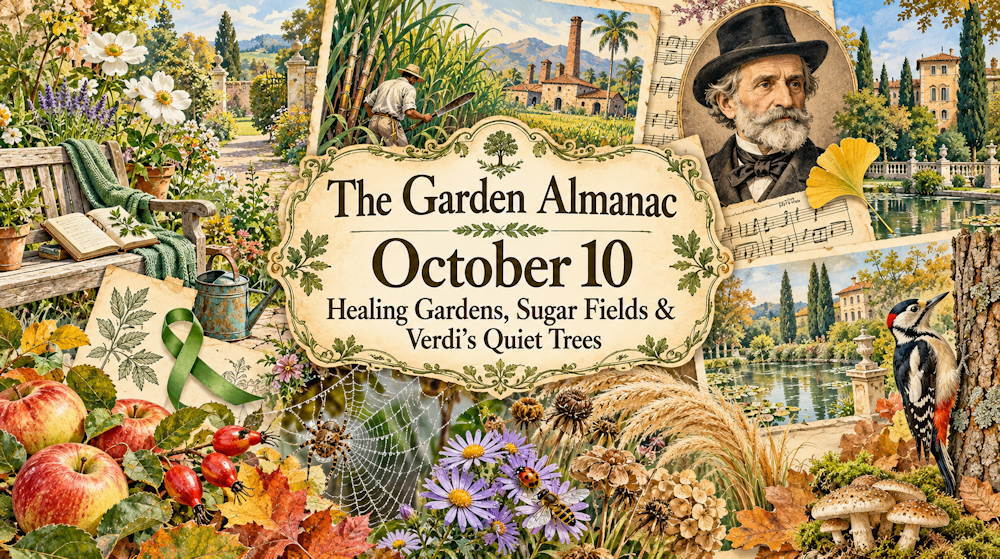
This is a date that opens three very different doors. One leads into the modern idea that green spaces can support mental health. Another leads to a Cuban sugar estate where landscape, labor and freedom became inseparable. A third leads to an Italian composer who understood that a country house, a park and a working farm could be part of a creative life.
October 10, 1992 – When Mental Health Found a Place in the Garden
World Mental Health Day was first observed on October 10, 1992, and its subject may seem, at first glance, far from pruning, compost or autumn planting. Yet few modern ideas have brought gardens closer to everyday life than the recognition that mental wellbeing is shaped not only by medicine and private resilience, but also by surroundings, routine, contact and care.
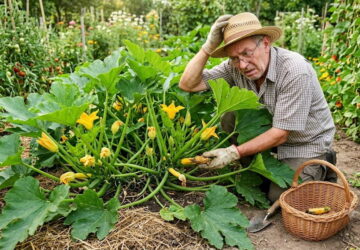
The garden’s role in this story is practical before it is poetic. A person tending plants is not only “relaxing” in a vague way. They are handling texture, reading weather, noticing change, making small decisions and returning regularly to a living place that does not hurry at human speed. Sowing, watering, mulching and harvesting all create rhythm – and rhythm is one of the quiet foundations of steadiness.
There is also a useful reversal here. Modern life often treats nature as scenery, something to visit when time allows. A garden refuses that distance. It asks for attention in small, repeated acts: checking whether the soil is dry beneath the surface, cutting back a spent stem, leaving seedheads for birds, seeing which plants cope with wind or shade. For today’s gardener, this makes October a good month not only for tidying, but for noticing which parts of the garden genuinely restore attention rather than merely look finished.
Garden Science – Why Do Green Spaces Help Us Feel More Grounded?
A garden gives the mind what researchers often call “soft fascination”: enough movement, scent, pattern and change to hold attention gently, without demanding constant effort. This is one reason even simple garden tasks can feel mentally settling.
- Repetitive tasks such as raking leaves, watering pots or sorting seeds can reduce mental overload.
- Natural patterns – branching stems, ripples on water, leaf veins – give the eye something ordered but not rigid.
- Seasonal change helps people mark time through visible, living signs rather than only through calendars and screens.
- A small, cared-for space can create a feeling of agency when larger events feel unmanageable.
Garden Reminder – Make Your October Garden Easier on the Mind
October jobs are useful, but they do not all need to be done at once. A calmer autumn garden often comes from choosing the right few tasks.
- Clear paths and steps first, especially where wet leaves may become slippery.
- Leave some seedheads standing for birds and winter structure.
- Move tender container plants before the first hard cold, but avoid crowding them into dark corners.
- Plant spring bulbs in groups rather than single scattered bulbs for a stronger display.
- Keep one small “observe, not tidy” corner where fallen leaves, stems and insects can continue their seasonal work.
October 10, 1868 – The Sugar Estate Where a Landscape Became Political
On October 10, 1868, Carlos Manuel de Céspedes issued the Cry of Yara at La Demajagua, his sugar plantation in eastern Cuba, beginning the Ten Years’ War. The setting matters. This was not an abstract declaration made in a neutral hall, but a call that rose from a plantation landscape shaped by sugarcane, mills, forced labor, export markets and colonial power.
Sugarcane is one of the world’s great agricultural forces: lush, tall, sun-hungry and capable of transforming whole regions into production landscapes. In the Caribbean, its beauty cannot be separated from its history. Fields that may look green and abundant from a distance also carried stories of exhaustion, inequality and ecological simplification. The surprising force of October 10 is that a cultivated field became the stage for questioning the system that had organized both land and people.
For gardeners, this is not a reason to distrust cultivation. It is a reason to look more carefully at what cultivation means. A garden, orchard or field always expresses choices: diversity or uniformity, extraction or renewal, shelter or exposure. Even on a small scale, mixed planting, soil cover, composting, water-wise design and habitat edges are not decorative extras. They are ways of refusing the old idea that land is valuable only when it is made to produce one thing as efficiently as possible.
What to Observe Right Now – October as a Landscape Teacher
October is one of the best months for seeing how a garden’s structure really works. Flowers may still be present, but the underlying design begins to show.
- Where does water linger after rain, and where does soil dry too quickly?
- Which beds still hold pollinators on mild afternoons?
- Which shrubs give berries, shelter or seed just as insects and birds need autumn food?
- Where has bare soil appeared, and could leaves, mulch or groundcover protect it through winter?
- Which plant combinations still look alive after summer’s peak has passed?
October 10, 1813 – Verdi’s Music, His Farm and the Park at Sant’Agata
Giuseppe Verdi, born on October 10, 1813, is remembered above all for opera, but his mature life was also rooted in land. At Sant’Agata, near Busseto, he shaped a country estate with a house, a romantic park, water, trees, paths and working farmland. The picture is more interesting than the familiar image of the solitary genius at a desk: Verdi was also a landowner who paid close attention to fields, livestock, plantings and the practical life of the countryside.
The park around Villa Verdi carried the taste of the nineteenth century: winding paths, ornamental trees, water features, shade, surprise and carefully staged naturalness. Yet it was not only theatre. Mature plane trees, oaks, magnolias, cypresses, ginkgo, roses and waterside plantings created a living structure that changed with season and age. A romantic garden succeeds when it feels effortless, but its ease is usually the result of long patience and repeated decisions.
That is a useful thought for autumn gardeners. The most convincing gardens are rarely made by adding more and more decoration. They are made by giving plants room to mature, choosing trees for their future size, understanding moisture and shade, and allowing some parts of the garden to deepen over time. October is an excellent month to think like a long-term gardener: before planting a tree, imagine not only next spring’s leaves, but its shadow in twenty years.
Wildlife Note – Why Mature Trees Matter More Than Perfect Tidiness
Old trees are not only large plants. They are layered habitats. Their bark, cavities, deadwood, leaf litter and root zones can support fungi, insects, birds and small mammals.
In an autumn garden, it is worth keeping mature trees healthy rather than making the ground beneath them too neat. Avoid deep digging around roots, leave some leaf litter where it will not smother delicate plants, and do not remove deadwood unless it is unsafe. A garden with older trees often has a richer winter life than a spotless one.
Looking Ahead
October 10 reminds us that gardens are never only private spaces. They can steady the mind, reveal the consequences of how land is used, and carry the long memory of people who planted for a future they would only partly see. The practical invitation is simple: make the autumn garden more observant, more diverse and a little less hurried. A path cleared for safety, a tree planted with its mature shape in mind, a corner left for wildlife – these are small acts, but they change the character of a place. And sometimes, that is where larger forms of care begin.