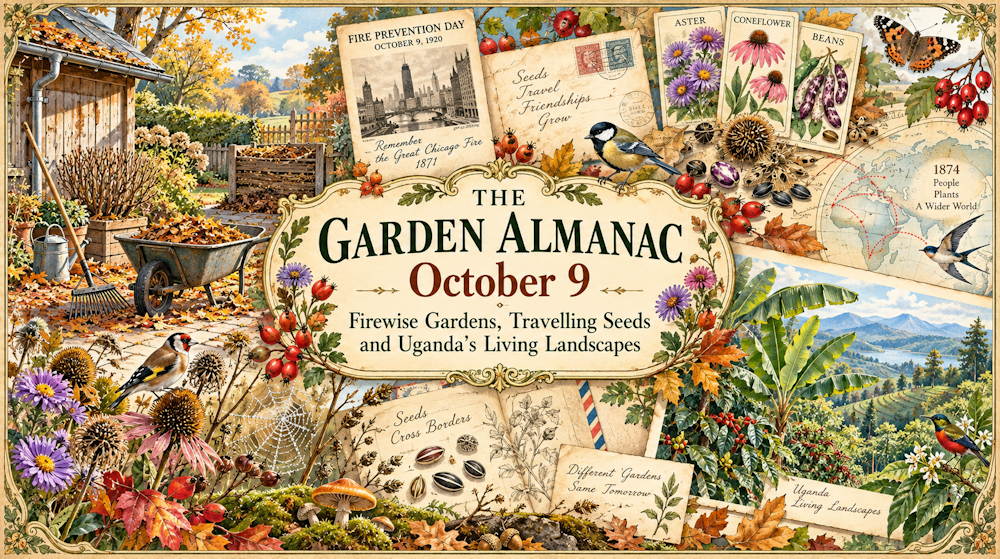

By October 9, the garden has usually entered its most revealing season. Leaves are no longer just decoration; they are mulch, wildlife shelter, fire fuel, compost material and a record of what the year has asked from the soil.
This date opens three very different doors: a city changed by fire, a world connected by post, and a country whose independence story is inseparable from fertile landscapes, food crops and biodiversity. Together, they remind us that gardens are never sealed off from history. They sit inside weather, transport, memory, risk and renewal.
October 9, 1920 – When Fire Prevention Became a Public Lesson
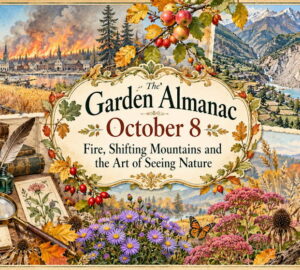
On October 9, 1920, the first presidential proclamation of Fire Prevention Day was issued in the United States. The date looked back to the Great Chicago Fire of 1871, which began on October 8 but did much of its worst damage on October 9. It was not only a city disaster. It was also a lesson in fuel, wind, drought, building materials and the danger of assuming that familiar surroundings are automatically safe.
The surprising detail is that Chicago was not alone. Around the same time, the Peshtigo Fire in Wisconsin became one of the deadliest wildfire disasters in recorded history. One fire became famous; the other, in a more rural landscape, was remembered differently. For gardeners, that contrast still matters. Fire risk is not only an urban problem or a forest problem. It can gather quietly wherever dry plant material, wind, heat and human carelessness meet.
A garden can either slow fire or feed it. Dry leaves packed against walls, unpruned shrubs touching fences, resinous conifers planted too close to buildings and old timber stored beside sheds all increase risk. In autumn, the practical question is not whether a garden should be tidy or wild, but where it should be tidy and where it can safely remain loose, leafy and wildlife-friendly.
A firewise autumn garden does not need to become bare. It needs zones of thoughtfulness: clear gutters, composted leaf piles kept away from structures, watered and healthy planting near the house, and less flammable groundcover in the most exposed spots. October 9 is a useful reminder that good gardening is not only about growth. Sometimes it is about spacing, pruning and reducing the wrong kind of abundance.
Garden Reminder – What Should You Clear Before Winter?
- Remove dry leaves from gutters, drains, wooden steps and shed roofs.
- Keep firewood, dry brush and old plant debris away from house walls.
- Prune shrubs that touch fences, windows or outbuildings.
- Compost leaves in a defined heap instead of letting them collect in risky corners.
- Leave some leaf litter under hedges and trees for wildlife, but keep it away from structures.
Garden Science – Why Dry Leaves Can Burn So Quickly
A dry leaf is light, thin and full of air spaces. Once its moisture content drops, it heats rapidly and can ignite far more easily than a dense green stem.
Wind makes the risk worse because it supplies oxygen and moves embers. That is why autumn garden care should treat dry leaves differently depending on location: under a hedge they can protect insects and soil life, but against timber, near vents or beside a shed they become a hazard.
October 9, 1874 – The Postal Treaty That Helped Seeds Travel
On October 9, 1874, the Treaty of Bern created the General Postal Union, later renamed the Universal Postal Union. Before that, international mail was slowed by a confusing patchwork of separate agreements, rates and rules. The treaty made letters easier to send across borders – and with them travelled catalogues, plant descriptions, seed lists, gardening advice and the ordinary correspondence of growers.
For gardeners, the hidden importance of postal history is not romantic nostalgia. It changed access. Seeds, bulbs and written knowledge could move more predictably between countries, nurseries, botanic gardens and home gardeners. A rare plant was no longer only something seen by travellers or collectors; it could become a printed offer, a packet in an envelope, a trial in someone’s soil.
That freedom also carried responsibility. Moving plant material can spread invasive species, pests and diseases as well as beauty and diversity. Modern gardeners inherit both sides of the story: the delight of seed exchange and the need for care. Saving local seed, choosing reputable suppliers, respecting import rules and avoiding invasive plants are all part of the same long history that once made the postal world feel suddenly smaller.
What to Observe Right Now – Seeds Worth Noticing in October
- Seed heads of asters, coneflowers and ornamental grasses feeding small birds.
- Self-sown seedlings appearing where summer flowers dropped seed.
- Rose hips, hawthorn berries and crab apples changing colour.
- Beans, peas or annual flower seeds drying for storage.
- Which plants have seeded too freely and may need controlling next year.
Wildlife Note – Leave Some Seed Heads Standing
Not every faded flower needs to be cut down in October. Seed heads can feed finches and other small birds, while hollow stems may shelter overwintering insects.
A good rule is selective tidiness: clear diseased foliage and unsafe clutter, but leave sturdy, healthy stems in quieter parts of the garden. The result is a garden that looks seasonal rather than abandoned – and one that still has food and shelter to offer.
October 9, 1962 – Uganda’s Independence and the Garden Logic of Diversity
Uganda gained independence on October 9, 1962. From a garden almanac point of view, the date invites us to look not only at flags and politics, but at a country often described through its fertile highlands, lakes, wetlands, forests and food crops. The independence story belongs to people, of course, but it also unfolded in a landscape where agriculture and biodiversity have always been deeply intertwined.
One of the most interesting lessons comes from the banana–coffee farming systems found in parts of Uganda. These are not simply two crops sharing space. Bananas can shade coffee, help keep soil cooler and moister, and add organic material through leaves and plant residues. In a small garden, the same principle appears when taller plants shelter more delicate ones, when mulch protects soil life, or when a mixed planting proves more resilient than a single exposed crop.
The wider recognition is that productivity and biodiversity do not always have to be enemies. A well-managed mixed system can support food, income, shade, soil organisms, pollinators and better water behaviour at the same time. That does not make land-use choices simple, especially where forests and wetlands are under pressure, but it does challenge the idea that cultivation must always mean simplification.
For today’s gardener, Uganda’s October 9 story can be read at a very practical scale. A vegetable bed with flowers for pollinators, a fruit tree underplanted with herbs, a hedge that shelters crops and birds, a compost-fed soil that holds moisture longer – these are small versions of a larger ecological truth. Diversity is not decoration. It is structure, insurance and life support.
Seasonal Tips – How to Build More Resilience Into an Autumn Garden
- Plant trees, shrubs and perennials while soil is still workable and moisture is returning.
- Use leaf mould or compost to improve soil structure before winter.
- Mix flowering plants, herbs and edibles instead of isolating every crop.
- Add wind protection for exposed beds before storms become frequent.
- Keep some late flowers for pollinators on mild autumn days.
Looking Ahead
October 9 does not offer one neat lesson, and that is its strength. Fire prevention asks us to notice risk before it becomes crisis. Postal history reminds us that seeds and ideas travel, but that movement needs responsibility. Uganda’s living landscapes show how much wisdom can sit inside mixed, layered, biodiverse growing systems.
For a gardener, the future begins in these practical choices: what to clear, what to save, what to share and what to plant together. A garden that learns from history becomes more than a pleasant space. It becomes a small, working answer to a changing world.