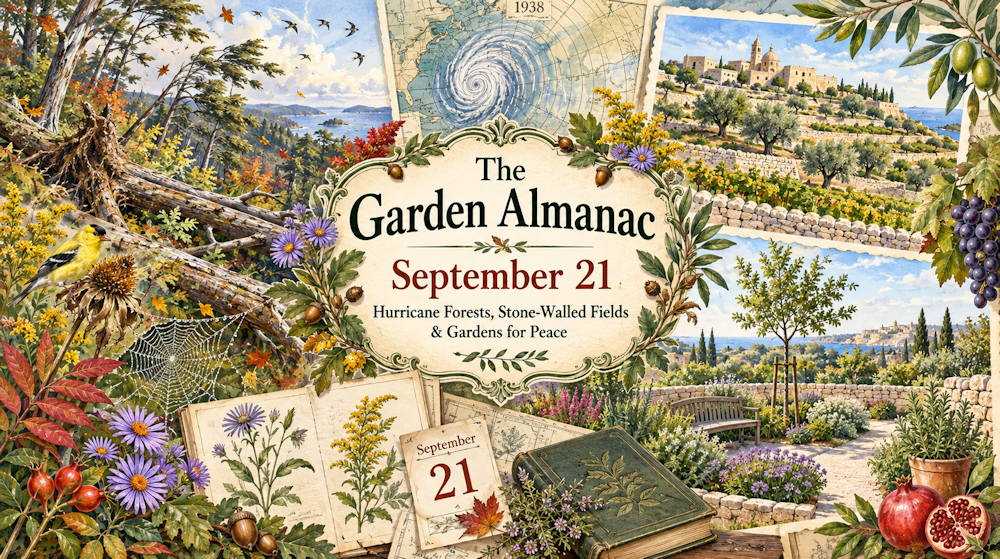

September 21 stands at one of the year’s great turning points. Across the temperate Northern Hemisphere, daylight is approaching its autumn balance, leaves are beginning to reveal hidden colours and gardens are quietly shifting energy from flowers and fruit towards roots, seeds and winter survival. South of the equator, the same light signals spring and a fresh surge of growth.
The date also opens three very different doors into the relationship between people and the living landscape. A hurricane redrew the forests of New England, a Mediterranean island celebrated independence in fields patiently held together by stone, and a global day of peace invited communities to imagine what careful cultivation might mean beyond the garden gate.
September 21, 1938 – The Hurricane That Redrew a Forest
On September 21, 1938, a fast-moving hurricane struck Long Island and southern New England with little effective warning. The storm, later known as the Great New England Hurricane or the Long Island Express, raced northwards and caused more than 600 direct deaths. Coastal settlements were devastated, while powerful winds brought down trees across a vast part of the region.
The destruction did not end when the wind dropped. Fallen timber altered light, moisture and temperature at ground level, created a major fire risk and opened enormous gaps in woodland canopies. Yet those gaps also became places of renewal. Seedlings, shrubs and sun-loving plants responded to the sudden light, while surviving trees and undamaged patches became the framework from which the forest rebuilt itself.
The storm’s long ecological afterlife helped scientists understand that a forest is not a fixed collection of mature trees. It is a changing mosaic shaped by wind, fire, pests, grazing and human use. Disturbance can be catastrophic for people and individual organisms, but varied habitats, mixed ages and biological diversity give the wider ecosystem more ways to recover.
A garden cannot be made storm-proof, but it can be made less brittle. Avoid relying on a single tree species, especially in exposed sites; give trees enough uncompacted rooting space; remove weak, crossing or damaged branches while they are still manageable; and check that newly planted trees are tied securely without being strangled by their supports. After severe wind, inspect from the ground first and leave split limbs, hanging branches and work near power lines to qualified professionals.
Garden Science – Why does diversity improve resilience?
Plants do not all respond to stress in the same way. Differences in rooting depth, crown shape, growth rate, flowering time and tolerance of drought or waterlogging mean that one weather event is less likely to damage every species equally. In a mixed planting, surviving plants can continue to shelter soil, feed wildlife and support recovery even when others struggle.
September 21, 1964 – Malta’s Independence in a Landscape Built to Hold Soil
Malta gained independence from the United Kingdom on September 21, 1964. The national anniversary belongs to modern political history, but the countryside surrounding its towns tells a much older story of adaptation. On these dry, limestone islands, farmers have long worked with shallow soils, steep slopes, intense sun and limited freshwater.
One of the landscape’s defining features is the network of terraced fields supported by traditional dry-stone rubble walls. Built without mortar, the walls slow runoff, retain precious soil and make cultivation possible on sloping ground. Their joints also offer niches for lichens, small plants and invertebrates. What looks like a boundary is therefore also a drainage system, erosion control, habitat and a store of practical knowledge.
The lesson travels well beyond the Mediterranean. On any slope, water should be slowed and spread rather than allowed to rush away carrying topsoil with it. Contour planting, low terraces, swales where suitable, ground-cover plants and a permanent organic mulch can all reduce erosion. In dry gardens, improve soil with organic matter, group plants by water need and water deeply but less often so moisture reaches the root zone instead of disappearing from the surface.
Seasonal Tips – What should gardeners do around September 21?
In temperate Northern Hemisphere gardens:
- Plant daffodils, crocuses and hyacinths while the soil is still workable; tulips are often best planted later in autumn.
- Divide congested clumps of hardy perennials when the soil is moist, then water them thoroughly.
- Keep watering recently planted trees and shrubs during dry spells – cooler air does not automatically mean moist soil.
- Check stakes, ties, trellises and loose containers before autumn winds strengthen.
- Leave healthy seedheads and stems standing, but remove diseased foliage rather than adding it to a cool home compost heap.
September 21 – When Peace Becomes a Place You Can Grow
The United Nations established the International Day of Peace in 1981, and in 2001 fixed its annual observance on September 21 as a day of non-violence and ceasefire. Its purpose is global, but its meaning is often expressed locally – through schools, neighbourhood gatherings, memorial trees and shared green spaces.
Gardens have long provided places where remembrance, food, beauty and community can occupy the same ground. A community plot requires agreement about water, paths, harvests and responsibility. It does not erase differences, but it creates a practical reason to work across them. In that sense, tending shared soil is not merely a symbol of cooperation – it is repeated practice in cooperation.
A “peace garden” need not be formal or grand. It might begin with one climate-suitable tree, a bench and a pollinator border, or with herbs and vegetables grown for a community kitchen. Choose plants that can thrive without excessive inputs, include species flowering at different times, provide accessible paths and agree who will water during the establishment period. Good intentions endure more readily when they are supported by a realistic maintenance plan.
Wildlife Note – What needs the late September garden?
Late-flowering plants such as asters, sedums and locally native daisies can provide nectar when many summer flowers are fading.
Ripening berries and insects help migratory and resident birds build reserves for colder weather or long journeys.
Standing stems, seedheads and fallen leaves offer food or shelter to birds, solitary bees and other invertebrates.
A shallow, regularly cleaned water source remains valuable in dry autumn weather as well as in summer.
Garden Science – Why are some leaves changing colour already?
As days shorten, many deciduous trees reduce chlorophyll production and begin withdrawing useful nutrients from their leaves. With the dominant green pigment fading, yellow and orange pigments that were present all along become visible; red pigments may be produced in some species under suitable conditions. Temperature and moisture influence the display, but day length is the dependable seasonal signal.
Very early colour can also indicate stress rather than an early autumn. A tree affected by drought, root damage or disease may begin shutting down leaves ahead of its neighbours. Compare plants of the same species nearby, check the soil below the surface and look for dieback or damaged bark before assuming the colour is purely seasonal.
What to Observe Right Now
Take a slow circuit of the garden and look for transitions rather than tasks:
- Which tree colours first – and is the change even across the crown?
- Where does dew reveal webs that were invisible the day before?
- lowers still attract bees during the warmest hour of the afternoon?
- Are birds feeding on berries, seeds or insects before moving on?
- After rain, where does water soak in, collect or run away with soil?
These small observations create a useful record. Repeated from year to year, they can reveal changing flowering times, persistent dry spots, wind exposure and the plants that offer the greatest value to wildlife at the edge of the season.
Looking Ahead
September 21 reminds us that landscapes survive through adaptation, memory and shared care. A storm-resilient planting, a wall that holds soil, or a community bed that brings neighbours together may seem modest, yet each strengthens the living systems around it. This autumn, choose one practical act that will outlast the season – plant for diversity, protect bare soil, conserve water or make room for wildlife. The future of a garden is built through such small decisions, repeated with patience.