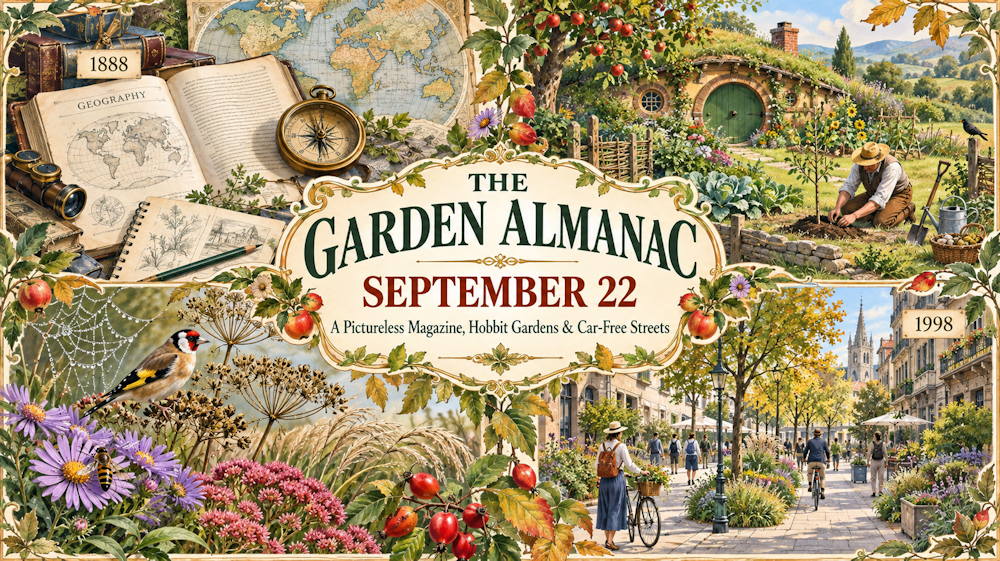

September 22 stands at one of the year’s great turning points. Near the equinox, daylight and darkness approach a temporary balance, autumn gathers momentum across the Northern Hemisphere, and spring begins to quicken in the south. In the garden, this is less a single dramatic change than a hundred quiet signals – a later sunrise, cooler soil, ripening seed and the first tree that no longer looks entirely green.
The date also opens several unexpected doors. It marks the beginning of a magazine that taught millions to look closely at the planet, a literary celebration rooted in gardens and trees, and a modern experiment in giving city streets back to people. Together, they ask a useful question for every gardener: what becomes visible when we slow down and pay attention to place?
September 22, 1888 – The Pictureless Beginning of National Geographic
The first issue of National Geographic appeared on September 22, 1888, only months after the National Geographic Society was founded in Washington, D.C. It looked nothing like the richly photographed magazine later recognised around the world. The early publication was sober, text-heavy and intended largely for a small circle interested in geography, mapping, exploration and the scientific description of landscapes.
Its lasting importance was not simply that it carried readers to distant places. It helped popularise a habit of looking at land as a connected system – shaped by water, climate, geology, plants, animals and people. That same habit sits at the heart of good gardening. A border is never just a row of plants: it is also a pattern of sunlight, drainage, shelter, soil life and seasonal change.
The gardener’s version of field geography begins close to home. Sketch where shadows fall in September, note where rain collects, mark the warm wall beside which fruit ripens first, and photograph the same view at regular intervals. A single observation can mislead, but a record kept through the seasons reveals frost pockets, dry zones and flowering patterns that memory alone tends to blur.
This is also the foundation of phenology – the study of recurring natural events such as budburst, flowering, migration and leaf fall. Recording the first ripe apple or the first autumn colour may feel modest, yet repeated observations can guide next year’s planting and add useful detail to wider citizen-science projects. The great lesson of that unillustrated first magazine is still fresh: before we can care intelligently for a landscape, we need to learn how to see it.
Garden Science – Do plants notice the equinox?
Plants do not consult the calendar, but many measure the changing length of day and night through light-sensitive pigments. In temperate regions, shorter days help trigger processes including dormancy, leaf senescence and the formation of winter buds, while temperature and soil moisture modify the response.
Autumn colour is part of nutrient recovery, not simply decline. As chlorophyll breaks down, deciduous plants move valuable compounds from leaves into stems and roots, revealing yellow and orange pigments that were present all along. This is one reason not to push hardy trees and shrubs with high-nitrogen fertiliser late in the season – soft new growth may have too little time to mature before cold weather.
September 22, 1978 – Hobbit Day and the Garden at the Heart of a Story
September 22 is the shared birthday of Bilbo and Frodo Baggins, and in 1978 the American Tolkien Society formalised the date as Hobbit Day. The celebration may belong to an imagined calendar, but its landscape feels remarkably familiar: hedges, lanes, orchards, kitchen gardens, old trees and fields managed on a human scale. The Shire is memorable not because it is untouched wilderness, but because home, food production and nature appear woven together.
Plants and trees carry real moral weight in Tolkien’s world. Industrial destruction is shown not only through smoke and machinery but through damaged soil, felled trees and the loss of local character. Restoration, by contrast, comes through patient acts of replanting and tending. Sam Gamgee’s identity as a gardener matters because gardening represents practical hope – the work of making a wounded place fertile again.
A modern garden can borrow this principle without trying to become a fantasy film set. Keep a fruit tree if space allows, use mixed hedging rather than a single clipped species, grow herbs near the door and let paths invite daily observation. Most importantly, treat mature trees, healthy soil and established habitat as assets that cannot be instantly replaced. A garden feels deeply rooted when useful plants, wildlife shelter and human pleasure occupy the same ground.
Wildlife Note – What should remain standing in an autumn garden?
A completely cleared garden offers fewer winter refuges than one tidied selectively. Where plants are healthy and not spreading serious disease:
- leave some hollow stems for overwintering insects;
- keep seed heads for birds and visual structure;
- rake a loose layer of leaves beneath hedges and shrubs;
- retain one quiet, undisturbed corner with twigs or dead wood;
- clean diseased material away separately rather than adding it to habitat piles.
September 22, 1998 – When City Streets Became Gardens in Waiting
On September 22, 1998, dozens of French towns took part in a coordinated day without cars. The idea expanded across Europe and, by 2000, September 22 had become the focus of a much wider car-free movement. Different cities have interpreted it differently – closing a central street, promoting walking and cycling, or simply inviting residents to experience how an urban neighbourhood changes when engines briefly fall quiet.
For gardeners, the most interesting result is not traffic policy itself but the question of land. Roads and parking occupy immense areas of hard surface, shed rain rapidly and divide habitats. When even a small share of that space becomes a tree pit, planted verge, rain garden or pocket park, it can slow stormwater, shade paving, cool the air and create stepping stones for insects and birds.
The domestic garden belongs to the same urban network. Avoid compacting soil around street and garden trees, replace unnecessary paving with permeable surfaces, and connect isolated planting with shrubs, climbers or flower-rich containers. Where local rules and drainage conditions allow, a shallow rain garden can receive runoff from a roof or path and let it soak gradually into planted soil. One garden cannot redesign a city, but many small green links can make the wider landscape more permeable to both water and wildlife.
Garden Reminder – Useful jobs around the September equinox
Adjust these tasks to local weather rather than following the date rigidly.
- Collect ripe seed on a dry day and label it with the plant name and year.
- Plant spring-flowering bulbs in well-drained soil in temperate Northern Hemisphere gardens.
- Divide established perennials only when the soil is moist and extreme heat has passed.
- Keep newly planted trees and evergreens watered during dry autumn weather – cooler air does not always mean moist soil.
- Remove diseased foliage, but compost healthy material or use it as habitat and mulch where appropriate.
In temperate Southern Hemisphere gardens, prepare for active spring growth, sow frost-tender crops only when local frost risk has passed, and provide flowers for emerging pollinators.
What to Observe Right Now – Read the Garden Like a Map
This week, choose one short route and walk it at the same time on several days. Repetition makes small changes easier to notice.
- Watch how far the midday shadow of a tree or fence now reaches.
- Look for the first colour change inside the crown, not only at its outer edge.
- Notice which late flowers still attract bees, hoverflies or butterflies in mild weather.
- Listen for changes in bird activity and watch for feeding flocks or seasonal movement.
- Compare dry and damp corners after rain – the pattern may suggest where future planting will thrive.
Looking Ahead
September 22 reminds us that landscapes change first in the details: a recorded observation, a replanted tree or a street briefly imagined without traffic. Gardeners are especially well placed to turn such details into long-term improvement because they revisit the same ground through every season. Map what you notice, protect what already works and make one practical change that gives soil, water or wildlife more room. The future of a greener landscape is built in exactly this way – place by place, and season by season.