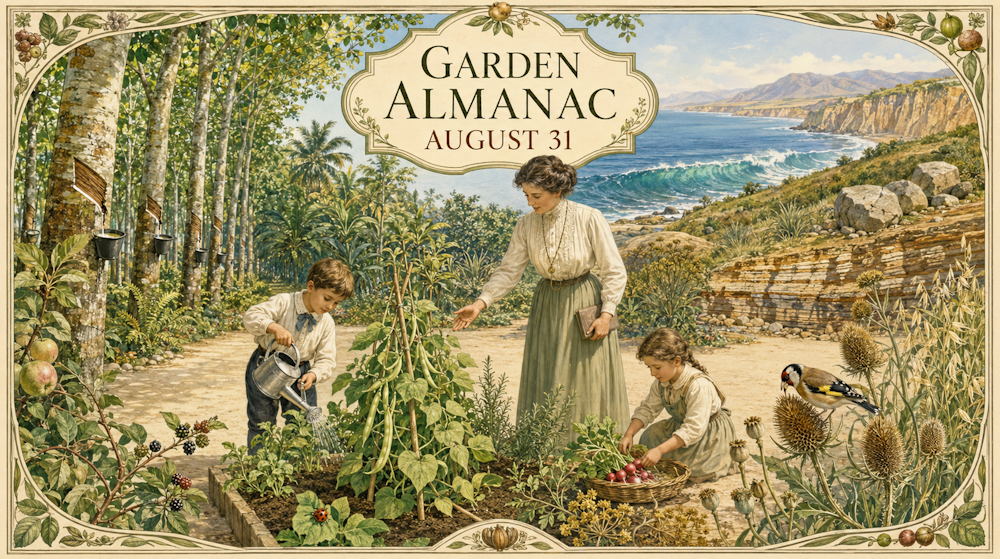

August 31 stands at a seasonal threshold. In northern gardens, summer is beginning to loosen its grip, seed heads are replacing flowers and the first cooler nights carry a hint of autumn. South of the equator, meanwhile, spring is gathering momentum beneath swelling buds and lengthening days.
The date also opens three unusually different windows onto the living world: Maria Montessori’s belief that children should learn by caring for real plants, the plantation landscapes inherited by an independent Malaya and the traces of a vast Pacific tsunami preserved for centuries in rocks, wetlands and coastal sediments. Together, they remind us that gardens are not separate from history. They are places where education, economics and natural forces all leave visible marks.
August 31, 1870 – Maria Montessori and the Garden at a Child’s Scale
Maria Montessori was born in Chiaravalle, Italy, on August 31, 1870. Trained as a physician, she developed an educational approach based on close observation, purposeful activity and the idea that children learn through direct engagement with their surroundings. Her classrooms became carefully prepared environments in which objects were accessible, work had a clear purpose and independence could grow through practice.
Nature was not merely decoration within this approach. Montessori argued that children needed meaningful contact with living things and suggested gardens in which they could sow, water, weed and harvest. Vegetables mattered alongside flowers because a crop made the connection between care and consequence unmistakable. A forgotten watering could leave a plant wilted, while steady attention might eventually produce something that could be eaten.
This remains one of the garden’s greatest educational strengths. A seed does not germinate faster because a child is impatient, and a caterpillar cannot be hurried through metamorphosis. Gardening makes time, dependency and responsibility visible in ways that abstract explanations rarely can. It also allows mistakes to become observations rather than failures: too much water, too little light or crowded seedlings all produce evidence from which to learn.
A child-friendly garden does not need to be large. A low container, a narrow raised bed or several clearly labelled pots can provide enough space for radishes, peas, strawberries, herbs and quick-growing flowers. Use child-sized tools, provide a reachable water source and give children genuine tasks rather than invented ones. The aim is not a flawless display but a place where they can recognise individual plants, notice change and contribute to the garden’s daily life.
Garden Inspiration – How can children take real responsibility in the garden?
- Give each child one pot or short row to observe and tend.
- Choose large, easy-to-handle seeds such as peas, beans, nasturtiums or sunflowers.
- Include something edible so that care leads naturally to harvest.
- Keep a simple record of germination, flowering, visiting insects and yield.
- Allow a few plants to complete their life cycle and form seed.
August 31, 1957 – Malaya’s Independence and the Landscape of Rubber
On August 31, 1957, the Federation of Malaya gained independence from Britain. The new nation inherited an economy and a landscape profoundly shaped by tropical commodities, especially natural rubber. Rubber trees native to the Amazon had been transported across the world, studied in colonial botanical networks and established on Southeast Asian plantations. By the twentieth century, long ranks of Hevea brasiliensis had become a defining feature of the Malayan countryside.
Those plantations demonstrate how dramatically a useful plant can alter land use. Rubber generated income and supported communities, but the expansion of a single commercial species also simplified habitats that had once held extraordinarily diverse tropical forests. In later decades, oil palm became another dominant crop. Malaysia’s experience therefore belongs to a much wider story about the tension between productive landscapes, rural livelihoods and biodiversity.
A garden may be tiny beside a plantation, yet the ecological principle is the same: diversity creates resilience. Beds containing only one species offer pests and diseases an uninterrupted food supply, while mixed planting provides different root depths, flowering periods and forms of shelter. Structural variety matters too. Trees, shrubs, herbaceous plants, ground cover and undisturbed organic matter create more niches than a flat planting of identical specimens.
The practical lesson is not that every garden must contain as many species as possible. It is to avoid unnecessary uniformity. Where space allows, combine plants from different families, stagger flowering times and retain several layers of vegetation. Even a small garden becomes more robust when no single plant carries the entire burden of food, shade, colour or wildlife support.
Garden Science – Why are monocultures more vulnerable?
Closely spaced plants of the same species share similar nutritional needs and are often susceptible to the same pathogens and insects. Once a specialist pest finds a suitable host, it can move easily from plant to plant. Greater botanical and structural diversity does not prevent every outbreak, but it can interrupt this continuity, support natural predators and reduce the chance that one problem will damage the whole planting.
August 31, 1420 – The Pacific Tsunami Preserved in Rocks and Wetlands
In the early hours of August 31, 1420, a huge earthquake struck the coast of what is now northern Chile. Modern research places its likely magnitude between 8.8 and 9.4. The resulting tsunami crossed the Pacific, reaching Hawaii and Japan, where accounts described the sea behaving strangely on September 1 even though no local earthquake had been felt.
For centuries, much of the event’s story remained unwritten. Scientists reconstructed it by reading the landscape: enormous coastal boulders carried inland, marine deposits left above their normal reach and disturbed layers preserved in wetlands. These natural archives show how soil and sediment can hold evidence long after human memory has faded. A wetland, in this sense, is not empty ground awaiting development but a living record of floods, storms, vegetation and changing shorelines.
The connection to gardening becomes especially clear wherever coastal land is exposed to saltwater flooding. Salt around roots makes it harder for plants to absorb water, even when the soil appears wet, and sodium can damage soil structure. After minor coastal inundation, gardeners should remove deposited debris, avoid adding fertiliser immediately and have the soil tested before replanting. Where drainage and freshwater supplies permit, salts may gradually be washed below the root zone, but badly affected ground can require professional assessment and repeated testing.
This ancient tsunami also offers a broader lesson in observation. A sudden retreat of the sea is a natural warning to move inland and to higher ground immediately, never an invitation to explore the exposed shore. Gardens in hazard-prone regions can support resilience through permeable surfaces, deep-rooted vegetation and protected drainage routes, but planting cannot substitute for evacuation planning or official safety guidance.
Wildlife Note – Why Leave Some Late-Summer Seed Heads Standing?
By the end of August, many fading flowers are becoming miniature food stores. Goldfinches and other seed-eating birds investigate plants such as teasel, sunflower, thistle and coneflower, while hollow or pithy stems may later shelter insects.
Cut back diseased material, but consider leaving healthy seed heads in quieter parts of the garden. Their silhouettes add autumn and winter structure, their seeds feed wildlife and their stems can continue serving the garden long after flowering has ended.
Garden Reminder – What Should You Do in the Garden at the End of August?
Late August is better suited to selective care than wholesale tidying. The garden is still active, and many plants and animals depend on what may look like fading summer growth.
- Collect ripe seed only on a dry day and store it in labelled paper packets once thoroughly dry.
- Keep newly planted trees, shrubs and perennials watered during dry spells because their roots are not yet established.
- Remove rotting fruit from beneath trees, but retain sound fruit for eating, preserving or sharing.
- Deadhead plants if you want more flowers, while leaving selected heads to ripen for seed and wildlife.
- Divide congested perennials only when conditions are not excessively hot or dry.
- Stop feeding tender plants with high-nitrogen fertiliser where autumn is approaching, as soft new growth is vulnerable to cold.
- Check containers frequently because mature plants may still exhaust their water supply quickly.
What to Observe Right Now – Signs That the Season Is Turning
Watch for changes rather than relying entirely on the calendar. Seasonal transitions arrive at different speeds according to latitude, altitude, rainfall and the character of each garden.
Notice whether morning dew is lingering longer, spiders are rebuilding webs across paths and berries are beginning to colour in hedges. Look for the first ripe seeds falling from pods, shortening intervals between watering and flowering ivy beginning to attract late-season insects. In the Southern Hemisphere, reverse the seasonal lens and watch instead for sap rising, buds opening and overwintering insects returning to activity.
Looking Ahead
August 31 shows how attentively tended ground can teach responsibility, while commercially valuable plants can reshape entire nations and disturbed sediments can preserve warnings across six centuries. The future garden will need all three kinds of awareness: care for individual living things, understanding of the systems surrounding them and respect for forces larger than any one plot. By planting diversely, observing closely and allowing part of the garden to remain useful to wildlife, we create landscapes that are not only attractive but better prepared for change.