
Late August is a curious moment in the garden. Summer is still generous, but its character is changing. The light begins to soften, some plants are setting seed, fruit is ripening on branches, and the first signs of autumn can appear almost unnoticed among the green. August 28 sits close to that seasonal threshold – a date when the garden is still in full production, yet already beginning to prepare for what comes next.
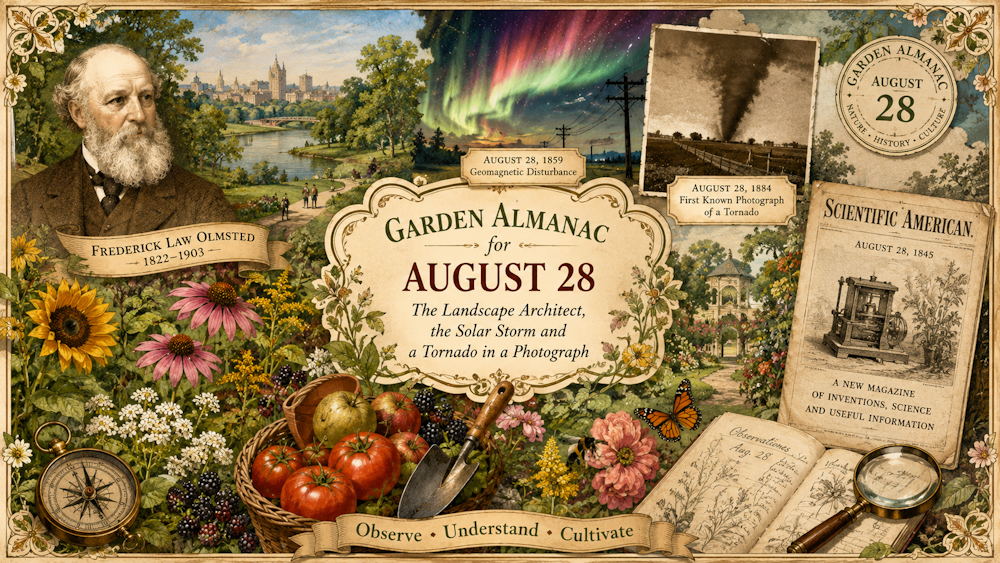
The history attached to this particular day offers an unexpectedly good way to look at that transition. August 28 marks the death of Frederick Law Olmsted, one of the most influential landscape designers of the nineteenth century. It also recalls the beginning of a remarkable sequence of solar and geomagnetic disturbances in 1859, an early example of how events far beyond the garden can affect life on Earth. On August 28, 1884, one of the earliest known photographs of a tornado was made, turning a fleeting atmospheric event into something that could be studied long after the storm had passed. And in 1845, the first issue of Scientific American appeared, helping establish a tradition of making scientific discovery accessible to a broad readership.
Together, these stories suggest a particularly useful late-summer idea: a garden is not simply a collection of plants. It is a designed landscape, a small ecological system, and a place where weather, science, observation and human culture all meet.
August 28, 1903 – The Landscape Architect Who Designed With Nature, Not Against It
Frederick Law Olmsted died on August 28, 1903, after a long career that helped establish landscape architecture as a profession in the United States. His best-known work includes New York’s Central Park, but his influence went far beyond a single famous park. He worked on public parks, residential landscapes, institutional grounds and large-scale park systems, and his approach placed considerable importance on existing topography, vegetation, water and the experience of moving through a landscape. The Library of Congress records his death on August 28 and traces the continuation of his work through the Olmsted firm after his death.
What makes Olmsted especially interesting to gardeners is that he did not treat landscape as a decorative surface. A successful landscape, in his view, could shape how people experienced a place. His designs often used curves, changes in elevation, woodland, open lawns and water to create a sequence of views rather than presenting everything at once. In Rochester, for example, his park planning followed the Genesee River and sought to preserve varied scenery rather than simply imposing a formal pattern on the land.
That principle remains surprisingly useful in a private garden.
A small garden does not need a grand avenue or a picturesque lake to benefit from landscape thinking. Before planting, look at what the site is already telling you. Where does rain collect? Which part receives morning rather than afternoon sun? Where does wind accelerate? Which trees already provide shade? Where are the natural paths through the garden?
Instead of correcting every irregularity, a gardener can sometimes make the existing conditions the starting point.
Garden Inspiration – Can a small garden borrow from Olmsted?
Think in terms of movement and sequence, rather than individual plants.
- Let a path curve slightly so that a planting is revealed gradually.
- Use a tree, shrub or hedge to frame a view instead of filling every open space.
- Keep naturally interesting landforms where possible rather than levelling everything.
- Treat shade, drainage and existing vegetation as design information, not obstacles.
- The result can be both more attractive and more resilient because plants are being matched more closely to the conditions already present.
Olmsted’s legacy also points toward an important modern principle: good landscape design does not necessarily mean controlling nature more intensively. Sometimes the better design is the one that works with the site’s existing character.
August 28, 1859 – When the Sun Reached Into the Garden
August 28, 1859, began a remarkable sequence of geomagnetic disturbances that continued into early September. NASA records two closely spaced major auroral episodes during the period, with the second associated with the famous solar flare observed by astronomers Richard Carrington and Richard Hodgson. NASA’s catalogue of auroral observations identifies August 28 as the beginning of the first major event, while the better-known Carrington Event followed several days later.
The later disturbance became famous because the resulting geomagnetic storm disrupted telegraph systems across much of the world. Auroras appeared at unusually low latitudes, while electrical equipment behaved in unexpected and sometimes dangerous ways. Historical records preserved by the British Geological Survey show the extraordinary scale of the magnetic disturbance in scientific observations from the period.
A solar storm might seem far removed from gardening, but it offers a useful reminder about the difference between weather and climate, and between local conditions and planetary systems.
A tomato plant does not care whether the gardener knows what is happening on the Sun. It does, however, respond continuously to radiation, temperature, water availability and atmospheric conditions. The garden sits inside a much larger physical system.
For today’s gardener, the practical lesson is not to worry about solar flares every time the leaves look tired. It is to become better at observing environmental conditions rather than treating every plant problem as a simple watering or feeding issue.
Garden Science – Why can plants wilt even when the soil looks damp?
Plant water status depends on more than the amount of water in the soil. Roots must be able to absorb it, and water must move continuously through the plant as it is lost through the leaves.
During hot, dry or windy weather, transpiration can become rapid. Container plants are especially vulnerable because their restricted root volume dries faster than surrounding garden soil. The RHS recommends checking soil moisture rather than relying on a fixed watering schedule, with particular attention to containers and newly planted specimens.
This is why deep, thorough watering during dry spells is generally more useful than repeatedly sprinkling the surface.
August 28 therefore makes a good date for looking upward as well as downward. The garden is local, but the forces acting on it are not.
August 28, 1884 – The Day a Tornado Became Something We Could Study
On August 28, 1884, a photograph was made of a tornado in South Dakota. NOAA records it as the oldest known tornado photograph, although the precise status of the image has been the subject of historical discussion. The photograph was taken approximately 22 miles southwest of Howard, South Dakota, by F. N. Robinson.
The significance of the image goes beyond its age. A tornado may exist for only a short time, yet a photograph can preserve evidence of its structure and behaviour for later examination. In that sense, the photograph represents a fundamental change in our relationship with nature: observation no longer had to depend entirely on memory or written description.
Gardeners do something similar every season.
A photograph of a plant on August 28 can reveal changes that are difficult to notice from day to day. A weekly picture of a tomato plant may show the gradual spread of disease. A series of photographs of a flowering border can reveal which plants provide nectar late in the season. Images of a tree after heavy rain can help identify recurring drainage problems.
The modern garden camera is therefore a surprisingly useful scientific instrument.
What to Observe Right Now
Late August is particularly good for noticing transitions rather than dramatic events.
- Which plants are still producing fresh flowers, and which have moved into seed production?
- Which areas of the garden dry out first after several hot days?
- Are bees and butterflies concentrated on a few late-blooming species?
- Which fruits are changing colour or becoming heavy enough to bend branches?
- Are leaves changing because of normal seasonal development, drought stress, pests or disease?
The value of observation is that it turns vague impressions into information. A gardener who notices that one border always dries first can change the planting plan next year. Someone who records flowering dates can gradually build a personal calendar for the garden.
That is the same basic habit that makes scientific observation useful: look carefully, record what you see, and compare it over time.
August 28, 1845 – When Scientific American Put Curiosity on Paper
On this date in 1845, the first issue of Scientific American was published. The inaugural issue appeared on Thursday, August 28, and described itself as a publication devoted to inventions, scientific principles, useful information and developments in the mechanical and other sciences. Its contents included subjects ranging from mechanics and telegraphy to chemistry and what the editors called a “Specimen of Vegetable Silk.”
That last detail is particularly appropriate for a garden magazine. The first issue was not simply about machines. It reflected a broader nineteenth-century enthusiasm for understanding how the natural and manufactured worlds worked.
For gardeners, that habit of curiosity is still one of the most useful tools available.
Why does a leaf curl? Why does one soil stay damp while another dries within hours? Why do some flowers attract dozens of insects while neighbouring plants receive almost none? Why does a plant flower earlier in one corner of the garden than another?
The answer is often more interesting than the solution.
And late August is an excellent time to ask such questions because the garden is full of visible evidence. Plants are responding to the accumulated conditions of the growing season, while insects are responding to the changing supply of flowers and fruit.
Wildlife Note – Why do late-summer flowers matter so much?
Late-summer nectar can be especially valuable to pollinators because the flowering season is beginning to narrow. The Xerces Society recommends providing a diversity of plants with different flowering periods so that pollinators have food resources throughout the growing season. Late-summer flowers can be particularly important for insects preparing for overwintering.
This is one reason not to make the late-August garden excessively tidy.
Leaving some seedheads standing can provide food and shelter for wildlife. Rudbeckias, sunflowers and other plants with bird-friendly seeds are examples where removing every spent flower is not necessarily desirable. The RHS specifically recommends leaving plants that produce useful seeds, fruits or ornamental seedheads rather than automatically deadheading everything.
A productive wildlife garden is not necessarily the garden that looks most immaculate on August 28. It may be the one where something is still feeding, nesting, ripening or setting seed.
Garden Reminder – What deserves attention on August 28?
Late August is a balancing act. There is still plenty to harvest and maintain, but autumn preparation is already beginning.
- Water deeply during dry spells, giving priority to containers, newly planted trees and shrubs, and plants showing genuine drought stress. Stored rainwater can be used where appropriate.
- Deadhead selectively. Remove spent flowers from plants such as roses, dahlias and penstemons when you want to prolong flowering, but leave seed-producing plants that benefit birds or that you want to collect seed from.
- Collect mature seed on dry days. Many hardy annuals and perennials can be harvested in late summer and stored for later sowing.
- Watch fruit and vegetables closely. Sweetcorn, early fruit and many late-summer crops can move rapidly from nearly ready to overripe.
- Begin thinking about autumn planting. In suitable climates, late August and September can be a good period for establishing perennials, provided new plants are kept adequately watered while they establish.
- Do not automatically rescue the lawn from every dry spell. Established turf can tolerate drought by becoming dormant, while trees, shrubs and valuable perennial plants may deserve a higher watering priority.
The key is discrimination. August gardening is not about doing more of everything. It is about deciding which plants need help, which plants need time, and which plants should simply be allowed to complete their seasonal cycle.
A Garden Is an Observation Post
The four August 28 stories have little in common at first glance. A landscape architect dies in Massachusetts. A solar disturbance begins to reshape the skies and magnetic field around Earth. A tornado is photographed on the prairie. A new scientific magazine appears in New York.
Yet they share a deeper thread: the changing relationship between people and the living world around them.
Olmsted showed that landscapes could be designed around natural character rather than treated as blank ground. The solar storms of 1859 demonstrated that even apparently distant physical forces could reach into human infrastructure. The tornado photograph turned a fleeting natural event into lasting evidence. Scientific American helped make observation and explanation part of everyday public culture.
The modern gardener can practise all four ideas on a much smaller scale.
Design with the site rather than constantly fighting it. Pay attention to environmental conditions. Record unusual weather and seasonal changes. Ask why a plant behaves as it does. Leave room for wildlife. And use the garden not only as a place to grow things, but as a place to learn how living systems work.
Looking Ahead
By the end of August, the garden is already writing the first lines of autumn. Seeds are forming, pollinators are searching for the last rich sources of nectar, fruits are reaching harvest, and plants are responding to the accumulated heat and dryness of summer.
The most useful response is not to rush the season.
Instead, August 28 is a good day to pause and look closely. Notice which plants have coped best with the summer. Notice where water disappears fastest. Notice which flowers still attract insects when many others have faded. Notice the first changes in leaves, light and wildlife.
Next year’s garden begins with observations made in this year’s garden.
That may be the most enduring lesson hidden in August 28: the best gardeners are not simply good at growing plants. They are good at noticing the world those plants are growing in.