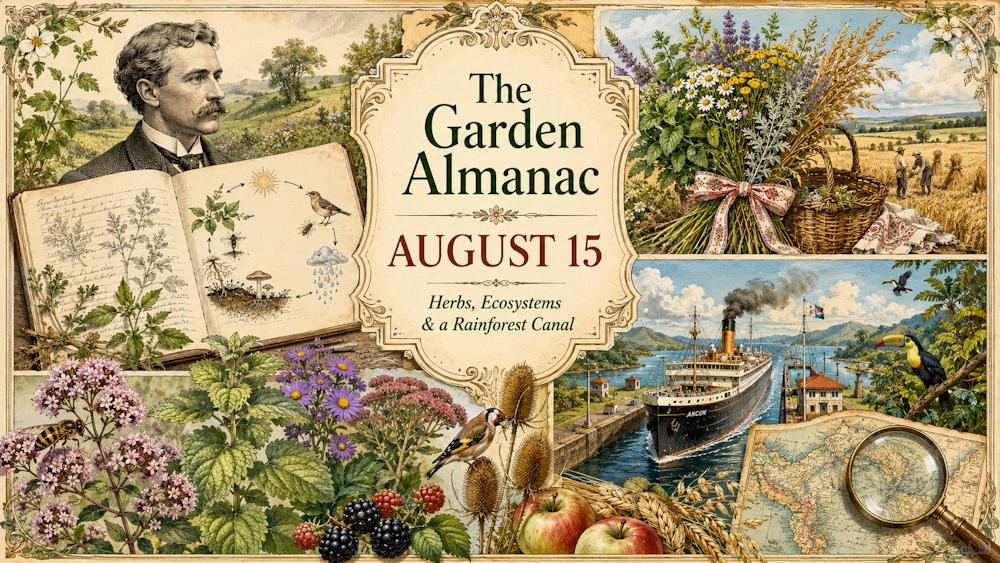

By mid-August, a garden can look generous and exhausted at the same time. Herbs are aromatic, seed heads are filling, late flowers hum with insects, and every dry patch of soil reveals how much the season has already demanded.
August 15 brings together three unusually fertile stories: an old harvest custom built from medicinal plants and grain, the birth of the ecologist who gave us the language of ecosystems, and the opening of a canal whose operation depends upon forests and rainfall. Each reminds us that a garden is never simply a collection of plants. It is a meeting place for culture, water, soil, wildlife and human choices.
August 15, 1871 – The Birthday That Gave Gardens a Bigger Name
Arthur George Tansley, born in London on August 15, 1871, helped transform the way people understood the living world. A botanist and pioneer of British ecology, he promoted the systematic study of vegetation, founded the journal New Phytologist and became the first president of the British Ecological Society. His most influential contribution arrived in 1935, when he introduced “ecosystem” into scientific literature as a way of describing organisms and their physical environment as one interacting unit.
That word changed the scale of the conversation. A woodland was no longer understood only as a list of trees, birds and fungi. Its soil, moisture, light, minerals, decomposing leaves and flows of energy also belonged to the same system. Tansley’s approach challenged the temptation to treat nature as scenery or to study each species in isolation.
A garden works in precisely this interconnected way. Compost affects soil organisms, soil structure influences water storage, flowers feed insects, insects support birds, and plant cover moderates temperature at ground level. Even a small intervention can travel through the system: removing every fallen leaf may reduce shelter for invertebrates, while leaving soil bare can increase evaporation, erosion and temperature extremes.
The practical lesson is to design relationships rather than merely arrange plants. Combine different flowering periods, keep living roots in the soil where possible, return suitable organic matter to beds and provide several layers of vegetation. A resilient garden does not depend on one perfect species or product – it depends on a web of useful connections.
Garden Science – What Makes a Garden an Ecosystem?
An ecosystem includes living organisms and the non-living conditions with which they interact. In a garden, this means plants, animals, fungi and microorganisms together with soil, water, air, sunlight and temperature.
Three processes are especially easy to observe:
- Energy enters through plants. Leaves capture solar energy, and that energy moves through herbivores, predators and decomposers.
- Nutrients circulate. Dead roots, leaves and other organic materials are broken down, releasing nutrients that can be used again.
- Water connects the system. Soil texture, roots, shade and organic matter influence whether rain runs away, evaporates or remains available to plants.
This is why healthy soil is not simply a container for roots. It is one of the busiest parts of the garden.
August 15 – When Europe Carried the Herb Garden in a Bouquet
The Feast of the Assumption has long coincided with harvest customs in parts of Europe. In Poland, August 15 is popularly associated with Matka Boska Zielna – Our Lady of the Herbs. Traditionally, people brought bouquets of herbs, flowers, grain and sometimes fruit or vegetables to be blessed. Related customs appeared elsewhere in Central and Eastern Europe, linking a religious feast with the ripening fields and the household’s dependence on useful plants.
These were not merely decorative bunches. Depending on the region and what grew nearby, bouquets might contain mint, chamomile, yarrow, tansy, wormwood, cereals and garden flowers. They acted as miniature records of the local season – part medicine chest, part harvest display and part expression of gratitude. Their composition also preserved knowledge about which plants were valued for food, fragrance, healing or protection.
For today’s gardener, the tradition offers a practical invitation: make a seasonal inventory before summer begins to fade. Which herbs are ready to dry? Which flowers are producing viable seed? Which plants have coped best with heat, drought or heavy rain? Harvest culinary herbs on a dry morning after the dew has lifted, tie them in small, loose bunches and dry them in an airy place away from direct sun. Thick bunches trap moisture and are more likely to develop mould.
Garden Reminder – What Should You Do in the Mid-August Herb Garden?
- Cut mint, oregano, thyme and lemon balm before flowering finishes and while the leaves remain healthy.
- Harvest only dry, correctly identified plants, and never use a folk name as the sole basis for deciding whether a wild herb is edible or medicinal.
- Remove damaged leaves before drying and discard any material showing mould, disease or chemical contamination.
- Allow some flower heads to remain for pollinators and seed production rather than cutting the entire plant.
- Label saved seed with the plant name and year – memory is rarely as dependable as it feels in August.
- Check local guidance before using herbs medicinally, especially during pregnancy or alongside prescribed medicines.
The old bouquets also carry a biodiversity lesson. A mixed gathering of cultivated plants, field flowers and cereals represented a varied landscape. Modern gardens can echo that diversity by combining herbs, ornamentals, vegetables and native plants instead of dividing them into isolated, sterile compartments.
August 15, 1914 – The Canal That Made a Forest Part of Its Machinery
On August 15, 1914, the cargo ship SS Ancon completed the first official passage through the Panama Canal. The opening connected the Atlantic and Pacific by a new navigable route, but the waterway was not simply a trench cut from one ocean to the other. Ships had to be raised and lowered through locks, and freshwater from an immense tropical watershed became essential to the entire operation.
The creation of Gatun Lake flooded the Chagres River valley and turned hilltops into islands. One of them, Barro Colorado Island, later became a protected biological reserve and one of the world’s most important sites for tropical forest research. A landscape dramatically altered by engineering consequently became a place where scientists could study tree growth, forest dynamics, animal populations and the effects of habitat isolation over long periods.
The canal’s history demonstrates a principle familiar in every garden: water management begins beyond the place where water is finally used. Forest cover helps protect soils, slow runoff and maintain the watershed that supplies the canal and nearby communities. In a garden, trees, hedges, ground-cover plants, permeable paths and organic-rich soil perform smaller versions of the same work. They intercept rain, reduce erosion and give water more time to soak into the ground.
Seasonal Tips – How Can a Garden Hold More Summer Rain?
A garden cannot reproduce a tropical watershed, but it can borrow its basic logic:
- Cover bare soil with compost, leaf mould or another suitable organic mulch.
- Direct water from roofs into a legal and safely installed rainwater-storage system.
- Place thirsty plants together instead of scattering them throughout dry borders.
- Use ground-cover plants where practical to shade soil and soften the impact of heavy rain.
- Create shallow planted depressions only where water can drain safely and will not threaten buildings.
- Water deeply but less frequently once established plants have developed adequate roots.
Mulch should not be piled against stems or tree trunks. Leave a small clear space around the base of plants to reduce the risk of rot and provide fewer hiding places for stem-damaging pests.
Wildlife Note – Why Leave Some Seed Heads Standing?
By mid-August, many flowers are changing roles. A faded bloom may no longer impress us, but its seeds can feed finches and other seed-eating birds, while its hollow or branching structure offers shelter to small invertebrates.
Leave a selection of healthy seed heads standing, especially on plants such as teasels, sunflowers, coneflowers and suitable native perennials. Remove plants that are diseased or dangerously invasive, but avoid treating every brown stem as waste. A slightly less polished border can function as a richer habitat.
Late-flowering plants are equally valuable. Bees, hoverflies and butterflies may still need nectar from asters, sedums, oregano, verbena and other regionally appropriate flowers. In hot weather, provide a shallow water source with secure landing stones and refresh it regularly so it does not become stagnant.
What to Observe Right Now – The Garden’s Mid-August Signals
August 15 is a useful moment to look carefully rather than rush immediately towards the next task. Watch for:
- seed pods changing from green to tan or brown;
- cooler dew settling in low parts of the garden;
- spiders rebuilding webs across paths and stems;
- butterflies feeding intensively on late flowers;
- fruit beginning to attract wasps, birds and mammals;
- differences in drought stress between mulched and bare soil;
- trees or shrubs showing premature leaf drop after heat or water shortage.
These details reveal both the approach of autumn and the effects of the summer just experienced. Record them with a date and photograph. Over several years, such notes can help you adjust sowing times, irrigation, plant selection and wildlife management to the actual conditions of your garden.
Looking Ahead
The stories attached to August 15 move from a bouquet to an ecosystem and from a garden-scale harvest to a rainforest watershed. Their shared lesson is practical: living systems remain productive when their relationships are protected. We can grow a wider range of useful plants, keep soil covered, conserve rainwater and leave room for the organisms that recycle, pollinate and regulate. The future garden may begin with individual choices, but its strength will always come from connection.