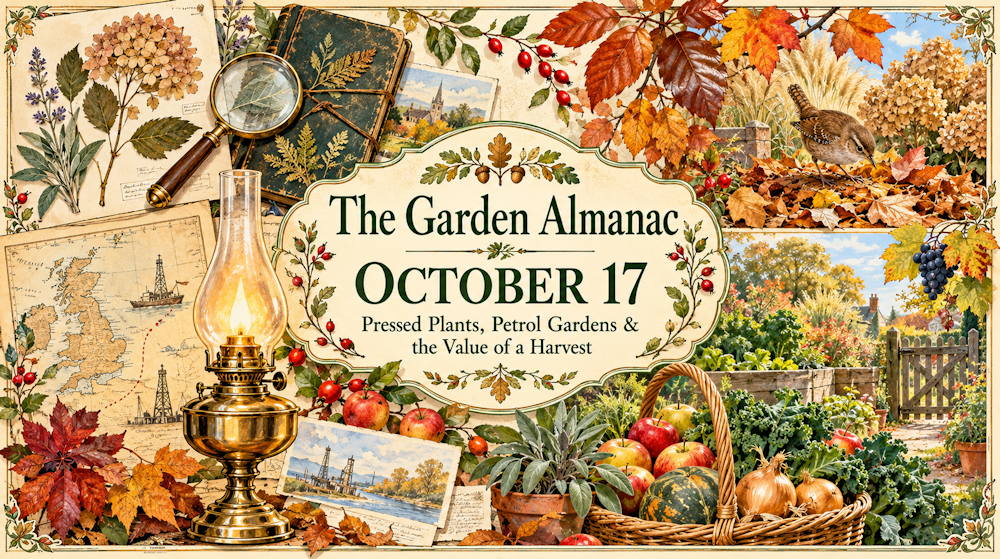

By mid-October, the garden has begun to reveal its structure. Flowers are fewer, leaves collect in sheltered corners, and every bowl of apples, basket of squash or row of winter greens feels more clearly like the result of time, weather and care.
October 17 opens several very different doors: to a young botanist’s plant press, to the shock of an oil-dependent world, and to a day that asks what dignity and food security mean in practice. They do not form one neat historical story – but together they make an unusually good day for noticing what keeps a garden, and a community, alive.
October 17, 1973 – When Oil Made the Garden Look Different
On this day in 1973, Arab oil-producing states announced production cuts that triggered the first great energy crisis of the modern era. Petrol stations, heated buildings and transport networks suddenly became visible as parts of everyday life that could not simply be taken for granted.
The shock reached far beyond the road. Modern food production depended – and still depends – on fuel for machinery, fertiliser manufacture, irrigation, refrigeration and long-distance transport. A supermarket shelf can make a tomato seem like a simple object; an energy crisis reveals the web of power, materials and labour behind it.
For gardeners, this is not an argument for imagining that every plot must become self-sufficient. It is a reminder that resilience often grows from modest choices: compost that returns nutrients to the soil, mulch that holds moisture, perennial herbs that return each spring, and crops chosen for the conditions already present rather than for an idealised season.
October is an especially good time to notice those choices. A bed covered with leaves, a full water butt and a store of home-grown onions will not solve the world’s energy problems – but they make a garden less wasteful, more observant and more capable of working with its place.
Garden Science – Why do leaves change colour in autumn?
As daylight shortens and temperatures fall, deciduous plants stop investing in chlorophyll, the green pigment that powers photosynthesis. Yellow and orange carotenoids, present in the leaf all along, become easier to see; some trees also make red anthocyanins when days are bright and nights are cool. Leaf colour is therefore not simply “autumn decoration” – it is part of a plant’s careful withdrawal and nutrient-saving process.
Garden Reminder – What is worth doing in the mid-October garden?
- Remove and dispose of clearly diseased leaves from roses, fruit trees and vegetables; healthy leaves can become valuable mulch or compost material.
- Plant spring-flowering bulbs while the soil is still workable, usually at roughly two to three times the bulb’s own depth.
- Avoid feeding plants with high-nitrogen fertiliser now. Soft late growth is more vulnerable to winter damage.
- Check stored apples, potatoes and squash regularly, removing any fruit or tuber that shows rot before it affects its neighbours.
October 17, 1785 – The Botanist Whose Plants Came Home Without Him
Christen Smith, born in Norway on October 17, 1785, was trained as a physician but became one of his country’s earliest professors of botany. At a time when many plants were still known chiefly as local curiosities or medicinal materials, he travelled, collected and studied them with the conviction that careful observation could reveal how landscapes worked.
His career was astonishingly short. Smith explored Norwegian mountains and the Canary Islands, and in 1816 joined an expedition up the Congo River. He died of fever before his thirty-first birthday, but his assistant David Lockhart succeeded in bringing Smith’s dried plant collection back to Europe. Hundreds of specimens survived where their collector did not.
That is the quietly remarkable power of a herbarium sheet. A pressed stem with its label can preserve a clue to a plant’s former range, flowering time and habitat long after the landscape itself has changed. A gardener need not make a scientific collection to borrow the habit: photograph the same border each month, label saved seed, and make notes on first frosts, flowering dates and pest arrivals. Small records can turn vague impressions into knowledge.
Wildlife Note – Leave some of the garden untidy
The autumn clear-up need not be total. Hollow stems, a modest leaf layer and a small pile of twiggy prunings can provide shelter for overwintering insects and other small animals. Keep paths, crowns of vulnerable plants and disease-prone areas clear, but allow one quiet corner to remain a little less polished.
October 17, 1987 and 1992 – A Date That Put Dignity Beside Food
October 17 is also the International Day for the Eradication of Poverty. Its roots lie in a 1987 gathering in Paris, and the United Nations formally recognised the date in 1992. The observance insists that poverty is not only a question of income: it is bound up with food, housing, health, participation and dignity.
That wider view matters in a gardening magazine because food growing has two very different truths. A kitchen garden can bring fresh flavour, nutrition, pleasure and confidence; shared gardens can create local knowledge and companionship. Yet a few raised beds cannot substitute for fair wages, secure housing or reliable access to healthy food. Romanticising “growing your own” can hide how unevenly people have access to land, time, tools and water.
The useful response is practical and generous. Share surplus rather than letting it spoil, save seed only from healthy open-pollinated plants when you can pass on reliable information with it, support local food-growing projects, and design community plots with paths and raised beds that more people can use. A harvest becomes more meaningful when its benefits travel beyond the person who planted it.
What to Observe Right Now
- Which parts of your garden hold the morning dew longest? These often reveal cooler, damper microclimates.
- Do fallen leaves gather in the same places after each wind? They may show where a future leaf-mould bay or sheltered habitat corner would work best.
- Which edible plants still look vigorous after cooler nights? Their performance is useful evidence for next year’s autumn planting plan.
Looking Ahead
October 17 does not offer one simple moral. It offers a pressed plant that still speaks across two centuries, an energy shock that made hidden dependencies visible, and a reminder that food is tied to dignity as well as calories. In the garden, the most lasting improvements are often the ones that reduce waste, sharpen observation and make room for other people and other species. This week, let the season’s abundance suggest not only what to store, but what to share and what to notice more carefully.