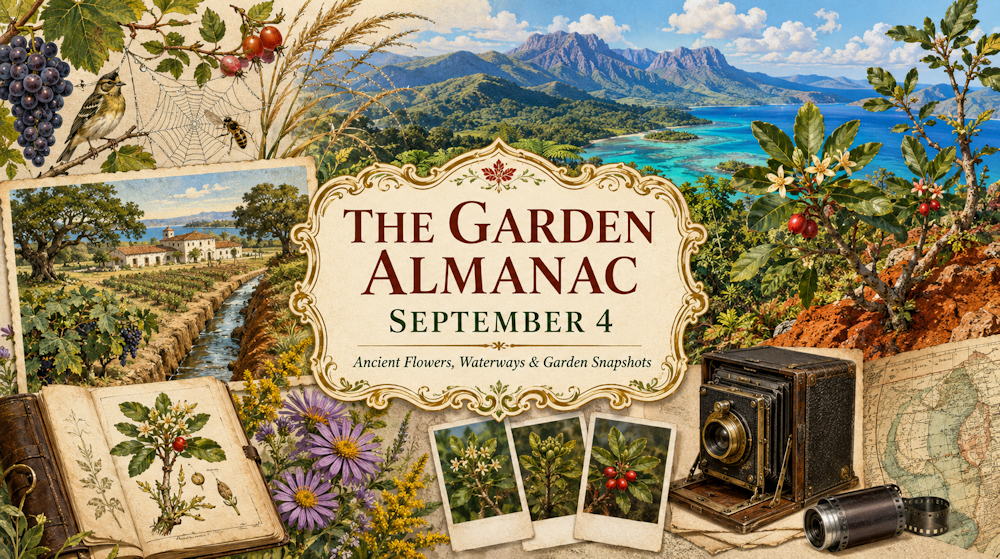

Early September is a season of subtle signals. In northern gardens, fruits are ripening, seed heads are drying and the first cooler nights are beginning to slow summer growth. South of the equator, meanwhile, lengthening days are waking buds, insects and nesting birds.
The stories attached to September 4 stretch across both hemispheres and several centuries. They lead from one of the world’s most extraordinary botanical refuges to an irrigated farming settlement beside a river, then into the age when an uncomplicated camera allowed ordinary people to preserve a fleeting moment outdoors.
September 4, 1774 – The Pacific Island Where Flowering-Plant History Survives
On September 4, 1774, during his second Pacific voyage, James Cook became the first recorded European to sight the main island of New Caledonia. Its mountainous outline reminded him of Scotland, known to the Romans as Caledonia, and the European name remained. For the Indigenous Kanak people, however, this was already a known, inhabited and carefully used landscape with its own names, food plants and generations of accumulated ecological knowledge.
New Caledonia’s greatest surprise lies in its flora. Long geographical isolation and unusual, metal-rich soils have produced exceptionally high levels of endemism, meaning that many of its plants occur naturally nowhere else. Among them is Amborella trichopoda, an unassuming evergreen shrub representing the earliest-diverging living lineage of flowering plants. It is not the ancestor of every modern flower, but its genetic position gives botanists an exceptionally valuable window into the early evolution of angiosperms.
The island’s ultramafic soils contain high concentrations of nickel and other metals while offering relatively few nutrients. Conditions that would defeat many familiar garden plants have encouraged remarkable adaptations. Some native species exclude harmful metals from their tissues, while others accumulate them in extraordinary quantities. These specialised plant communities demonstrate an important gardening principle on a dramatic scale – a plant can thrive only when its biology matches the ground beneath it.
That specialisation also creates vulnerability. Mining, fire, habitat fragmentation and invasive species can erase populations with extremely restricted ranges. New Caledonia therefore reminds gardeners that rarity is often rooted in place. Conserving a plant means protecting not only the visible specimen but also its soil, pollinators, fungal partners, water cycle and surrounding community.
Garden Science – Why does the right plant struggle in the wrong soil?
Soil affects far more than the supply of water. Its pH, mineral composition, drainage and organic matter determine which nutrients roots can absorb and which microorganisms can live around them. Before repeatedly feeding an unhealthy plant, check whether its basic soil requirements are being met. A simple pH test and close observation of drainage may reveal more than another dose of fertiliser.
Wildlife Note – How Can a Garden Protect Locally Special Species?
Endemic wildlife may sound like a concern for remote islands, but every region has species tied to particular habitats, host plants or seasonal food sources. A garden becomes more valuable when it reflects the ecology of its own surroundings.
- Grow several locally native plants rather than relying on a single token species.
- Include flowers with different shapes and overlapping bloom periods.
- Leave some hollow stems, leaf litter and undisturbed soil for overwintering insects.
- Avoid releasing unfamiliar ornamental plants into nearby natural habitats.
- Record unusual visitors and share credible observations with a local wildlife project.
September 4, 1781 – Los Angeles Began as an Irrigated Farming Community
On September 4, 1781, 44 settlers from 14 families established a farming community beside the Los Angeles River. The settlement that would become Los Angeles was home to people of Indigenous American, African and European ancestry and formed part of Spain’s colonial expansion into Alta California. The chosen site was not an empty landscape – Tongva communities had long lived with the river, gathering, hunting and managing resources that included acorns from coast live oaks.
Water made the new pueblo possible. A gravity-fed irrigation channel known as the Zanja Madre, or Mother Ditch, diverted river water towards fields and homes. Later branches extended the network as the settlement grew. The channels supported crops in a climate marked by long dry summers, but expanding demand, pollution and alterations to the river gradually exposed the limitations of treating a living watershed merely as a supply line.
The practical lesson reaches well beyond Southern California. Water-efficient gardening begins with the whole site, not the watering can. Direct rain towards planted ground, slow runoff with vegetation and permeable surfaces, add organic matter where appropriate, and group plants according to moisture requirements. Most importantly, choose plants suited to the expected rainfall instead of designing a garden that can survive only through constant irrigation.
Garden Reminder – What should you do in the garden in early September?
- Check soil moisture below the surface before watering – cool mornings can make dry ground appear damper than it is.
- Water recently planted trees and shrubs deeply while they establish roots, especially during dry spells.
- Collect ripe seed on a dry day and label it immediately with the plant name and date.
- Remove diseased fallen fruit, but leave healthy seed heads where birds can feed on them.
- Plant or divide suitable perennials once extreme heat has passed and reliable moisture returns.
September 4, 1888 – The Camera That Taught Gardeners to Look Again
On September 4, 1888, George Eastman received a patent for his compact roll-film camera and registered the Kodak trademark. Earlier photography demanded heavy equipment, glass plates and specialised chemical knowledge. Eastman’s preloaded camera dramatically simplified the process, placing a means of recording everyday life into the hands of amateurs.
Gardens soon became natural subjects. A photograph could preserve a rose at its peak, document the changing shape of a border or record how a landscape looked before development transformed it. Over time, garden photographs also acquired scientific value. Dated images can reveal changes in flowering, leaf emergence, fruit ripening, snowfall and the arrival of migratory wildlife.
A modern phone camera can serve the same observational purpose with far greater precision. Photograph one fixed view of the garden every week, and take close-ups of several indicator plants when they bud, flower and set seed. Keep the date and location attached. After a few seasons, the collection becomes more than an album – it becomes a personal phenological record that can guide pruning, sowing, watering and wildlife-friendly planting.
What to Observe Right Now – Which Signs Mark the Turn of the Season?
Rather than looking only for dramatic autumn colour or the first spring blossom, notice the smaller changes that reveal how plants and animals respond to shortening or lengthening days.
- Which plants are still providing pollen and nectar?
- Are fruits ripening earlier or later than in previous years?
- Where does dew remain longest in the morning?
- Which trees are beginning to slow their growth or open their buds?
- Are birds feeding, gathering nesting material or travelling through the area?
- Which parts of the garden stay green without additional watering?
Choose one plant and photograph it from the same position today. Repeating the picture weekly will make gradual seasonal changes much easier to recognise.
Seasonal Tips – Let the Garden Keep Its Own September Record
A useful garden diary does not require lengthy daily entries. Record rainfall, unusual heat or cold, first and last flowers, pest outbreaks, harvest dates and major jobs such as planting or pruning. Add photographs when a plant looks particularly healthy or begins to fail.
These notes make future decisions more reliable. If a perennial repeatedly collapses in the same wet corner, or a fruit tree flowers before late frosts have passed, the pattern becomes difficult to dismiss. Local records are often more useful than a general calendar because they describe the conditions in one particular garden.
Looking Ahead
September 4 shows how strongly plants are shaped by place, water and observation. New Caledonia’s ancient lineages ask us to protect complete habitats, while the Mother Ditch of Los Angeles reminds us that every cultivated landscape depends on a wider watershed. The first easy-to-use camera adds a practical tool – careful, repeated documentation. By matching plants to their conditions, using water thoughtfully and recording seasonal change, gardeners can make choices that become more informed with every passing year.