
By mid-August, a garden carries two seasons at once. Tomatoes, beans and late flowers are still gathering the sun, while dry seed heads and the first tired leaves quietly announce that summer has begun to turn.
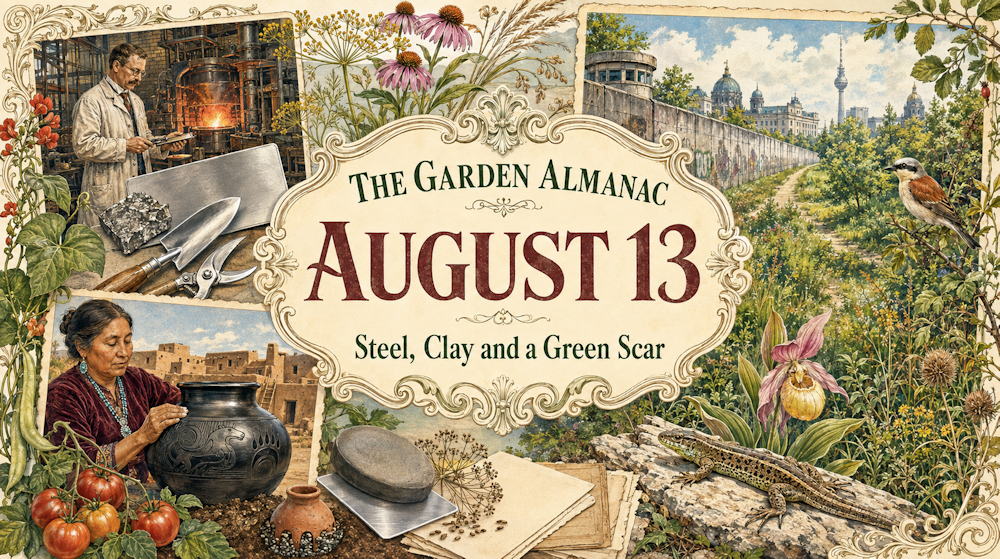
August 13 opens three unusually different doors onto that moment: a Sheffield experiment that changed the tools in our hands, the birth of a Pueblo potter whose vessels joined earth, water and memory, and a barrier across Berlin whose former course would one day shelter wildlife. Together, they ask a practical garden question – what can we make from the materials and spaces already around us?
August 13, 1913 – The Day “Rustless Steel” Left the Furnace
On August 13, 1913, Sheffield metallurgist Harry Brearley produced an iron alloy containing about 12.8 per cent chromium and 0.24 per cent carbon. He had been investigating metals that could resist erosion in gun barrels, but the more peaceful possibilities soon became clear: here was a steel able to withstand attack from substances including vinegar and fruit juice. Brearley called it “rustless steel”; the more memorable name “stainless steel” followed.
The crucial ingredient was chromium. When enough chromium is present, oxygen helps form an extremely thin, stable oxide film on the metal surface. If that film is lightly scratched, it can form again as long as oxygen is available. Stainless steel is therefore corrosion-resistant, not magically stain-proof – salts, harsh chemicals, prolonged damp and neglect can still damage it.
For gardeners, the legacy is visible in trowels, forks, dibbers, harvesting knives and tool fittings that meet wet soil, acidic plant juices and humid sheds. Stainless steel is easy to clean and useful where corrosion resistance matters, although a well-made carbon-steel blade may hold a particularly keen edge. Material alone does not determine quality – blade geometry, heat treatment, joint construction and a handle that suits the user matter just as much.
The practical lesson is wonderfully unglamorous: even corrosion-resistant tools last longer when soil and sap are removed, blades are dried, pivots are lubricated and cutting edges are maintained. August harvests leave tomato residue, fruit acids and sticky sap on tools, so a quick wipe after use is far easier than restoring a neglected blade in winter.
Garden Science – Why can stainless steel still rust?
Its chromium-rich surface film needs oxygen and a reasonably clean surface to remain protective. Dirt trapped against wet metal, salty fertiliser residues and inappropriate cleaning chemicals can encourage local corrosion. Stainless tools should still be washed when necessary, dried before storage and kept away from persistently damp compost or soil.
August 13, 1904 – Margaret Tafoya and the Memory Held in Clay
Margaret Tafoya was born at Santa Clara Pueblo in New Mexico on August 13, 1904, into a Tewa pottery tradition extending through many generations. She learned from her mother and became renowned for large hand-coiled vessels made from clay gathered on Santa Clara land. The pots were slowly formed, polished with smooth stones and fired outdoors using natural fuels – a demanding practice in which material knowledge could not be separated from place.
Her storage and water jars carried more than water. Carved rain clouds, water serpents and the bear paw – a sign associated with finding water – expressed the realities of life in an arid landscape. Tafoya preserved inherited methods while developing a distinctive artistic language, showing how a useful object can also hold ecological observation, family memory and cultural continuity.
Gardeners can take a direct lesson from the relationship between clay and moisture. Unglazed porous terracotta allows some water to move through its walls, which is why buried clay irrigation vessels can release moisture gradually into the surrounding soil. Above ground, the same porosity makes terracotta containers dry faster than plastic or glazed pots. Check them more frequently in hot weather, water thoroughly until the root ball is evenly moist, and group pots where possible to reduce exposure to drying wind.
Seasonal Tips – How do you stop terracotta pots drying out too quickly?
- Water in the morning, applying enough to moisten the whole root ball rather than only the surface.
- Test the compost several centimetres down – a dry crust can conceal moisture below, while a damp-looking surface can sometimes hide a dry root ball.
- Move small pots out of fierce afternoon sun and drying wind during heatwaves.
- Add a thin organic mulch without pressing it against the plant’s crown.
- Place saucers only where temporary standing water will not harm the plant, and never leave drought-tolerant species permanently waterlogged.
August 13, 1961 – From Barbed Wire Sunday to a Living Corridor
Before dawn on August 13, 1961, East German forces began sealing the border around West Berlin with barbed wire and barricades. Streets were broken, movement was stopped and a division that would last for 28 years took physical form. Gardens and allotment plots near the border were among the spaces cleared as fortifications expanded – ordinary cultivated ground became part of a controlled and deadly landscape.
Yet the wider inner-German border produced an ecological afterlife no one had intended. Land excluded from intensive farming, construction and everyday disturbance became refuge for plants and animals. After reunification, conservationists worked to preserve much of this long strip as the German Green Belt, now part of a European habitat network following the former Iron Curtain. The history must never be romanticised – wildlife benefited from an absence created by human repression – but the landscape demonstrates what continuity and reduced disturbance can do.
A garden-scale wildlife corridor does not require kilometres of protected land. A mixed hedge linked to a shrub bed, pond margin, meadow patch or neighbour’s tree canopy lets animals move between feeding, nesting and shelter sites. Avoid sealing every boundary with bare fencing; where safe and appropriate, retain connected vegetation and small ground-level passages. Several modest habitats joined together are often more useful than isolated pockets surrounded by paving.
Wildlife Note – What makes a useful garden corridor?
- Continuous cover from native or wildlife-friendly shrubs rather than widely separated specimen plants.
- Flowers across the seasons, so pollinators do not meet a long gap in nectar and pollen.
- Safe access at ground level for small animals where local species and circumstances make this appropriate.
- Darker routes at night – unnecessary outdoor lighting can disrupt bats, moths and other nocturnal wildlife.
- Fewer pesticides, because a corridor that leads through routinely treated plants can become an ecological trap.
Garden Reminder – What needs attention in the mid-August garden?
Harvest courgettes, beans, cucumbers and tomatoes regularly to keep productive plants from diverting energy into overmature fruit. Water deeply at the soil rather than sprinkling foliage, concentrating on containers, recent plantings and fruiting crops; established lawns and many mature ornamentals usually deserve lower priority during dry spells.
Remove diseased leaves from tomatoes and other crops, but do not strip healthy foliage that shades ripening fruit. Stop feeding woody plants with high-nitrogen fertiliser late in the season, as soft new growth may not harden before cold weather. Leave some sound seed heads standing for birds and insects, while collecting ripe seed only on a dry day and labelling it immediately.
What to Observe Right Now – Signs That Summer Is Turning
- Watch where dew first lingers in the morning – it often reveals cooler pockets and slower-drying areas of the garden.
- Look for bumblebees sleeping or resting in open flowers, especially early in the day.
- Notice which plants remain fresh without extra water – they offer clues for more drought-resilient planting.
- Check hedges and seed heads for young birds learning to forage independently.
- Listen after sunset for the changing soundscape of late-summer insects.
Looking Ahead
August 13 reminds us that resilience can begin with an alloy, a clay vessel or a connected strip of undisturbed ground. Durable tools still need care, containers must be understood rather than merely watered, and wildlife needs routes as well as refuges. By maintaining what we own, working with the properties of natural materials and linking the green spaces within our reach, we can make gardens that waste less and support more life. The future garden may be shaped as much by thoughtful connections as by new purchases or new planting.