
By mid-October, the garden has begun to speak in a lower voice. Leaves gather along paths, seed heads darken, apples sit heavy in crates, and the last warm afternoons feel borrowed rather than promised.
October 12 is one of those dates that opens unexpectedly wide. It carries the memory of ships crossing an ocean, a royal wedding that became a harvest-season festival, and a modern population milestone that asks every gardener a practical question: how do we feed, share and protect a living planet?
October 12, 1492 – The Day the World’s Gardens Began to Change
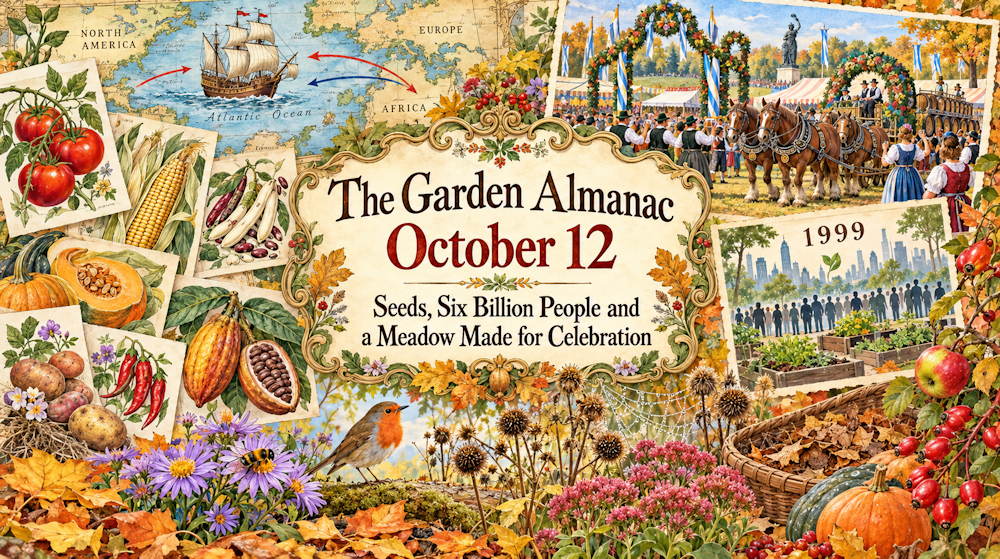
When Christopher Columbus’s expedition reached the Caribbean on October 12, 1492, the moment was recorded for centuries as a story of exploration. From a garden’s point of view, however, it was also the beginning of one of the largest biological exchanges in human history. Plants, animals, people, diseases, seeds and food habits began moving between the Americas, Europe, Africa and Asia on a scale that had never happened before.
The familiar kitchen garden was quietly remade by this exchange. Tomatoes, potatoes, maize, beans, squash, peppers, cacao and many other crops from the Americas eventually became staples far from their original landscapes. It is strange to remember that Italian tomato sauces, Irish potato fields, Hungarian paprika, Swiss chocolate and many European vegetable plots all depend on plants that once belonged to another side of the Atlantic.
The less comfortable part of the story matters too. This movement of plants did not happen in a neutral world. It was tied to colonization, forced labour, disease and the disruption of Indigenous societies that had already developed sophisticated farming systems, seed knowledge and crop diversity. The garden lesson here is not simply that useful plants travel. It is that every crop carries a history of people, power, adaptation and loss.
For today’s gardener, October 12 is a good day to look at the vegetable bed as a living map. A tomato seedling, a potato tuber or a climbing bean is not just a productive plant; it is part of a long human story of selection, migration and survival. Saving seed, growing diverse varieties and learning where crops come from are small but meaningful ways to garden with more attention.
Garden Science: Why Plant Diversity Makes a Garden More Resilient
A diverse garden is usually more stable than a garden built around one crop or one variety. Different plants use nutrients in different ways, root at different depths, flower at different times and attract different insects.
That means diversity can help a garden cope with stress. If one crop suffers from drought, disease or pest pressure, another may still thrive. This is why mixed borders, crop rotation, companion planting and heirloom varieties are more than decorative choices – they are practical tools for resilience.
October 12, 1810 – The Wedding Meadow That Became Oktoberfest
On October 12, 1810, Crown Prince Ludwig of Bavaria married Princess Therese of Saxony-Hildburghausen. The public celebrations that followed included a horse race on open land outside Munich, and the site became known as Theresienwiese – Therese’s meadow. What began as a royal wedding celebration gradually grew into Oktoberfest.
Before it became famous around the world for beer tents and crowds, the festival had a strong agricultural and seasonal character. It belonged to the rhythm of autumn: horses, local food, brewing, harvest display and civic gathering. In the following years, agricultural shows became part of the celebration, turning the meadow into a place where rural skill and urban pride met in public.
That is the detail worth keeping. A festival can change its costume over time, but its roots often remain in land use, crops, animals and seasonal abundance. For gardeners, the first Oktoberfest is a reminder that harvest is not only a private moment at the kitchen table. It is also social: sharing apples, swapping seeds, giving away surplus herbs, taking produce to a local event, or simply inviting neighbours to taste what the season has given.
Garden Reminder: What to Do in the Garden Around October 12
Mid-October is a useful checkpoint before the colder, wetter part of the year arrives.
- Collect healthy fallen leaves for leaf mould; avoid storing diseased leaves with compost meant for vegetables.
- Plant spring-flowering bulbs while the soil is still workable.
- Lift tender plants or take cuttings before the first hard frost.
- Clear only what you need to clear; leave some seed heads and hollow stems for wildlife.
- Check stored apples, onions and potatoes regularly, removing any damaged ones before rot spreads.
- Mulch bare soil with compost, leaves or straw to protect soil life through winter.
October 12, 1999 – Six Billion People and the Question of Food
On October 12, 1999, the world marked the symbolic Day of Six Billion, the point at which global population was estimated to have reached six billion people. The exact date was symbolic rather than mathematically perfect, but the message was unmistakable: human numbers, food systems, land and water were now part of one global conversation.
For gardeners, this can feel too large to touch. A vegetable bed cannot solve global food security. Yet it can make the issue visible in a way statistics often cannot. Soil fertility, water use, pollination, crop choice, composting and food waste are not abstract themes when you are standing beside a raised bed in October, deciding whether to protect winter greens or leave the soil bare.
The most useful insight is not that everyone must grow all their own food. It is that food has a footprint before it reaches the plate. A small garden can teach timing, patience, limits and abundance at human scale. Growing herbs on a balcony, planting fruit trees, composting kitchen scraps or choosing seasonal produce all make the same quiet point: feeding people well begins with respecting the living systems that feed the plants.
Wildlife Note: Leave a Little Autumn Mess
A perfectly tidy autumn garden can be surprisingly poor habitat. Many beneficial insects overwinter in leaf litter, hollow stems, loose bark, dry grasses or undisturbed soil.
If you can, leave a few quiet corners untouched until spring. Seed heads feed birds, leaf piles shelter invertebrates, and late flowers such as asters, sedums and single dahlias can still support pollinators on mild days. The aim is not neglect, but selective tidiness: clear paths and diseased material, while keeping some shelter for the small lives that help the garden recover next year.
What to Observe Right Now
October observation is slower than spring observation, but it can be just as revealing.
- Which plants still attract bees or hoverflies on sunny afternoons?
- Where do leaves collect naturally, and could that become a future leaf-mould corner?
- Which trees colour first, and which hold green leaves longest?
- Are birds feeding more actively on berries, seeds or insects?
- Which parts of the garden stay damp after rain, and which dry quickly?
These details are easy to miss, yet they are practical. They show where frost may settle, where soil needs protection, where wildlife already finds food, and where next year’s planting could work with the garden rather than against it.
Looking Ahead
October 12 reminds us that gardens are never isolated. A vegetable bed can carry the memory of ocean crossings, a festival meadow can preserve traces of harvest culture, and a population milestone can bring global food questions back to the soil under our hands.
The future of gardening will depend less on grand gestures than on attentive habits: growing a wider range of plants, wasting less, protecting soil, sharing abundance and leaving room for wildlife. In that sense, the mid-October garden is not winding down completely. It is storing choices for the year ahead.