

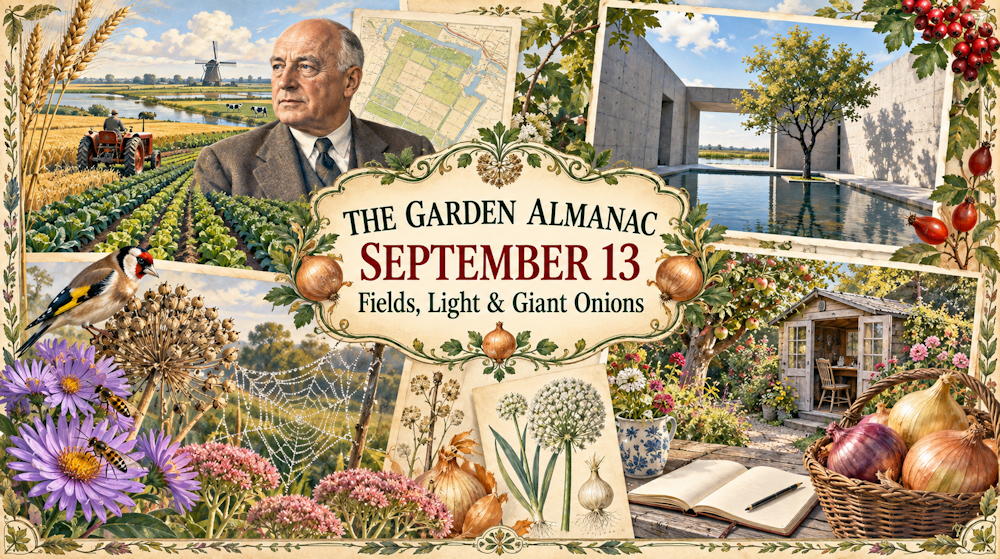

By September 13, the garden is beginning to speak two languages at once. Summer still lingers in ripening fruit, late flowers and warm afternoons, while cooler nights, lengthening shadows and the first drifting leaves announce the season ahead.
It is a fitting date for stories about change. Today’s almanac moves from the fields of post-war Europe to the carefully framed landscapes of Japan and the wonderfully eccentric garden of one of Britain’s best-known storytellers. Each asks the same practical question in a different way: how should people shape the land without losing what makes it alive?
September 13, 1908 – Sicco Mansholt and the Reinvention of European Farming
Sicco Mansholt, born in the Netherlands on September 13, 1908, understood agriculture from the soil upwards. He came from a farming family, studied tropical agriculture, worked on a tea plantation in Java and later established his own farm on reclaimed land in the Dutch Wieringermeer polder. During the Second World War, he joined the Dutch resistance and helped organise food supplies at a time when hunger made the relationship between farming and public survival brutally clear.
After the war, Mansholt became the Netherlands’ minister of agriculture. His immediate task was to restore food production, modernise farms and prevent the shortages that Europeans had recently endured. As the first European Commissioner for Agriculture, he became one of the principal architects of the Common Agricultural Policy. Mechanisation, greater efficiency and coordinated markets helped turn scarcity into abundance, but the transformation also encouraged larger farms, specialisation and increasingly intensive methods.
Mansholt eventually became uneasy about the system he had helped to build. By the early 1970s, influenced by warnings about finite resources and unrestricted economic growth, he was arguing that production could not remain the only measure of success. His change of mind now feels strikingly contemporary. European agriculture still wrestles with the same tension between reliable harvests and the long-term health of soils, water, wildlife and rural communities.
For today’s gardener, the lesson is not that efficiency is undesirable, but that it must be measured carefully. A vegetable bed that produces heavily while losing organic matter, requiring ever more fertiliser or leaving soil bare for months is not truly efficient. Keep roots in the ground where possible, return composted material to the soil, rotate plant families and leave room for flowers that support beneficial insects. Productivity and ecological resilience work best when they are planned together.
Garden Reminder – What should you do in the garden in mid-September?
- Sow spinach, rocket, lamb’s lettuce and winter salads where autumn remains mild.
- Plant spring-flowering bulbs once the soil has cooled, but before it becomes saturated.
- Harvest onions and maincrop potatoes on a dry day, then cure them before storage.
- Cover empty vegetable beds with a green manure, mulch or a new crop rather than leaving bare soil.
- Keep watering recently planted trees and perennials – cooler air does not mean their roots are established.
September 13, 1941 – Tadao Ando and the Garden as Framed Nature
Japanese architect Tadao Ando was born in Osaka on September 13, 1941. Largely self-taught, he became internationally known for buildings in which concrete, water, sky and natural light create spaces of remarkable stillness. His work does not simply place architecture beside nature. Walls, openings, courtyards and paths determine how rain is heard, how sunlight travels and when a visitor suddenly encounters a tree, a pool or a distant horizon.
That approach has much in common with traditional Japanese garden design. A garden need not reveal everything at once: a wall can conceal a view, a turning path can slow the visitor and an opening can frame one carefully chosen scene. Even a small courtyard can feel expansive when it includes moving shadows, reflective water or a clear view of the sky. Space gains character not only from what is added, but also from what is deliberately left open.
Home gardeners can apply the same principle without rebuilding the house. Before adding more plants, look at the garden from its most frequently used doors, windows and seats. Prune or reposition only what interrupts the strongest view, repeat a limited selection of materials and allow one plant, container or patch of water to become the focal point. A calmer composition often makes individual plants more noticeable and leaves enough open ground for air circulation, access and future growth.
Garden Inspiration – How can a small garden feel larger?
Frame one view instead of displaying the whole space immediately. A partly concealed path, a gap in a hedge or a foreground branch can create depth. Darker foliage near the viewer and finer-textured plants farther away can also make the distance appear greater.
Garden Science – Why Does September Light Feel Different?
The Sun follows a lower path across the sky as the September equinox approaches in the Northern Hemisphere. Its light arrives at a shallower angle, producing longer shadows and often revealing the texture of leaves, grasses and seed heads more clearly than the overhead light of midsummer.
Plants also register the changing season through night length. In many species, specialised light-sensitive pigments help regulate dormancy, bud formation, flowering and leaf fall. Temperature matters too, but a warm autumn cannot completely disguise the steadily lengthening nights.
This is one reason artificial light can affect gardens. Strong security lamps shining throughout the night may alter the behaviour of nocturnal insects and interfere with seasonal signals in some plants. Direct outdoor lighting downwards, use the lowest useful intensity and switch it off when it is not needed.
September 13, 1916 – Roald Dahl’s Garden of Orchids, Roses and Giant Onions
Roald Dahl, born in Wales on September 13, 1916, filled his stories with peaches, beans, foxes, woods and plants that behaved in thoroughly unexpected ways. Nature in his books is rarely mere scenery. It grows, transforms, hides secrets and occasionally refuses to obey the rules – qualities familiar to anyone who has raised a courgette that became a marrow overnight or found a seedling in a place where it was never sown.
The garden surrounding Gipsy House, his Buckinghamshire home, contained an orchard, vegetable plots, formal garden rooms, a maze and large numbers of roses. Dahl was particularly interested in onions and orchids, while animals including hens, a tortoise and birds added to the garden’s lively character. A path led through this cultivated world to the small writing hut where many of his stories took shape.
His garden offers more than a charming connection between plants and literature. Children and adults notice nature more closely when it contains a story, experiment or modest element of surprise. Try growing an unusually coloured bean, measuring a sunflower each week, saving seed from the best tomato or leaving a small path through tall grasses. Curiosity is a genuine gardening skill: it encourages observation, comparison and the patience to discover why one plant thrives while another struggles.
Wildlife Note – Should you cut down all faded flowers now?
No. Leave some sturdy, disease-free seed heads standing through autumn. Goldfinches and other seed-eating birds may feed on them, while hollow or sheltered stems can provide refuge for invertebrates. Remove plants affected by serious disease, but allow healthy echinacea, teasel, sunflowers and ornamental grasses to remain where they will not collapse across paths.
What to Observe Right Now
Mid-September rewards anyone willing to pause before beginning the next garden job.
- Look for spiders’ webs outlined by morning dew between stems and shrubs.
- Notice which late flowers still attract bees, hoverflies and butterflies on sunny afternoons.
- Check hedges for ripening berries before scheduling any autumn trimming.
- Compare the colour of leaves on dry ground with those growing in cooler, moisture-retentive soil.
- Watch for migrating birds feeding intensively before continuing their journey.
These observations can guide future planting. A flower crowded with insects deserves a place in next year’s garden, while a shrub carrying berries into autumn may be more valuable than one chosen for foliage alone.
Seasonal Tips – Preparing the Garden Without Making It Too Tidy
Autumn preparation does not require stripping the garden bare. Remove annual weeds before they shed seed, but leave fallen leaves beneath established hedges and shrubs where they can break down safely. On lawns, collect thick layers that would smother the grass and use them to make leaf mould.
Lift and divide overcrowded perennials once the soil is moist and growth has slowed. Replant healthy outer sections at their original depth and water them thoroughly. Avoid dividing tender or late-flowering species if cold weather is likely to arrive before they can establish new roots.
This is also a useful time to record the season. Photograph borders from the same viewpoint, mark gaps and note which plants flopped, suffered from drought or flowered particularly well. Such records turn vague impressions into practical decisions when planting begins again.
Looking Ahead
The stories attached to September 13 show that cultivation is never simply a matter of producing more or filling every available space. Mansholt’s changing ideas remind us to measure success through soil and ecological health as well as yield; Ando demonstrates the value of light, restraint and carefully framed nature; Dahl shows what curiosity can grow from an orchard, a vegetable plot or one extraordinary onion. In the weeks ahead, protect the soil, preserve useful shelter for wildlife and leave room for the garden to surprise you. The most resilient gardens are productive, observant and imaginative all at once.