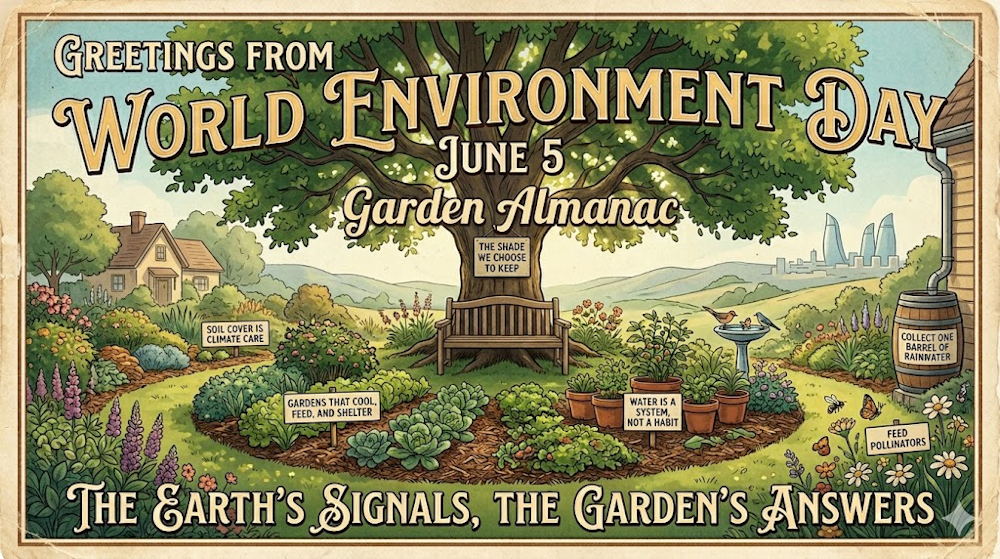

June 5 is World Environment Day, one of the world’s largest annual platforms for environmental awareness and action. Led by the United Nations Environment Programme and observed every year on June 5 since 1973, it invites people, communities and governments to respond to the environmental challenges shaping life on Earth.
In 2026, the global commemoration is hosted by Azerbaijan in Baku, with a focus on climate change and the urgent question of how humanity responds to Earth’s signals.
The Garden Almanac brings that global question down to soil level.
A garden is where climate stops being abstract. It appears as dry soil, stressed leaves, overheated pots, sudden downpours, missing insects, thirsty birds, and the difference between a yard that bakes and one that breathes under trees.
Earth’s Signals at Garden Scale
The Earth’s signals are often described in large terms: rising temperatures, extreme weather, biodiversity loss, drought, flood, land degradation. In the garden, the same signals become intimate.
A seedling wilts. A clay pot overheats. Rain runs off compacted ground instead of sinking in. Bare soil cracks. A once-reliable plant struggles. Pollinators arrive in smaller numbers. A tree becomes the only bearable place to sit in the afternoon.
These are not separate from the global story. They are the global story made local.
Gardens teach us to notice cause and effect. They show how soil, water, shade and life are connected. They show that resilience is not a slogan, but a structure: covered soil, living roots, stored rainwater, layered planting, shade, habitat and care.
Soil Cover Is Climate Care
Bare soil is vulnerable. It heats quickly, loses moisture, forms crusts under heavy rain and feeds fewer living organisms. Covered soil is more protected. Mulch, compost, leaf litter, plant residues and living groundcovers can all help moderate temperature, reduce evaporation and support soil life.
This is one of the simplest garden answers to environmental stress.
To cover the soil is to refuse waste. Fallen leaves become protection. Grass clippings become moisture keepers. Compost becomes fertility returned. Plant residues become part of a cycle rather than a bag of rubbish.
In a warming world, soil care is climate care.
Water Is a System, Not a Habit
Watering is not only about turning on a tap. It is about understanding how water moves through a place.
Does rain sink in or run away? Is the soil compacted? Are thirsty plants placed in the hottest corner? Is there shade? Can rainwater be collected? Are plants watered deeply enough to encourage resilient roots?
Morning or evening watering is usually kinder than watering under harsh midday sun. Deep watering often helps more than frequent shallow sprinkling. Mulch makes every drop work harder.
A garden that manages water well is not simply greener. It is wiser.
Saint Boniface and the Oak
June 5 is also associated with Saint Boniface, remembered in Christian history as a missionary and reformer. One of the best-known episodes in his legend is the felling of Donar’s Oak, or Thor’s Oak, a sacred tree venerated by Germanic peoples. According to the tradition preserved in early accounts, Boniface cut down the tree, and its wood was later used for a Christian church.
On World Environment Day, this old story feels especially charged.
In one age, the cutting of a tree could become a symbol of religious transformation. In ours, keeping a tree alive can become a symbol of ecological wisdom.
This does not erase the historical meaning of the legend. But it does change the question we bring to it. Today we might ask: what trees are we willing to protect? What shade do we choose to keep? What living systems do we recognize before they are gone?
The Shade We Choose to Keep
An old tree is not only a large plant. It is shade, cooling, carbon storage, bird habitat, insect life, fungal relationships, leaf litter, soil protection, memory and shelter.
A newly planted tree matters deeply, but it cannot instantly replace an old one. Young trees are promises. Mature trees are functioning systems.
This is why tree protection belongs at the heart of garden-scale environmental action. Before removing a tree, the question should not be only: is it inconvenient? It should be: is it dangerous, diseased beyond help, or truly impossible to retain? If not, perhaps its shade is worth more than its absence.
In hot summers, the best garden technology may still be a living canopy.
Gardens That Cool, Feed, and Shelter
A climate-wise garden does several things at once. It cools with trees, shrubs and covered soil. It feeds pollinators with flowers across the season. It shelters birds, insects, amphibians and small mammals. It stores water where possible. It wastes less organic matter. It avoids unnecessary chemicals. It creates layers of life.
This does not require every garden to become wild. It requires gardens to become more generous.
A hedge can be habitat. A compost heap can be soil in progress. A birdbath can be a lifeline. A patch of longer grass can be refuge. A fruit tree can feed people and wildlife. A flowering herb can bring bees. A saved old tree can change the temperature of an entire corner.
Small Answers Matter
World Environment Day can feel overwhelming because the problems are large. But gardens are places where action becomes visible.
Cover one bed.
Save one tree.
Collect one barrel of rainwater.
Plant one patch for pollinators.
Compost one season’s worth of leaves.
Leave one corner undisturbed.
Choose one less chemical response.
Create one more place of shade.
These are not enough by themselves, but they are not nothing. They are practices of attention. They train households, neighborhoods and communities to see land differently.
What June 5 Teaches
June 5 teaches that environmental care begins wherever we have influence.
For some, that may be policy, science, education or public action. For gardeners, it is also soil, shade, water, compost, planting and restraint.
In the Garden Almanac on this day, World Environment Day meets the old story of Saint Boniface’s oak. One story remembers a tree cut down as a sign. The other asks what signs we choose now.
Perhaps today’s sign is a tree left standing.
A bed covered against heat.
Rainwater saved.
A garden made cooler, kinder and more alive.
The Earth sends signals. The garden gives us a place to answer.