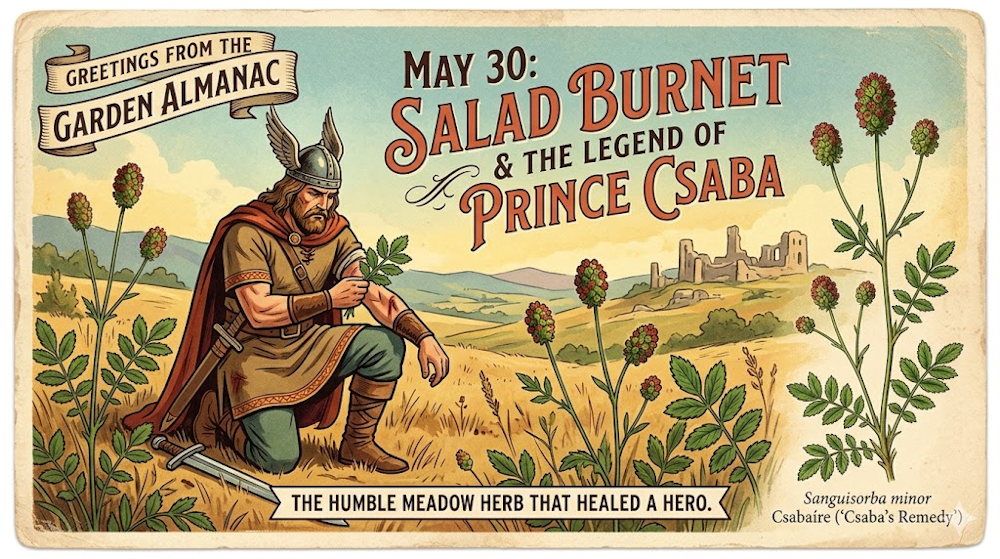

May 30 brings a small, modest plant into the Garden Almanac: salad burnet, Sanguisorba minor. In Hungarian tradition, it is linked with the name csabaíre vérfű, a plant remembered through the legend of Prince Csaba and the healing of wounds.
It is not a showy flower. It does not dominate a meadow. Yet it carries one of the most powerful things a plant can carry: a story.
Prince Csaba and the Healing Herb
In Hungarian and Székely legend, Prince Csaba is remembered as a heroic figure connected with origins, return, survival and hope. His story belongs to the world of legend rather than documented biography, but that is exactly why it has remained so alive in cultural memory.
The plant known as csabaíre vérfű is said to have gained its name from the legend that Prince Csaba used it to stop bleeding after battle. The name can be understood as “Csaba’s remedy,” a healing herb tied to a wounded hero.
Whether read as folklore, plant lore or cultural memory, the story shows how deeply people once connected plants with fate, healing and identity. A herb was not only a herb. It could become a name, a remedy, a legend and a link to place.
What Is Salad Burnet?
Sanguisorba minor, commonly known in English as salad burnet, is a perennial herb of dry grasslands, sunny slopes, calcareous soils and open meadow-like habitats. It has finely divided leaves and small rounded flower heads, often greenish, reddish or brownish in tone.
It is a plant of restraint rather than spectacle. You may pass it by unless you are looking closely.
That quietness is part of its charm. Salad burnet is the kind of plant that rewards attention. It belongs to the dry meadow, the herb border, the wild garden and the old herbal tradition.
A Herb for Wounds and Astringency
The Latin genus name Sanguisorba points toward blood: from words associated with absorbing or staunching blood. In traditional herbalism, burnets were valued as astringent plants, often linked with wound care, bleeding, digestive complaints and other uses related to tightening and drying tissues.
These uses were commonly associated with tannins, the compounds that give many astringent plants their characteristic effect.
Today, such traditions should be understood as herbal history rather than emergency medical advice. Serious wounds or internal bleeding require proper medical care. But as part of the history of plant knowledge, burnet remains a fascinating example of how people read healing potential in the plants around them.
A Leaf With a Fresh Taste
Salad burnet also has a gentler culinary side. Young leaves are edible and are often described as having a fresh cucumber-like, sometimes slightly nutty taste. They can be used in salads, cold drinks, herb mixtures and summer dishes.
This gives the plant two faces: the legendary wound herb and the quiet kitchen herb.
In one story, it belongs to battle and healing. In another, it belongs to a fresh bowl of salad on a warm day. The same plant can move from myth to meadow to table.
Names, Memory, and Plant Lore
Folk plant names are rarely just labels. They are small archives. They may preserve a use, a story, a place, a warning, a resemblance or a belief.
The Hungarian name csabaíre shows this beautifully. It does not merely identify a botanical species. It remembers a legendary healer’s moment. It turns a plant into a cultural object.
Older plant names could sometimes shift between species or vary by region, because traditional plant knowledge was based on use, appearance, habitat and local experience. Scientific names aim for precision. Folk names carry memory.
Both matter.
Burnet in the Wildlife-Friendly Garden
Salad burnet can also belong in a modern wildlife-friendly or naturalistic garden, especially where dry, sunny conditions suit meadow plants. It fits well into herb gardens, edible flower plantings, dry meadow borders and low-input areas where plants are allowed to be useful to more than humans.
The wider burnet family and related meadow plants can also have ecological value. In natural and semi-natural grasslands, such plants contribute to the texture and diversity of habitats that support insects, including pollinators and butterflies.
A garden that includes modest meadow plants becomes richer in quiet ways. Not every valuable plant needs to shout.
Joan of Arc and the Calendar of Heroes
May 30 is also widely associated with Saint Joan of Arc. Her story belongs to another country and another tradition, yet it creates an interesting echo beside the legend of Prince Csaba.
Both bring together youth, courage, conflict, suffering and memory. In the Garden Almanac, the connection is not about comparing histories, but about noticing how calendars preserve heroic stories through symbols, names and rituals.
Plants often become part of that preservation. A herb, a flower, a tree or a landscape can carry a legend farther than stone alone.
What May 30 Teaches
May 30 teaches that healing herbs are never only about chemistry, and legends are never only about the past. Between them lies a world of human attention: watching plants, naming them, using them, telling stories about them and passing those stories on.
Salad burnet is small, but its story is large. It speaks of dry meadows, old remedies, edible leaves, battle wounds, folk names and the human need to believe that nature may offer help in difficult moments.
In the Garden Almanac on this day, one modest herb becomes a bridge between plant and legend, wound and remedy, meadow and memory.