
May 29 is a day when history, folklore, and ecology meet beneath the branches of one remarkable tree: the oak.
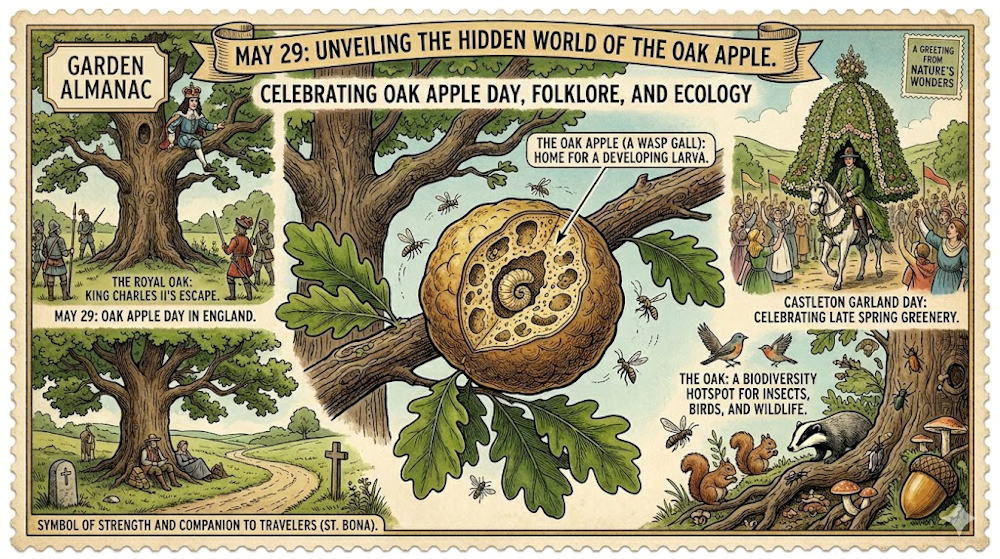
In England, the date is known as Oak Apple Day, a traditional celebration linked to the restoration of King Charles II and the famous story of the Royal Oak, where the future king supposedly hid from his enemies. Yet beyond the historical connection lies a fascinating natural phenomenon that deserves attention in its own right.
The oak apple is not a fruit. It is a gall—a specialized plant structure formed when tiny insects, usually gall wasps, influence the growth of the tree.
The result is a round, apple-like growth created from the oak’s own tissues. Inside, a developing larva finds shelter, food, and protection. What appears to be a simple lump on a leaf or twig is actually a highly sophisticated biological structure.
A Living Partnership
Gall formation is one of nature’s most intriguing interactions.
When a gall wasp lays an egg in the tree, chemical signals trigger the oak to produce a unique growth around it. The developing insect benefits from this structure, while the tree continues its life largely unaffected.
Although the relationship may seem unusual, it is a natural part of the ecological complexity that surrounds mature trees.
More Than a Tree
An oak is far more than a single organism standing in a landscape.
Its branches support birds and insects. Its bark shelters countless small creatures. Its roots interact with fungi beneath the soil. Its acorns feed wildlife, and its fallen leaves enrich the ground.
Old oaks are often described as biodiversity hotspots because they support such a wide variety of life forms.
Oak galls are just one visible reminder that every mature tree hosts an entire community.
Oaks and Human Culture
Across Europe and many other parts of the world, oaks have long symbolized strength, endurance, and stability.
Ancient oaks have served as landmarks, gathering places, and symbols of continuity. Their longevity allows them to witness generations of human history.
Because of these qualities, oak leaves and acorns frequently appear in heraldry, monuments, and traditional decorations.
Celebrating Greenery
May 29 is also associated with Castleton Garland Day in Derbyshire, England. During this colorful celebration, a rider known as the Garland King wears an enormous floral structure covered with greenery and flowers.
The tradition reflects a universal human impulse: celebrating the abundance of late spring through plants, branches, and blossoms.
Similar customs can be found throughout Europe, where seasonal festivals often incorporate greenery as a symbol of renewal and vitality.
Trees as Companions
The day is also linked to Saint Bona of Pisa, a patron saint of travelers.
For centuries, large trees served as landmarks and resting places along roads and pilgrimage routes. Their shade offered comfort, and their presence helped travelers navigate unfamiliar landscapes.
Even today, a mature tree creates a sense of place unlike any other feature in a garden or landscape.
The Lesson of May 29
The oak apple reminds us that nature is full of hidden stories.
What appears to be an odd growth is actually evidence of a complex relationship between species. It is a visible sign that life is constantly interacting, adapting, and creating new forms.
May 29 encourages us to look more closely at the natural world. Sometimes the most remarkable discoveries are not found in rare places or dramatic landscapes, but in the small details hanging quietly from the branch of an ordinary tree.
The oak does not grow apples. It grows connections.