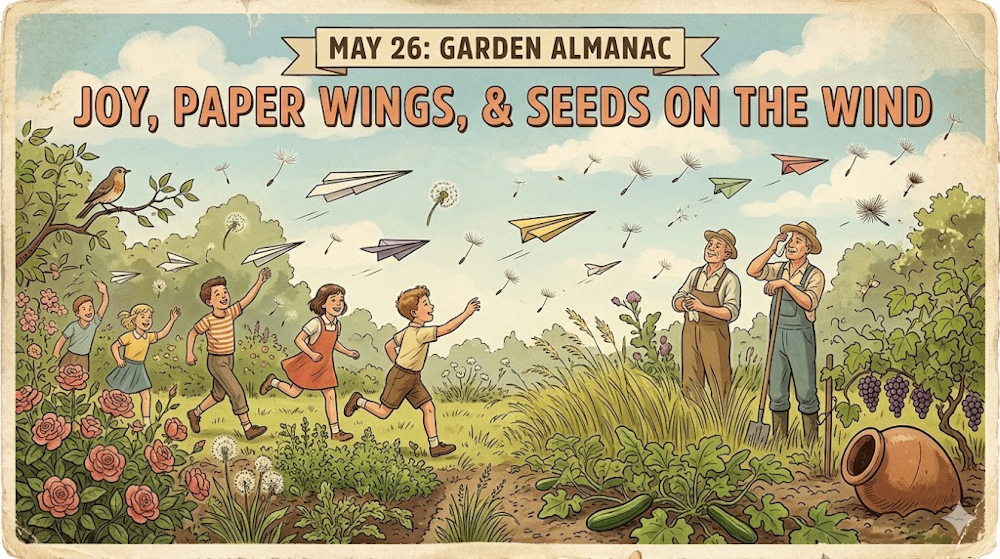

May 26 brings a lighter mood to the Garden Almanac. It is the feast day of Saint Philip Neri, remembered for joy, warmth and human kindness. It is also National Paper Airplane Day, a playful modern observance that fits the garden better than it first appears.
Because the garden, too, knows how to fly.
By late May, the air is full of movement. Seeds drift, spin, float and travel. Pollen moves. Leaves tremble. Grasses bend. Children throw paper airplanes. Gardeners wipe their hands, look up for a moment, and remember that not everything in the garden is about control.
Some things are about delight.
Saint Philip Neri and the Joy of the Garden
Saint Philip Neri is often associated with joy, humor and a generous human spirit. In the Garden Almanac, his day is a reminder that a garden is not only a place of labor. It is also a place of gladness.
Gardeners can easily forget this in late May. There is so much to do: watering, tying, planting, weeding, checking for pests, watching the weather, rescuing seedlings from their own dramatic tendencies. The garden becomes a list, and the list never ends.
But a garden is not only a list.
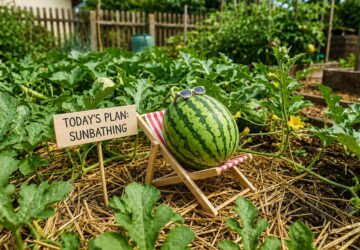
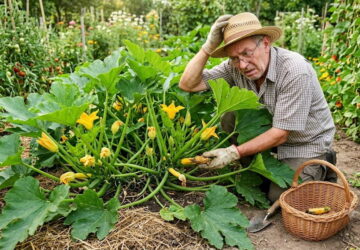
It is the scent of herbs after rain. A rose opening unexpectedly. A bird returning to the same branch. A child blowing dandelion clocks. A tomato plant finally deciding to forgive the weather. A moment of laughter when the courgette plant grows as if personally sponsored by chaos.
Joy is not an extra in the garden. It is one of the reasons we return.
Paper Airplanes and the Question of Flight
National Paper Airplane Day may sound far from gardening, but paper airplanes ask a question that plants answered long ago: how can something small travel through air?
A folded piece of paper glides because shape, balance and air meet in the right way. Seeds do the same, only with far older designs.
Dandelion seeds carry tiny parachutes. Maple samaras spin like little helicopters. Cottonwood and poplar seeds float on silky fibers. Thistle and willowherb seeds ride the wind on fine plumes. Each structure is a small solution to a large problem: how to reach somewhere new.
In the garden, flight is not always dramatic. Sometimes it is a seed leaving quietly on a breeze.
The Wind as an Uninvited Gardener
Gardeners have mixed feelings about wind. It dries soil, bends seedlings, scatters mulch, knocks over pots and arrives with comic timing whenever fine compost or dry leaves are involved.
Yet wind is also a gardener of its own kind. It moves seeds, carries pollen, dries damp leaves, cools hot spaces and reshapes the garden’s small weather. It brings things we did not plant and takes things farther than we expected.
A wind-sown plant in the wrong place may be called a weed. In another place, it may be a gift.
The wind reminds us that a garden is not a closed room. It is open to the world.
Seeds Built for the Air
Wind-dispersed seeds are among nature’s most elegant small inventions. The dandelion’s feathery parachute slows its fall and lets it drift. The maple’s winged seed spins, reducing speed and extending distance. Fluffy seeds use lightness and surface area to travel across surprising spaces.
These forms are not decorations. They are survival strategies.
A seed that lands too close to its parent may face shade, crowding and competition. A seed carried farther may find light, soil and opportunity. What looks like play is often serious botanical engineering.
The paper airplane and the dandelion seed both belong to the same lesson: flight depends on form, timing and air.
Georgia, Wine, and the Earth That Remembers
May 26 is also Independence Day in Georgia. In the Garden Almanac, this date offers a brief but beautiful connection to one of the world’s oldest wine cultures. Traditional Georgian qvevri winemaking uses large clay vessels buried in the earth, where wine ferments and matures underground.
This gives May 26 a quiet link to the vineyard lore of the previous day. On Saint Urban’s Day, winegrowers watched the weather and worried over the vines. On May 26, Georgia reminds us that grapes are not only crops. They are memory, craft, family, earth and culture.
A vine is a plant. Wine is a story people make from it.
The Seriousness of Play
Joy, paper wings, windblown seeds and buried wine may seem like a strange combination, but they all belong to the same late-May truth: the garden is richer when it is not reduced to usefulness.
The garden feeds, yes. It also teaches, surprises, frustrates, amuses and connects. A seed in the wind, a child’s paper airplane, a saint remembered for joy, a buried clay vessel of wine: each one says that human life with plants has always been practical and poetic at the same time.
What May 26 Teaches
The lesson of May 26 is simple: leave room for delight.
Work in the garden, but do not only work. Notice the flying seed. Laugh at the wind. Let some herbs flower. Watch what arrives without permission. Remember that not every good thing in the garden can be measured in harvest weight.
In the Garden Almanac on this day, the garden becomes lighter. It lifts a little. It reminds us that joy, like a seed, often travels farther when given air.