
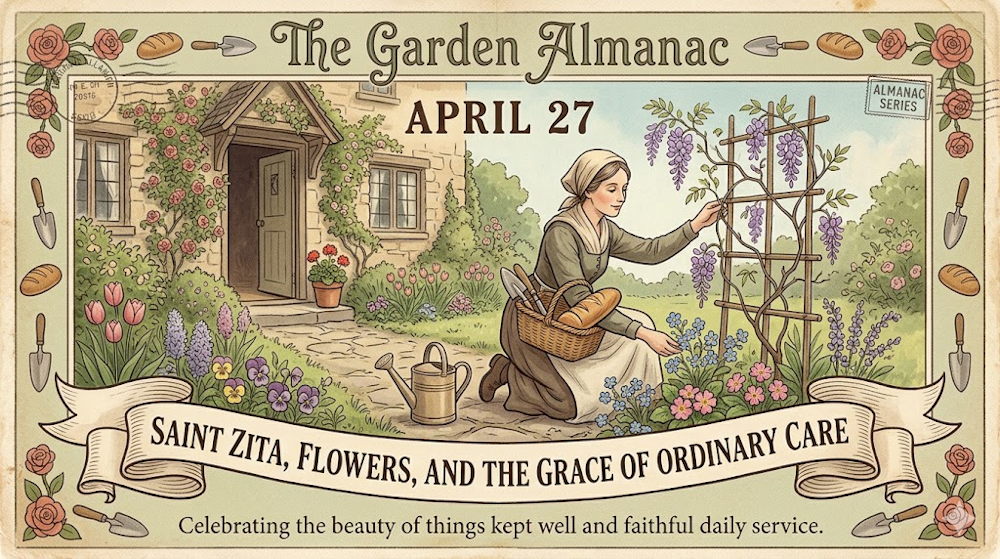

April 27 carries a quieter kind of spring meaning. It is not a date of dramatic thresholds or major agricultural rites, but one that lends itself beautifully to the smaller virtues of the season: steadiness, order, attentiveness, and the beauty of things kept well. In the Garden Almanac, it becomes a day for noticing how much of the garden’s life depends not on spectacle, but on ordinary care.
Saint Zita, whose feast falls on this day, is associated with homemakers, domestic workers, and the dignity of faithful daily service. That makes her an unexpectedly fitting figure for late April. By now, the garden is beyond its first awakening and has entered a phase where regular tending matters deeply. Small acts begin to shape the whole atmosphere of the place.
Saint Zita and the Dignity of Tending
Zita’s story belongs to service, humility, and constancy. These are not always celebrated qualities in gardening, which often favors bloom, harvest, and visible transformation. Yet anyone who has kept a garden well knows that its true character is built through repetition: watering before stress sets in, tying what needs support, clearing what chokes growth, and noticing small imbalances before they become larger ones.
That is why Saint Zita suits this date so naturally. She represents the grace of care that does not draw attention to itself, even while it makes all the difference.
Bread, Flowers, and the Domestic Garden
In Lucca, Saint Zita’s feast is associated with bread and flowers. The pairing feels perfect for an almanac. Bread speaks of nourishment, necessity, and the daily table. Flowers speak of beauty freely given, the part of life that exceeds strict usefulness.
A good garden often holds both. It feeds and it delights. It supports living and enriches it. By late April, this balance becomes especially visible in kitchen gardens, thresholds, pots, herb corners, and the flower borders nearest the house.
The Garden Close to the Door
April 27 is particularly well suited to thinking about the garden nearest the home: the entryway, the path, the small bed under a window, the potted plants on a step, the shrub that softens a wall, the patch that makes the house feel inhabited rather than merely occupied.
These are not insignificant parts of a garden. They often carry its emotional truth. They reveal whether a place is being lived with attentively or simply managed.
What This Day Suggests in Practice
This is a good day for gentle maintenance rather than ambitious intervention. Water containers well. Tidy edges. Support fresh growth. Remove what is clearly crowding. Notice where the garden wants a little more softness, fragrance, or welcome.
In the Garden Almanac, April 27 belongs to the beauty of constancy. Not every spring day calls for bold work. Some ask instead for the patience that keeps a place lovable.