

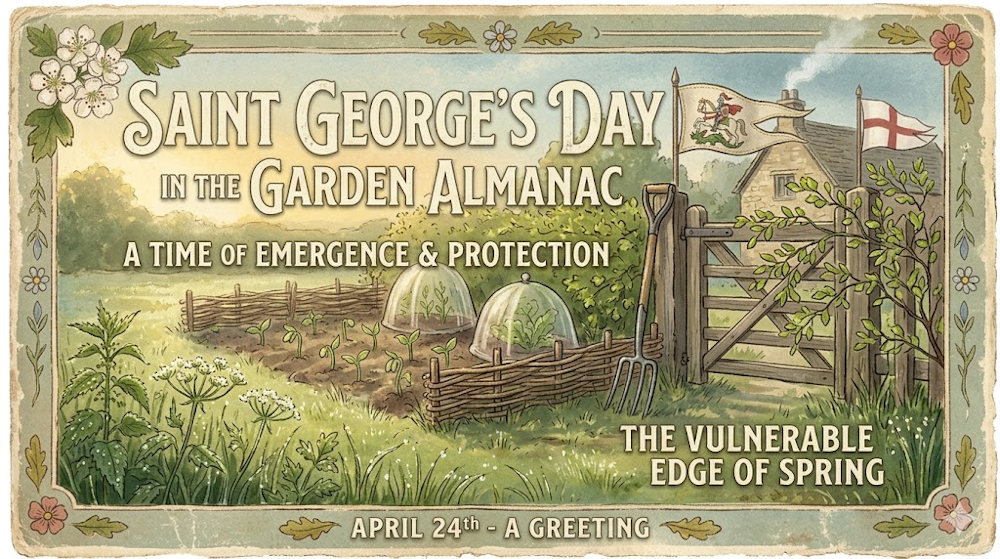

April 24 sits in that delicate part of the season when spring feels real, but not fully secure. Growth is visible, the garden is clearly awake, and the year seems to be moving forward with confidence. Yet this is still a time when young stems can be checked by cold, tender leaves can be marked by rough weather, and early promise still needs protecting. In a garden almanac, that makes April 24 a date of alertness as much as advancement.
Across Europe, the days around Saint George have long carried the feeling of a seasonal threshold. They belong to the outward movement of spring: livestock returning to pasture, fields reopening, work rhythms changing, and the land shifting from preparation into active growth. That broad seasonal meaning matters more here than any single local custom. April 24 is a day that asks not only whether spring has arrived, but whether it can now be trusted.
Saint George and the Courage of the Season
Saint George is best known in legend as the dragon-slayer, but in seasonal tradition his day often stands for another kind of courage: the courage of emergence. This is the point in the year when life begins to move out of shelter and into exposure. The garden is no longer waiting underground or holding back in bud. It is declaring itself.
That is why Saint George suits the almanac so well. His name gathers together ideas of protection, risk, testing, and release. These are all deeply springlike themes. By late April, the season is not fragile in the way it was in March, but it is not beyond danger either.
Dew, Dawn, and What the Morning Reveals
Few things belong to late April more beautifully than dew. In older traditions, dew at Saint George’s time was often seen as charged with vitality, blessing, or fertility. Even without carrying the old beliefs literally, the image remains exact.
A dewy morning tells the gardener a great deal. It reveals how the garden is holding moisture, where the chill settles, how air is moving, and which plants are beginning to harden into strength. Dawn at this time of year is not ornamental. It is diagnostic. It shows the real condition of the season before the day smooths it over.
Protection as a Spring Instinct
Many spring customs around this time of year were, at their core, protective. Whether expressed through ritual, symbolic gestures, green branches, smoke, iron, or blessing, the purpose was much the same: to guard what had only just begun.
Gardeners still live by that instinct, even if the language has changed. Now the threats are named as cold snaps, fungal pressure, pests, wind scorch, or sudden stress. But the underlying truth is exactly the same as it was in older agrarian life: early growth is hopeful, but it is not invincible.
Beans, Beginnings, and the Working Year
Late April has also often been linked with practical beginnings: sowing, hiring, setting duties, choosing who watches what, and deciding how the season will be managed. In that sense, April 24 belongs not only to folklore, but to organization. Spring does not advance by weather alone. It advances because people begin acting in step with it.
That practical note gives the day an especially strong almanac quality. It is about more than symbolism. It is about the moment when seasonal energy turns into work.
What This Day Suggests in Practice
April 24 is a good day to walk the garden early, pay close attention to moisture, support what is tender, and notice where growth is now strong enough to rely on and where it still needs shelter. It favors steadiness over haste.
In the Garden Almanac, this date belongs to spring’s vulnerable edge: not the first stirring, and not yet the settled season, but the living threshold between the two. That is why it feels so charged. The garden is opening for real, and what happens next depends partly on how carefully we read it now.