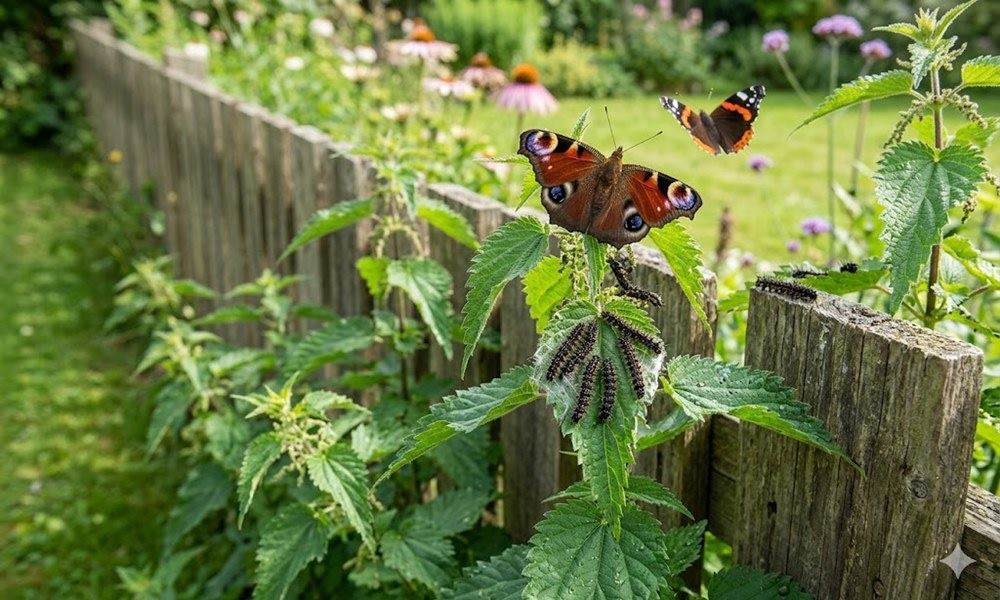

Nettles have a serious image problem. In most gardens, they are treated like unwelcome intruders: they sting, they spread, they look unruly, and worst of all, they seem to return with the confidence of a plant that has absolutely no intention of apologizing. A gardener spots them by the fence, sighs deeply, pulls on gloves, and prepares for battle. And yet nettles are rarely discussed the way they actually deserve to be. They are not just “weeds.” They are a small ecological nursery, or if we want to sound more refined, an essential host plant for several well-loved butterflies.
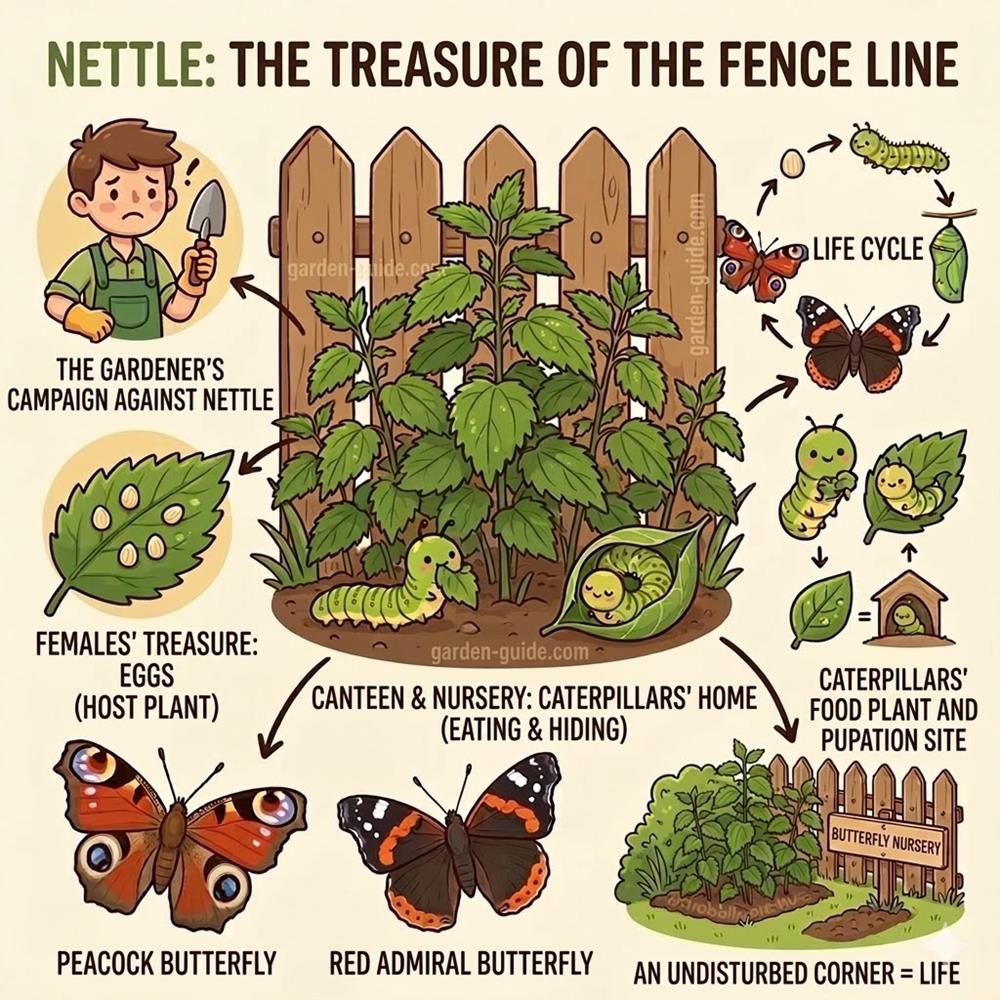
In plain language: what looks like prickly mess to us is, for many caterpillars, a nursery, canteen, and protected play area all in one.
I used to look at nettles as a personal insult to garden discipline. Then one day I took a closer look at a patch left standing by a fence and realized it was not just leaves. It was life. Caterpillars, folded leaves, tiny hidden shelters, and the very clear feeling that I was not looking at neglect at all. I was looking at a functioning miniature ecosystem. Since then, nettles have stopped being just “something to remove” and become more of a negotiation partner.
Why are nettles so important for butterflies?
Because the caterpillars of several striking, familiar butterfly species do not merely tolerate them. They actively need them. The adult butterfly is graceful, weightless, and photogenic, but before that it was a caterpillar, and caterpillars do not survive on flower nectar. They need a host plant. A plant where the female can lay eggs, and where the emerging larvae can actually grow and feed. Nettles are exactly that kind of plant.
Species such as the peacock butterfly, red admiral, map butterfly, and painted lady are all linked with nettles, and in the case of the peacock and red admiral especially, the relationship is widely known. This matters because many gardeners happily plant “butterfly-friendly” flowers while accidentally removing the less glamorous but far more important part of the butterfly life cycle: the caterpillar food plants.
In other words, plenty of gardens provide a butterfly restaurant but no butterfly nursery. The two work best together.
The butterfly life cycle does not end with pretty wings
You only really understand the role of nettles when you stop thinking only about the adult butterfly. The process begins with the egg, then comes the caterpillar, then the chrysalis, and only then the butterfly. Garden romanticism usually prefers stage four, the elegant flying part. Nature insists on all four.
A female butterfly does not lay eggs on a plant because the view is attractive. She does it because the caterpillars need food when they hatch. Nettle leaves are nutrient-rich, suitable for fast-growing larvae, and when the plants grow in dense patches, they also offer protection. The young caterpillars often begin life in groups and can remain relatively well hidden among the leaves.
This is the point where nettles suddenly look very different. Not like a weed patch, but like a nursery with group rooms.
Why does it work so well at the base of a fence?
Because the fence line is one of the garden’s classic transitional zones. It is not used as intensively as the middle of a lawn or the neat rows of a vegetable bed. It often offers a little shade, some shelter from wind, a certain amount of quiet, and perhaps most importantly, that useful condition known as “nobody disturbs this every other day.” Nettles thrive in exactly these sorts of places.
From the butterfly and caterpillar point of view, that is ideal. The plant is not constantly trampled, it is less likely to be accidentally mown down, and it does not attract the same constant attention as a rose bed. What looks to the gardener like an untidy edge often functions for wildlife as a very respectable housing development.
Caterpillars really do love nettles, and not because they enjoy suffering
This is worth clearing up, because once a plant stings us, it is easy to assume it must be unpleasant for everything else too. But caterpillars are not built like humans. For them, nettles offer several advantages.
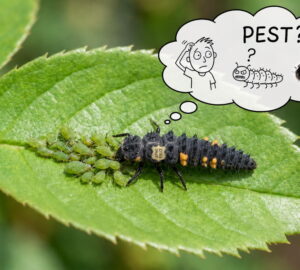
First, the leaves are nutrient-rich, which matters enormously when your entire business model is rapid growth through relentless eating. A caterpillar is basically an eating machine with slightly better public relations. Second, the dense leaves and stinging surface can provide some protection from predators. Third, the structure of the plant helps caterpillars remain hidden, and some species even use folded or spun leaves to create small shelters. So nettles are not only a menu. They are also, to some extent, a security system.
Leaving nettles is not laziness. It is a deliberate wildlife-friendly choice
This may be the sentence many gardeners most need to hear. Not every self-seeded plant is an enemy. Nettles can spread, of course, and no one is suggesting you surrender the entire garden to them, but leaving a small, intentional patch can be an extremely sensible decision.
Especially if the goal is to support butterflies not only in postcard terms, with flowers for adults, but in ecological terms too. A butterfly-friendly garden does not begin when you plant echinacea and verbena. It begins when you make room for the entire life cycle.
That sometimes means accepting that the garden is not a sterile display space but a living system. Slightly less control, slightly more life.
No, you do not need to grow a nettle forest
Before anyone gets carried away, leaving nettles does not mean handing the garden over to spontaneous green anarchy. The best solution is usually a compromise. A patch at the base of the fence, in a less-used corner, near a compost area, or somewhere out of the main traffic line is often enough.
The point is to choose the spot deliberately. Then the nettles are not “taking over.” They have a role. This is one of the best agreements between gardener and nature: you keep a workable garden, and the butterflies get their nursery.
But yes, they still sting
They do. They remain impressively consistent on that front. But that still does not mean every nettle should be interpreted as a declaration of war. In the right place, nettles can be useful in all sorts of ways: for plant feed, compost activation, green matter, and, ecologically speaking, as butterfly-support infrastructure.
Very few plants manage to be this unpopular and this useful at the same time. Nettles are a bit like that neighbour you first assume is grumpy, only to discover that half the street would fall apart without them.
So what is the real lesson?
That not everything valuable in a garden is immediately decorative. Some plants do not win beauty contests. They win at ecological support work. Nettles are a perfect example. They do not ask for stylish containers, they do not pose in the middle of the border, and they are not trying to create Mediterranean ambience. They simply stand by the fence and quietly provide the next generation of several beloved butterflies.
That is a fairly impressive achievement for a plant many people still see as nothing more than an annoying stinging weed.
So the next time you notice a patch of nettles along the fence, perhaps your first thought will not be “that has to go,” but something more like “well then, the butterfly nursery is open.” And that makes the whole garden a more interesting place.