

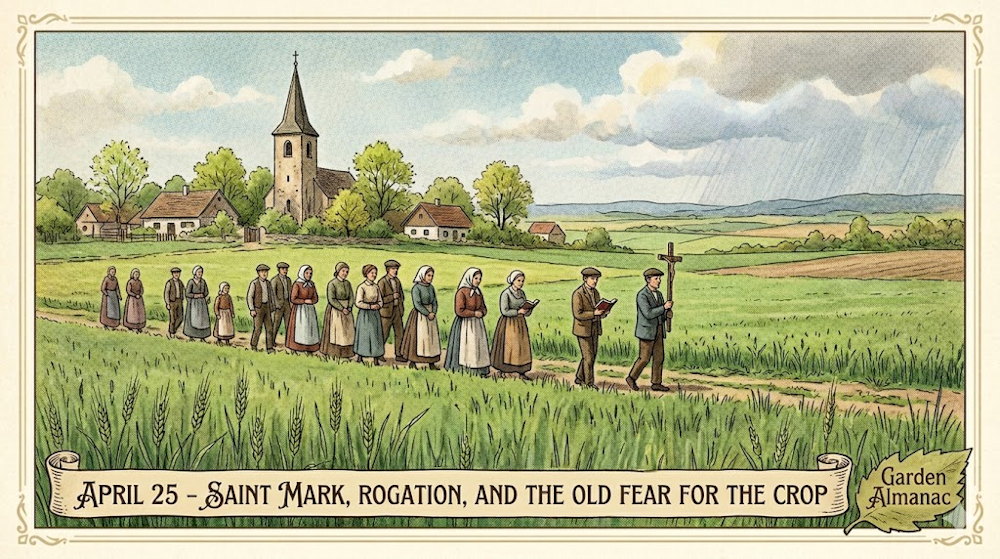

April 25 is one of the clearest agricultural dates in the spring calendar. In Christian tradition it is the feast of Saint Mark the Evangelist, and in older Western practice it is also the Major Rogation: a day of procession, supplication, and blessing for the fields. In an almanac, this gives the date unusual weight. It belongs not merely to spring growth, but to the anxious interval when the crop is already underway and yet still deeply vulnerable.
This is the point in the season when the year begins to show its promise and its risk at the same time. The grain is no longer a plan. It is standing in the field, exposed to weather, disease, accident, and all the uncertainties that have always made farming an act of both labor and trust.
Saint Mark and the Blessing of the Fields
The processions and prayers associated with Saint Mark’s Day were not symbolic in a decorative sense. They were practical acts of hope. Communities went out to the fields, asked for protection from blight, hail, drought, and other disasters, and marked the landscape as something shared between human care and forces beyond control.
That spirit translates beautifully into the Garden Almanac. By late April, a gardener already knows that effort alone does not guarantee success. Growth has begun, but fulfillment is still far away. Saint Mark’s Day belongs to that difficult and honest middle space.
Robigalia and the Rust in the Grain
Long before Christian observance shaped this date, April 25 in ancient Rome was the day of the Robigalia, a rite intended to protect crops from grain rust and plant disease. The fear behind it was entirely practical. A field could look promising and still fail. One invisible affliction could undo a season’s work.
This older layer matters because it reveals how persistent agricultural anxiety has always been. Across belief systems, people returned to the same question: how do we protect what is growing from the things we cannot fully command?
Rogation as a Seasonal Mood
The word rogation comes from asking, and that spirit of asking belongs deeply to this date. April 25 is not a triumphant day in the almanac. It is a beseeching one. It carries humility, watchfulness, and a recognition that growth is never entirely self-secured.
For gardeners, this mood is easy to understand. A season may look healthy and still need mercy from the weather. Moisture can turn to rot. Dryness can come quickly. Wind can scar what had seemed secure. The day is not pessimistic, but it is sobering.
Signs in the Field
Traditional rural life often read this date through the behavior of the landscape itself. Birdsong, moisture, cover in the grain, and atmospheric change all became signs of what kind of harvest might follow. Whether taken literally or not, such observations reflect something very real: by late April, the field begins to reveal its condition to anyone patient enough to look.
That is true in gardens too. The season is readable now in a different way than it was in March. Growth patterns, vigor, stress, and ecological activity all begin to show themselves more clearly.
What This Day Suggests in Practice
April 25 is a good day to look at planted ground with both gratitude and seriousness. Notice whether crops or young growth are truly thriving, whether disease pressure may become an issue, whether moisture is balanced, and whether the garden’s living systems are active around what is growing.
In the Garden Almanac, this is a day for respect rather than confidence. Not because spring is failing, but because it has become real enough to lose.