
May 6 is a richly layered spring date in the almanac because it gathers several traditions around one central truth: by now, the season is asking to be acted on. The soil is warming, tender crops begin to feel possible, and spring is no longer just an idea in the landscape. It has entered both work and celebration.
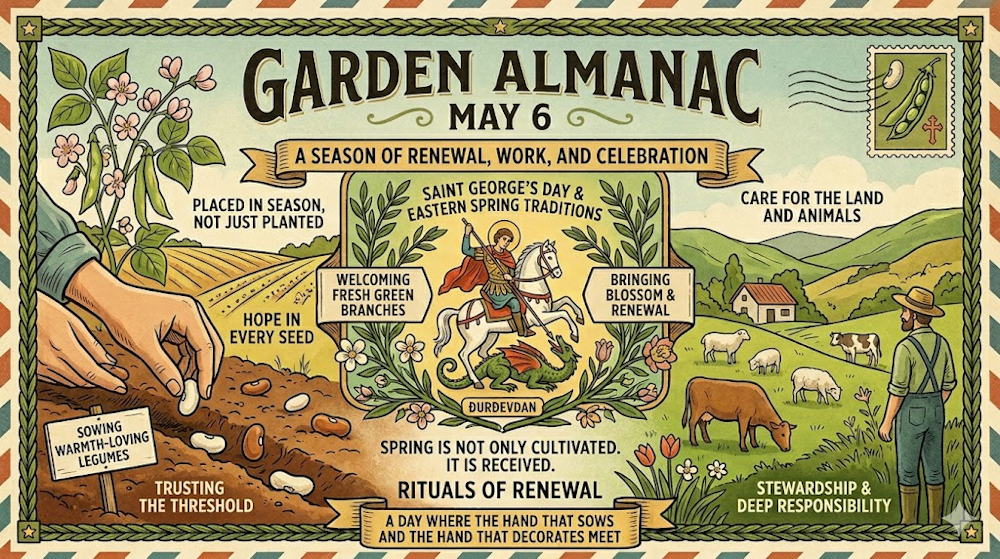
One of the strongest garden meanings of the day lies in bean sowing. Across older seasonal thinking, legumes belonged to that moment when the year had moved far enough forward to allow hope, but still required judgment. Beans are not planted simply because the calendar says so. They are planted because the season finally begins to feel trustworthy enough.
Sowing Beans at the Right Threshold
Bean sowing customs often preserve a practical horticultural intelligence beneath their folk surface. Warmth matters. Soil condition matters. The difference between an eager sowing and a successful one can be the difference between foliage and fulfillment.
This makes May 6 an excellent almanac date for thinking about thresholds. The garden is crossing from preparation into confidence, but only if the gardener respects timing. A seed placed well is not merely planted – it is placed in season.
Saint George in the Eastern Spring
May 6 also belongs, in much of the Orthodox world, to Saint George’s Day. In the Balkans, among Eastern Christians, and in related spring traditions such as Đurđevdan, Gergyovden, Yuri’s Day, and Ederlezi, this date carries a vivid atmosphere of green branches, flowers, washing, renewal, protection, and the ceremonial welcoming of spring.
That makes the day especially valuable in an international Garden Almanac. It shows how the season can be marked not only by work in the soil, but by ritual gestures that bring water, blossom, and fresh greenery into daily life. Spring is not only cultivated. It is received.
Seeds, Protection, and Folk Imagination
Bean traditions also tend to attract a remarkable amount of folk belief. Seeds are rarely treated as neutral in agrarian imagination. They can heal, protect, fail, or carry hidden force. This is not merely superstition in the dismissive sense. It reflects the deep emotional charge of planting.
Every gardener knows, in a more modern way, that seed carries disproportionate hope. A handful of beans is small in the hand, but large in consequence.
A Day for Renewal and Responsibility
May 6 also invites a broader reflection on care: care for the land, for animals, for the systems that link the household or garden to the wider living world. Spring renewal is not only decorative. It places responsibility back into view.
This gives the date an unusual depth. It is about sowing, but also about stewardship. About new life, but also about the kind of attention that allows life to continue well.
What This Day Suggests in Practice
May 6 is a good day to consider sowing warmth-loving legumes if conditions are right, to pay attention to whether the soil genuinely feels ready, and to notice where spring has become established enough to move from caution toward confidence. It is also a beautiful day to welcome the season more consciously: with greenery, water, flowers, and a sense of renewal rather than mere routine.
In the Garden Almanac, this is a date where work and celebration meet. The hand that sows and the hand that decorates are both answering the same season.