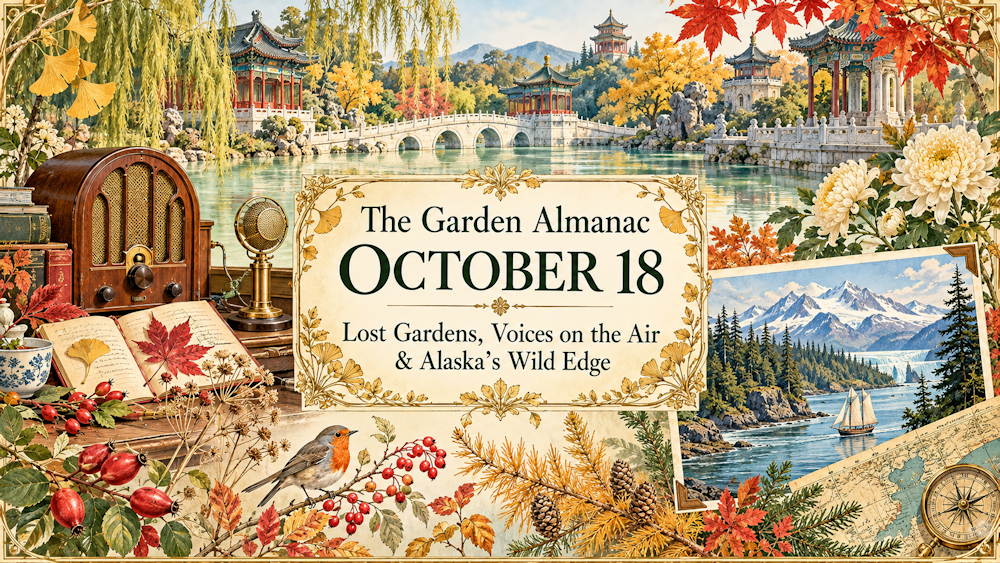

Mid-October is a season of partial revelations. Leaves loosen their hold, seed heads become more visible, and the garden’s bones begin to show through its summer abundance.
October 18 opens three very different doors: into an imperial garden in Beijing, into the first days of broadcasting, and onto a rain-swept hill in Alaska. They do not form one neat historical lesson – but each changes the way we might look at a cultivated place, a shared piece of knowledge or a living landscape.
October 18, 1860 – When the Garden of Perfect Brightness Burned
In 1860, on the outskirts of Beijing, the Old Summer Palace – Yuanmingyuan, often translated as the Garden of Perfect Brightness – was not simply a palace with flower beds around it. It was an immense imperial landscape of lakes, islands, pavilions, planted scenes, winding paths and carefully framed views, developed over generations by Qing emperors.
Its name as the “Garden of Gardens” was no idle compliment. The place gathered distinct landscapes into one great composition: formal architecture, water, groves, open ground and intimate garden rooms. Visitors did not take in the whole garden at once. They moved through it, one scene giving way to another, much as a well-made garden still leads us from shelter to prospect, from shade to reflected light.
On October 18, during the Second Opium War, British troops set fire to the complex after days of looting by Anglo-French forces. The destruction consumed buildings, collections and libraries, but it also erased a vast living work of landscape design. A garden can be rebuilt in part; its buildings can be copied; yet the mature trees, the relationships between water and path, and the accumulated memory of a place are much harder to restore.
That is why old gardens deserve more than admiration for their prettiness. When planning a border, a pond edge or a path, think in sequences rather than isolated features. Let a shrub partly conceal the next view, use a tree to frame a borrowed glimpse beyond the garden, and give a small space a pause before its next reveal. Yuanmingyuan reminds us that a garden is not merely planted ground – it is a way of moving through time and place.
Garden Science – Why do autumn leaves fall?
Before a deciduous tree sheds a leaf, it forms an abscission layer at the base of the leaf stalk. This gradually cuts the leaf off from the branch while the tree reabsorbs useful nutrients, especially nitrogen and phosphorus.
- Fallen leaves are not garden waste by default – they are stored fertility returning to the soil.
- Keep leaves off lawns and paths, but collect them separately to make leaf mould.
- Leave some leaf litter beneath hedges and shrubs, where it can shelter soil life and small invertebrates.
October 18, 1922 – The Day Gardening Found a Wider Voice
On October 18, 1922, the British Broadcasting Company was formed. It would later become the BBC, but its earliest promise was already remarkable: voices and practical knowledge could travel beyond the village hall, the nursery catalogue and the neighbour’s fence.
Gardening was an especially natural subject for the new medium. A gardener with a radio could hear timely advice without belonging to a horticultural society, owning a large garden or having access to a specialist bookshop. The question of when to sow, prune, mulch or protect a crop became part of a wider public conversation. In 1947, the BBC’s How Does Your Garden Grow? – later Gardeners’ Question Time – turned listeners’ real problems into broadcast material.
There is something quietly modern in that exchange. Gardening advice is most useful when it travels in both directions: expertise matters, but so do local observations about soil, frost pockets, wind, pests and rainfall. This October, make a small garden notebook of your own. Record the first morning frost, where leaves linger longest, which border dries first after rain and what still flowers for insects. A season’s worth of such notes will usually outlast a dozen generic tips.
Garden Reminder – Three useful October jobs
- Plant trees, shrubs, roses and hedging while the soil remains workable and moist; water them in well, even after rain, so soil settles around the roots.
- Mulch fruit trees and berry bushes with compost or well-rotted organic matter, keeping it a hand’s width away from trunks and stems.
- Cut spent pea and bean stems at ground level instead of pulling them up. Their roots may leave nitrogen-rich nodules in the soil.
October 18, 1867 – The Landscape That Changed Flags
On a hill above Sitka, Alaska, the Russian flag was lowered and the United States flag raised on October 18, 1867. The ceremony formally transferred Alaska from Russia to the United States – an event now marked as Alaska Day.
A transfer on paper can sound abstract, but Alaska was never an empty northern expanse waiting for a new label. It was, and remains, a land of Indigenous communities, salmon rivers, coastal forests, tundra, glaciers and immense seasonal rhythms. Political boundaries changed in an afternoon; the ecological relationships of the place did not.
For gardeners, Alaska offers an extreme version of a familiar truth: plants do not grow according to a map or a calendar alone. They respond to light, soil temperature, drainage, wind, snow cover and the length of the growing season. A sheltered city garden, a coastal plot and a hillside only a few kilometres away can behave like different climates. October is a good time to notice your own garden’s small territories – the warm wall, the wet corner, the windy gate and the patch where frost arrives first.
Wildlife Note – Leave a little of the garden unfinished
Autumn tidiness can remove food and shelter at exactly the moment wildlife needs both.
- Leave healthy seed heads of plants such as teasels, echinacea and ornamental grasses where they will not cause a problem.
- Keep a few hollow stems and dry leaves in a quiet corner for overwintering insects.
- Check nets over ponds, fruit or crops often and keep them taut so birds and other animals cannot become entangled.
What to Observe Right Now – The Garden’s Changing Map
Watch where the first leaves collect after a windy day. They often reveal the garden’s invisible currents: sheltered corners, low points and the routes taken by moving air. Notice, too, which plants still hold their leaves, which berries are being visited, and where rain lingers longest after a shower.
These are not minor autumn details. They are clues for next year’s planting – and reminders that every garden is a landscape in miniature, shaped by weather, wildlife and the choices made over time.
Looking Ahead
October 18 offers no single instruction for the gardener. Instead, it gives us a lost garden whose design still invites careful looking, a broadcast tradition that made practical knowledge shareable, and a northern landscape that refuses to be reduced to a boundary on a map. As the growing season slows, use the quieter weeks to observe rather than simply clear away. The notes you make, the leaves you compost and the shelter you leave for wildlife can all become part of next year’s garden story.