

By September 14, the garden has begun to reveal which plants can prolong summer and which are already preparing to withdraw. Seed heads darken, migrating birds pass through unfamiliar places, and cooler nights quietly alter the pace of growth.
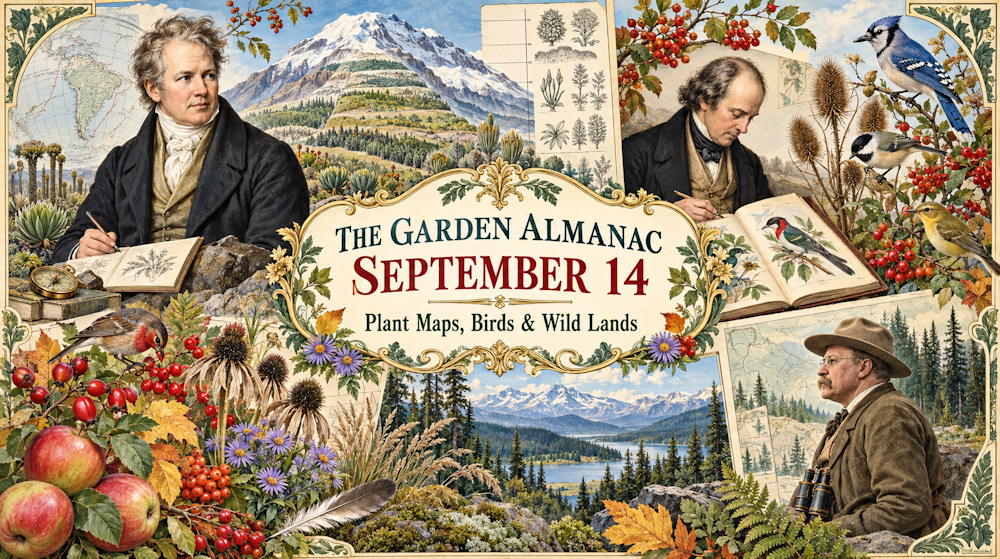
This date also brings together three influential ways of seeing the living world: Alexander von Humboldt mapped plants as members of climate-shaped communities, John Gould transformed birds into vividly recorded subjects of science, and Theodore Roosevelt carried conservation into national politics. Their stories remind us that no garden exists in isolation – it belongs to a much larger landscape of climate, habitat and human choices.
September 14, 1769 – Alexander von Humboldt and the Invention of Nature’s Plant Map
Alexander von Humboldt was born in Berlin on September 14, 1769. During his travels through the Americas at the turn of the 19th century, he measured temperature, altitude, humidity and magnetic forces while also recording plants, animals and landscapes. Instead of treating each specimen as a separate curiosity, he looked for relationships – particularly the way climate and elevation determine where different forms of life can flourish.
His celebrated depiction of Mount Chimborazo in present-day Ecuador arranged vegetation along the mountain’s slopes according to altitude. It showed that climbing a tropical mountain could resemble travelling from warm lowlands towards colder latitudes: forests gave way to shrubs, grasses and finally sparse alpine vegetation. This was an early visual expression of plant geography and of an idea now fundamental to ecology – species occur in communities shaped by environmental limits.
Humboldt also recognised that people could change those limits. Around Lake Valencia in Venezuela, he connected forest clearance with declining water levels and warned that removing woodland could alter soils, moisture and local climate. Long before modern climate science, he understood that vegetation does more than decorate a landscape: it stores water, moderates temperature, protects soil and influences the atmosphere immediately around it.
A garden offers a small but remarkably clear version of Humboldt’s interconnected world. A south-facing wall, a shaded hollow and an exposed balcony may lie only metres apart yet support very different plants. Before replacing a struggling specimen, observe the site itself: note when sunlight arrives, where frost lingers, how quickly soil dries and where rainwater collects. Matching a plant to its microclimate is usually more effective than repeatedly trying to correct an unsuitable location with extra watering or feeding.
Garden Science – What Is a Garden Microclimate?
A microclimate is the set of local conditions found within a small area. In one garden, temperature, wind, light and moisture can vary substantially because of walls, slopes, paving, trees and buildings.
- A south-facing wall absorbs heat by day and releases it slowly after sunset.
- Low ground often collects cold air, increasing the risk of frost.
- Hedges reduce wind but may also create dry soil through root competition.
- Paving raises nearby temperatures and speeds the loss of soil moisture.
- Tree canopies moderate heat while intercepting part of the rainfall.
Map these differences through the seasons before making major planting decisions. The right microclimate can make a marginally hardy plant more reliable, while the wrong one can defeat even a locally native species.
September 14, 1804 – John Gould, the Bird Man Who Made Observation Visible
English ornithologist John Gould was born at Lyme Regis on September 14, 1804. Beginning with practical skills in taxidermy, he became one of the most productive publishers of illustrated bird books in the 19th century. His lavish volumes presented birds from Europe, Asia, Australia and other regions with a vividness that helped readers recognise them as living creatures adapted to particular places.
Gould also examined bird specimens collected by Charles Darwin in the Galápagos Islands. By determining that several puzzling specimens belonged to distinct but related species, he helped clarify evidence that would become important to Darwin’s thinking about adaptation and evolution. Gould’s achievements depended on a wider circle of artists and naturalists, notably his wife, Elizabeth Gould, whose skilled lithographs shaped the beauty and scientific value of many early publications.
Modern gardeners do not need rare books or distant expeditions to continue this tradition of careful observation. A simple garden bird record can reveal when migrants arrive, which plants provide autumn food and whether changes in maintenance affect wildlife. Note the date, species, behaviour and plant being used rather than recording only the number of birds. Over time, repeated observations may show that an untidy seed head, berrying shrub or dense hedge is functioning as vital habitat.
Wildlife Note – How Can a Garden Help Birds in Early Autumn?
September can bring resident birds, dispersing juveniles and long-distance migrants into the same garden. Food is still available, but its location and abundance are changing rapidly.
- Leave some sunflower, teasel and other seed heads standing.
- Keep berrying shrubs unpruned until their fruit has been used.
- Provide clean, shallow water, particularly during dry weather.
- Avoid cutting every hedge and border at the same time.
- Clean feeders regularly to reduce the spread of disease.
A wildlife-friendly garden needs more than food. Dense cover offers protection, leaf litter shelters invertebrates, and layered planting gives different species places to forage at different heights.
What to Observe Right Now – Who Is Using the Autumn Garden?
Spend ten quiet minutes watching one fruiting shrub, seed-rich border or patch of lawn. Look for feeding height, preferred plants and interactions between species. Birds searching beneath leaves may be taking insects rather than seeds, while repeated visits to one shrub can identify a particularly valuable food source. These observations can guide future planting more reliably than a generic list of “wildlife plants”.
September 14, 1901 – Theodore Roosevelt and the New Scale of Conservation
On September 14, 1901, Theodore Roosevelt became the 26th president of the United States following the death of William McKinley. Although his accession came through tragedy, his presidency marked a decisive period in the history of conservation. Roosevelt treated forests, watersheds, wildlife and scenic landscapes as matters of public concern rather than inexhaustible resources awaiting development.
During his presidency, protection was extended across national forests, wildlife refuges, national parks and monuments. These policies helped establish the principle that governments have a responsibility to preserve functioning landscapes for future generations. The approach was not free from the assumptions and injustices of its era – protected-land policies often overlooked or displaced Indigenous relationships with those territories – but the political recognition that land and wildlife required long-term stewardship proved enormously influential.
For gardeners, the useful lesson lies in thinking beyond individual specimens. A mature tree is not simply an ornamental object: it may cool buildings, slow rainfall, store carbon, support fungi and provide nesting or feeding sites. A hedge can form part of a neighbourhood wildlife corridor, while a pond may serve animals moving across several adjoining gardens. Before removing an established feature, consider not only what will replace its appearance but also which ecological functions would disappear with it.
Garden Reminder – Useful Jobs for the Middle of September
Early autumn is an excellent time to improve resilience without stripping the garden of food and shelter.
- Collect ripe seed on a dry day and label it immediately.
- Plant spring-flowering bulbs in free-draining soil at an appropriate depth.
- Divide overcrowded herbaceous perennials once the soil is moist.
- Water newly planted trees and shrubs deeply during dry spells.
- Remove diseased foliage, but leave healthy stems and seed heads where possible.
- Start a leaf-mould area rather than sending fallen leaves away.
Delay wholesale tidying. Hollow stems, dry flower heads and undisturbed corners become increasingly valuable as insects prepare for winter.
Looking Ahead
September 14 shows how observation can grow into responsibility. Humboldt taught us to read plants through climate and place, Gould demonstrated the value of recording living detail, and Roosevelt’s era moved conservation onto the scale of public policy. In today’s garden, those ideas meet in practical choices: study the site, preserve useful habitat and connect each planted space to the wider landscape. Even a modest garden can become a carefully observed refuge – and part of a much larger ecological future.