

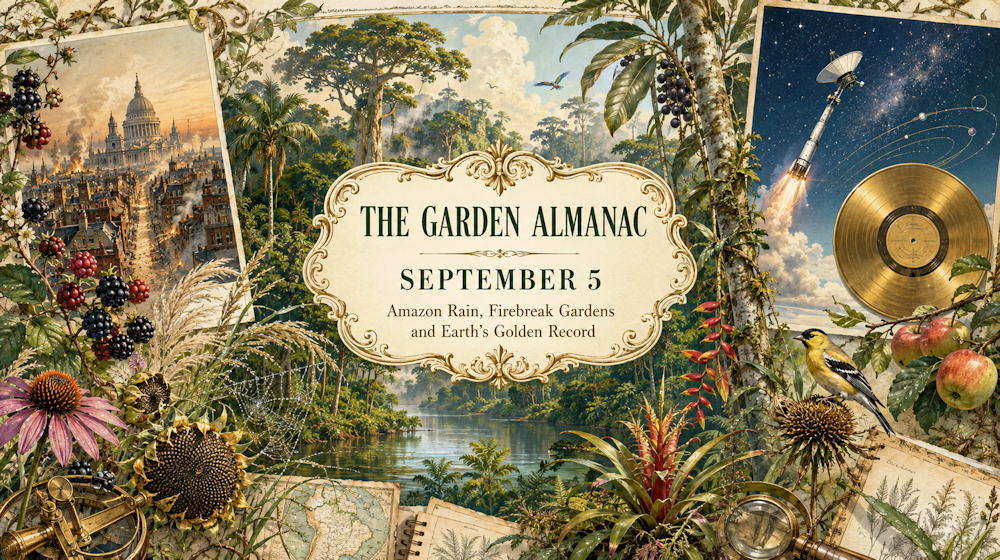

September 5 arrives at a seasonal crossroads. Across much of the Northern Hemisphere, gardens are beginning to loosen their hold on summer, while in the south, spring growth is gathering pace. Seed heads stand beside late flowers, fruit ripens, and changing light quietly reshapes the garden.
This date also connects three striking views of our relationship with nature: a vast rainforest that helps regulate a continent’s water, a city forced to reconsider how landscapes resist fire, and a spacecraft carrying images and sounds of Earth into interstellar space. Together, they remind us that every garden belongs to systems much larger than its boundaries.
September 5, 1850 – The Province That Gave Amazon Day Its Date
Brazil observes Amazon Day on September 5, a date chosen because the Province of Amazonas was created on this day in 1850. The anniversary has grown beyond its administrative origins to become an occasion for considering the future of the Amazon biome, which extends across several South American countries and contains forests, rivers, floodplains, wetlands and human communities shaped by seasonal water.
The Amazon is often described simply as a rainforest, but its living structure is far more varied. Some forests are flooded for months, while others grow on land that remains above seasonal river levels. Plants occupy distinct layers, from shaded forest floors to immense canopies where leaves compete for light. Roots, fungi, insects, animals and microorganisms continuously move nutrients through soils that are not always as naturally fertile as the luxuriant vegetation might suggest.
Water is the great organising force. Trees draw moisture from the soil and release water vapour through their leaves, contributing to atmospheric flows that can influence rainfall far beyond the forest itself. Forest loss therefore alters more than wildlife habitat – it can disrupt the movement of water through landscapes on which farms, cities and gardens depend.
For gardeners, Amazon Day offers a practical lesson in creating resilient planting rather than merely collecting individual plants. Layered vegetation protects soil, moderates temperature and provides many kinds of habitat. Even a small garden can borrow this principle by combining trees or tall shrubs with lower shrubs, perennials, ground-cover plants and climbers suited to the local climate. The aim is not to imitate a tropical rainforest, but to build a living community in which plants occupy different spaces and perform different jobs.
Garden Science – How Do Leaves Help Move Water Through a Landscape?
Plants release water vapour through microscopic openings called stomata, mainly on their leaves. This process, known as transpiration, helps draw water and dissolved minerals upwards from the roots and also cools the plant.
In a garden, vegetation can influence its immediate surroundings in several useful ways:
- Trees and shrubs shade soil and slow moisture loss.
- Ground-cover plants reduce surface heating and erosion.
- Leaf litter helps rain soak into the soil instead of running off.
- Several layers of planting create cooler, more humid shelter for wildlife.
A densely planted garden cannot manufacture regional rainfall, but it can create a noticeably gentler microclimate and use incoming water more effectively.
September 5, 1666 – What London’s Smouldering Streets Teach Us About Fire
By September 5, 1666, most of the Great Fire of London had been brought under control after flames had swept through a city of tightly packed buildings. Strong wind, combustible materials and narrow streets helped the fire spread. Houses were eventually demolished to create gaps that the flames could not cross easily – an early and drastic form of the firebreak principle.
The disaster is an urban story, yet it carries an increasingly relevant landscape lesson. Gardens do not cause wildfires by themselves, and no planting scheme can make a vulnerable property completely fireproof. The arrangement and condition of vegetation, however, can affect how readily flames and embers move towards a building. Continuous dry growth, accumulated debris and branches touching structures can form a chain of fuel.
In fire-prone areas, thoughtful maintenance matters more than searching for a supposedly fireproof plant. Remove dead material near buildings, keep gutters free of leaves, prune lower branches where locally recommended and avoid allowing shrubs to create an uninterrupted route from boundary vegetation to the house. Local fire-service guidance should always take priority because suitable distances, materials and planting choices vary with climate, terrain and building design.
Garden Reminder – A Five-Minute Late-Summer Safety Check
Early September is a useful moment to look for dry material that has accumulated during summer:
- Clear dead leaves and brittle stems from steps, decks and walls.
- Move stored firewood away from buildings where local guidance advises it.
- Check that climbing plants are not blocking vents or covering damaged wiring.
- Water newly planted trees deeply if conditions are dry, rather than sprinkling the surface.
- Keep access paths and gates clear for people, tools and emergency services.
Healthy vegetation can provide cooling shade and help protect soil. The goal is not to strip a garden bare, but to interrupt obvious pathways through which fire could travel.
September 5, 1977 – Voyager 1 Carries a Garden Beyond the Solar System
Voyager 1 was launched from Florida on September 5, 1977, beginning a journey past Jupiter and Saturn and eventually into interstellar space. The spacecraft transformed scientific understanding of the outer Solar System, but its most evocative cargo was not an instrument. Attached to it was a gold-plated record designed as a compact introduction to Earth.
The Golden Record contains greetings, music, human voices and sounds from the natural world, including wind, thunder, birds and other animals. Its images present not only people and technology but also leaves, flowers, a forest with mushrooms, fallen foliage, a tree with daffodils, food crops and agricultural work. When asked to describe Earth, the project’s creators could not tell the story without plants.
That choice carries a quiet message for every gardener. Plants are not decorative scenery around human life – they make complex terrestrial life possible. They turn sunlight into stored chemical energy, release oxygen through photosynthesis, support food webs, help form and protect soils, and create habitats from the smallest stem cavity to the largest forest canopy. A garden managed for diversity becomes a small but genuine record of what living Earth can do.
Wildlife Note – Should Seed Heads Be Cut Down in September?
Not all of them. Seed heads can provide food for birds and shelter for insects, while hollow or sturdy stems may remain useful well into winter. Plants such as sunflowers, teasels, coneflowers and many ornamental grasses can continue contributing to the garden after their flowers have faded.
Remove stems that are diseased, collapsing onto paths or turning soft and rotten. Leave a selection of healthy standing growth in quieter parts of the garden, especially where it will not create a fire or access problem. This mixed approach keeps borders manageable without removing every late-season resource at once.
What to Observe Right Now – The Garden Changes Its Use of Light
Around early September, shortening days become increasingly noticeable in northern gardens. Plants respond not only to temperature but also to day length, which can influence flowering, dormancy and seasonal growth. Meanwhile, many birds and insects are adjusting their behaviour as food sources shift.
Take a slow look around the garden and notice:
- which flowers still open on warm afternoons;
- where dew remains longest in the morning;
- which fruits are softening or changing colour;
- whether spiders are building webs in newly sheltered places;
- which plants are beginning to form seeds rather than new flowers;
- where spring growth is emerging in Southern Hemisphere gardens.
These observations reveal the garden’s microclimates. A border that stays warm and sunny may support insects later in the season, while a cool hollow can collect moisture and experience an earlier frost.
Seasonal Tips – What Can Gardeners Do in Early September?
In temperate Northern Hemisphere gardens, this is often a good time to divide congested herbaceous perennials, collect ripe seeds and plant suitable hardy perennials while the soil remains warm. Continue deadheading plants that can still produce flowers, but leave selected seed heads for wildlife and winter structure.
Sow appropriate green manures on empty vegetable beds. Their roots cover and hold the soil, while the upper growth can suppress weeds and capture nutrients that might otherwise be washed away by winter rain. The right species and sowing date depend on local conditions, so choose a crop suited to the available space and the next planned planting.
In the Southern Hemisphere, inspect fresh spring growth for aphids and other sap-feeding insects before colonies expand. Support young climbers, refresh mulch without piling it against stems, and check irrigation systems before warmer weather increases demand. Wherever you garden, water according to the soil rather than the calendar – test below the surface before deciding that a plant is dry.
Looking Ahead
September 5 links a rainforest’s water cycle, a city’s hard-earned understanding of fire and a spacecraft’s portrait of a living planet. Each story points towards the same practical idea: resilience depends on relationships – between leaves and water, plants and buildings, wildlife and habitat, or gardens and the wider climate.
We cannot reproduce the Amazon at home or protect a landscape through one border alone. We can, however, keep soil covered, plant in useful layers, conserve water, reduce avoidable fire risks and leave room for other species. These modest choices help ensure that the living Earth celebrated on the Golden Record remains recognisable here at home.