


The clear, crisp air of late October brings a distinct shift to the garden landscape. Leaves drop to reveal the structural architecture of woody trees, seed heads stand dried like intricate sculptures, and the soil cools down in preparation for winter rest. Yet, this autumn date reminds us that the land is never truly still – it is an ever-evolving canvas shaped by atmospheric forces, evolutionary design, and human ingenuity.
Looking back through history on October 22 reveals how deeply our understanding of climate, plant biology, and soil stewardship has been shaped by moments of unexpected discovery. From distant planetary atmospheres to the silent mechanics of a falling dandelion seed, today’s almanac explores how historic breakthroughs illuminate the everyday patterns of our own backyard ecosystems.
October 22, 1975 – The Alien Atmosphere That Reframed Earth’s Greenhouses
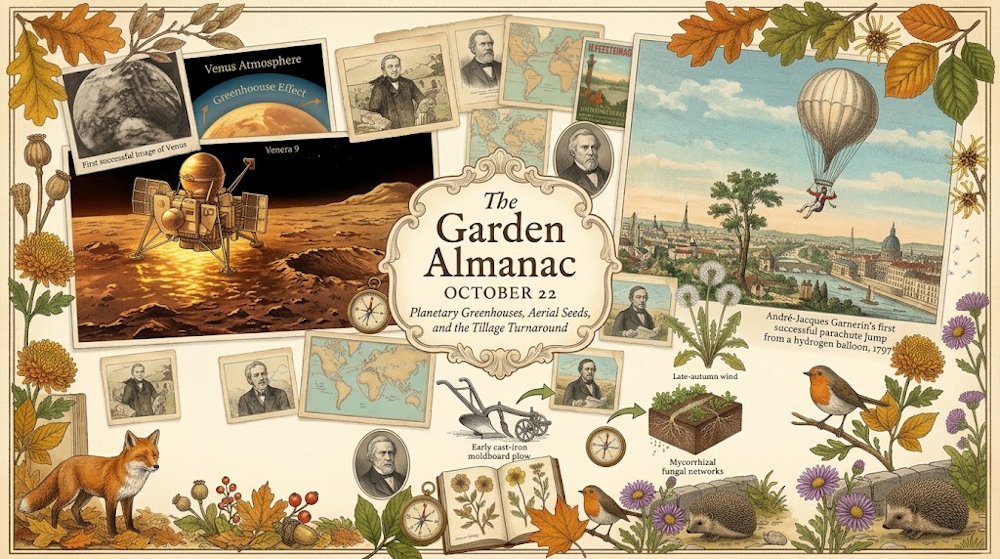
On this day in 1975, the Soviet unmanned spacecraft Venera 9 touched down on the hostile surface of Venus, sending back the first pictures ever taken from the surface of another planet. What greeted scientists was a world locked in a runaway greenhouse effect – a dense atmosphere dominated by carbon dioxide that trapped solar thermal radiation, driving surface temperatures above 450 degrees Celsius. Beyond space exploration, Venera 9 provided humanity with its first stark, visual laboratory model of thermal trapping in a enclosed atmospheric system.
For gardeners, the physics that turned Venus into a furnace is the very principle that makes controlled microclimates possible on a gentle, life-supporting scale. The glass of a greenhouse, the polytunnel arch, or even a simple glass cloche placed over tender winter greens operates through thermal wave conversion. Shortwave solar radiation passes easily through clear barriers, strikes the soil and plant tissue, and warms them; the absorbed energy is then re-radiated as longwave infrared energy, which cannot pass back through the barrier as easily, creating a protected micro-zone.
Understanding this radiation dynamic shifts how we construct winter protection. A dark stone wall positioned on the northern side of a cold frame acts as a high-density thermal mass, storing heat during peak daylight hours and gradually releasing it during freezing late October nights. Placing cold-sensitive herbs like rosemary or late-season brassicas near South-facing brickwork creates a sheltered micro-zone that effectively mimics a hardiness zone two steps warmer than the surrounding lawn.
Leveraging these atmospheric boundaries allows late-autumn growers to extend harvests well into November without artificial heating. Simple adjustments – such as choosing dark-colored mulches to absorb ambient solar warmth during bright October afternoons – maximize the natural heat storage capacity of garden beds before the winter deepens.
Garden Science: How Do Garden Microclimates Retain Heat Without Electricity?
- Thermal Absorption: Darker, organic-rich soils absorb more light energy during sunny autumn days than pale, light-colored clay surfaces.
- Radiant Delay: Heavy materials like masonry, stone borders, and water-filled containers absorb heat slowly and release it continuously across cold nighttime hours.
- Windbreak Shielding: Densely planted hedge lines reduce thermal loss caused by convective wind movement across foliage surfaces.
Wildlife Note: Creating Winter Safe Harbors for Garden Pollinators
As ambient temperatures drop below 10 degrees Celsius, solitary bees, late-flying hoverflies, and overwintering butterflies seek stable thermal microclimates. Leaving undisturbed piles of hollow plant stems, stone borders, and dry leaf litter along sunny south-facing walls provides these vital insects with frost-free shelter required to survive until spring.
October 22, 1797 – Parachutes, Aerodynamics, and the Genius of Wind-Dispersed Seeds
When French aeronaut André-Jacques Garnerin stepped out of a hydrogen balloon 3,000 feet above Paris on October 22, 1797, he made the first successful descent using a flexible umbrella-like parachute. Garnerin’s flight demonstrated that a carefully shaped canvas surface could harness air resistance to slow a gravity-driven drop, transforming what would be a fatal plunge into a controlled, floating descent.
Long before human aeronauts engineered canvas canopy systems, plants had perfected the physics of aerial dispersal. Wind-dispersed seeds – known botanically as anemochores – utilize sophisticated parachute structures like the silky pappus of dandelions, milkweeds, and clematis species. These tiny feather-like plumes do not simply catch the breeze; they generate a stable ring-shaped vortex directly above the seed head, creating a low-pressure area that keeps the seed aloft over vast distances on remarkably light air currents.
Observing dried seed heads in the late October garden provides a fresh perspective on plant strategy and garden management. Plants that rely on wind dispersal invest energy into high seed volume and lightweight aerodynamic transport rather than thick, nutrient-dense seed coats. Knowing this helps gardeners time their autumn cleanup: seed heads of desirable species can be collected on calm, humid mornings when atmospheric moisture weighs down the plumes, preventing unwanted drift across neighboring beds.
Garden Reminder: Autumn Seed Harvesting & Soil Coverage
- Collect on Dry Afternoons: Harvest mature seed pods when capsules turn brown and crisp, but before autumn winds scatter them across lawn borders.
- Store in Breathable Paper: Avoid plastic bags for long-term seed storage; paper envelopes allow residual moisture to evaporate, preventing fungal rot.
- Apply Organic Surface Cover: Top open beds with a 5 cm layer of shredded fallen leaves to anchor soil microbes and suppress wind-drifted weed seeds.
October 22, 1788 – The Tillage Legacy and the Return to Undisturbed Soils
On October 22, 1788, early agricultural patent developments for cast-iron moldboard plows began transforming European and North American landscapes, marking a major turning point in soil management. Tillage became the ultimate symbol of agricultural progress: turning over heavy earth, burying weed seeds, and creating clean, uniform planting beds for spring crops.
Yet, over two centuries of intensive tillage revealed an unintended consequence: deep, frequent flipping of soil disrupts fragile fungal networks, accelerates organic matter oxidation, and destroys soil structure. Today’s ecological revolution in home gardening and regenerative agriculture embraces a fundamental paradigm shift back toward undisturbed soil systems – popularizing the “no-dig” or low-tillage movement.
Rather than turning soil each autumn, modern garden practice relies on surface application of organic matter, mimicking natural forest floors. Top-dressing beds with well-rotted compost or leaf mold in late October allows earthworms and soil organisms to incorporate nutrients naturally, preserving delicate mycorrhizal networks while suppressing winter weeds effectively.
What to Observe Right Now: Late October Natural Transitions
- Mycelial Cord Networks: Peel back a layer of damp leaf litter to spot white thread-like fungal hyphae actively breaking down organic matter.
- Seed Pod Dehiscence: Watch how dried poppy capsules and witch hazel pods split open in dry afternoon air to release seeds.
- Formations of Migratory Birds: Observe v-shaped flocks of geese moving south, driven by changing seasonal light and atmospheric pressure fronts.
Looking Ahead
The stories of October 22 remind us that successful gardening is an ongoing dialogue with natural laws rather than an effort to master them through brute force. By observing how heat moves through protected microclimates, how seeds travel on late-autumn winds, and how soil thrives when left undisturbed, we gain tools to work alongside nature’s timing. As late autumn settles over the landscape, take time to observe the subtle microclimates and hidden life in your garden – small choices made today lay the groundwork for a resilient, vibrant spring.