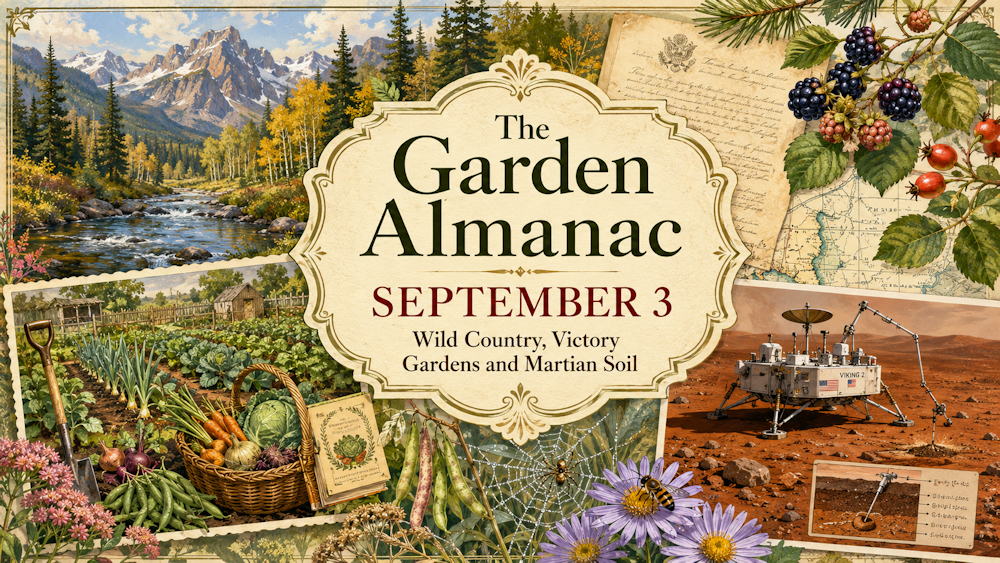

Early September is a threshold disguised as an ordinary day. In northern gardens, summer is still flowering, yet mornings arrive cooler, shadows lengthen and seed heads begin to replace petals. The season has not ended – it has simply started to speak in a different voice.
September 3 opens three windows onto our relationship with the living world: protected wilderness, vegetable plots created in wartime and the stony soil of Mars. Together, they ask a question every gardener meets: how much should we control, cultivate or simply observe?
September 3, 1964 – The Day Wilderness Gained a Legal Voice
On September 3, 1964, President Lyndon B. Johnson signed the Wilderness Act into law in the United States. The legislation created the National Wilderness Preservation System and initially protected more than nine million acres. Its most memorable phrase described wilderness as a place where the earth and its community of life remain “untrammeled” by people – not untouched in every historical sense, but free from deliberate human control.
That distinction matters far beyond national parks. A healthy landscape is a working network of soil organisms, fungi, plants, insects, birds, water and weather. Large protected areas allow ecological processes to continue at a scale no garden can reproduce, safeguarding habitats, watersheds and room for species to move as conditions change.
The modern wildlife garden applies the same principle on a smaller scale. It does not need to look abandoned, but it benefits from areas where management becomes lighter: a hedge allowed to thicken, leaves left beneath shrubs, seed heads kept through winter or one corner where stems are not cut until spring. These small refuges provide nesting material, shelter and food while connecting gardens to the wider landscape.
The practical lesson is that intervention should have a purpose. Before clearing a patch, ask what already uses it; before replacing a mature shrub, consider the cover and flowers it provides; before reaching for a pesticide, identify the insect and the actual damage. A garden becomes more resilient when neatness is balanced with habitat.
Wildlife Note – How much “wild” space does a garden need?
Even a small garden can offer useful habitat when its features are varied and connected.
- Keep a patch of dense planting where birds and insects can shelter.
- Leave some hollow and pithy stems standing until consistently warm spring weather.
- Allow fallen leaves to remain under hedges and shrubs, away from paths and delicate lawn areas.
- Provide shallow water with a safe landing stone and refresh it regularly.
- Choose several plants that flower at different times, including locally appropriate native species.
September 3, 1939 – When Gardens Joined the Home Front
On September 3, 1939, Britain declared war on Germany after the invasion of Poland, and France followed later that day. The conflict rapidly disrupted trade, labour and food supplies across Europe and far beyond it. Within weeks, the British government launched the Dig for Victory campaign, encouraging households to turn gardens, allotments and spare ground into productive vegetable plots.
The campaign transformed the idea of what urban and ornamental land could do. Lawns, parks and other open spaces were cultivated, while public advice taught inexperienced growers about sowing, crop rotation and storage. By the later war years, millions of allotments were producing substantial quantities of food. Gardening supplied fresh produce, diversified diets and gave civilians a practical role in a national emergency.
The enduring lesson is less about nostalgia than resilience. Perennial herbs, fruit bushes, compost systems, saved seed and healthy soil all build capacity gradually. Early September is an ideal time to assess which crops earned their space, sow quick autumn leaves where the climate allows, and improve vacant beds with compost or green manure rather than leaving soil bare.
Garden Reminder – What can you do in the garden in early September?
Conditions vary by climate, but these jobs suit many temperate Northern Hemisphere gardens:
- Sow radishes, spinach, rocket and cold-tolerant salad leaves for autumn harvests.
- Harvest onions and maincrop potatoes in dry weather, then cure or dry them before storage.
- Collect ripe seed only from healthy, open-pollinated plants and label it with the variety and year.
- Divide established spring-flowering perennials if the soil is moist and the weather is no longer hot.
- Top up mulch after rain, keeping it away from plant crowns and woody stems.
- Continue watering newly planted trees and shrubs deeply – cooler air does not mean their roots are established.
September 3, 1976 – Viking 2 Put Martian Soil to the Test
On September 3, 1976, NASA’s Viking 2 lander touched down at Utopia Planitia on Mars. It photographed the rocky northern plain and began measuring temperature, atmospheric pressure and wind. Nine days later, its remote sampler arm began collecting Martian surface material and delivering samples to onboard instruments for chemical and biological tests. The experiments detected intriguing chemical activity but found no clear evidence of living microorganisms.
For gardeners, the mission offers a dramatic reminder that soil is more than crushed rock. On Earth, productive soil contains mineral particles, air, water, organic matter and an immense biological community. Bacteria, fungi and small animals release nutrients, build aggregates and help create the structure through which roots can breathe and water can move. A material may contain essential chemical elements and still lack the living processes that make terrestrial soil fertile.
That difference can be felt in an ordinary garden bed. Digging when soil is wet damages its structure, while leaving it bare exposes the surface to erosion and temperature extremes. Adding mature compost, protecting the surface with plants or mulch and keeping living roots in the ground support the biological system on which long-term fertility depends.
Garden Science – What is the difference between soil and dirt?
“Dirt” is often used for displaced or unwanted mineral material. Healthy garden soil is an ecosystem. Its structure depends partly on organic compounds and fungal threads that help bind particles into crumbs, creating pores for air and water. This is why compost improves more than nutrient levels: over time, it can also improve water retention in light soils and drainage and workability in heavy ones.
Avoid working a bed when a squeezed handful stays in a dense, sticky lump. If it crumbles when gently pressed, conditions are usually kinder to soil structure.
What to Observe Right Now – The First Signs of the Seasonal Turn
The date on the calendar cannot dictate the season, but the garden gives its own local signals. Look rather than rush, and note what is changing.
- Which flowers still receive the most visits from bees and hoverflies?
- Are spiders becoming more visible as dew outlines their webs?
- Which fruits and seed heads are attracting birds?
- Does morning dew linger longer in shaded parts of the garden?
- Are deciduous plants slowing their growth or showing the first colour changes?
These observations can guide future planting. A late-flowering plant crowded with insects deserves a place in next year’s plan, while a dry corner that repeatedly finishes early may need tougher species rather than more irrigation.
Garden Science – Why do plants notice shorter days before we do?
Plants detect changes in day length through light-sensitive systems that help regulate flowering, dormancy and other seasonal responses. Temperature and moisture also matter, so two plants of the same species may behave differently in different gardens. The shortening days of late summer do not automatically cause leaves to fall, but they form part of the signal that growth should slow and preparations for winter should begin.
For gardeners, this explains why heavy feeding late in the season can be unhelpful for many hardy woody plants: it may encourage soft new growth that has little time to mature before cold weather. Compost used as a soil improver is different from a quick dose of high-nitrogen fertiliser. The goal now is steady establishment, healthy roots and well-ripened growth rather than a last burst of tender foliage.
Looking Ahead
September 3 reminds us that good stewardship has more than one form. Sometimes it means protecting land from intensive use, sometimes cultivating every useful metre with care, and sometimes examining a handful of soil closely enough to discover how much remains unknown. In our own gardens, the future can begin with equally practical choices: protect habitat, grow some food, feed the soil and observe before intervening. Small plots cannot solve every environmental challenge, but they can become living places where resilience is practised season after season.