


Late August brings a subtle change to northern gardens. The light is mellower, seed heads are replacing some of the flowers, and the first signs of autumn appear even while tomatoes, beans and soft fruit continue to ripen.
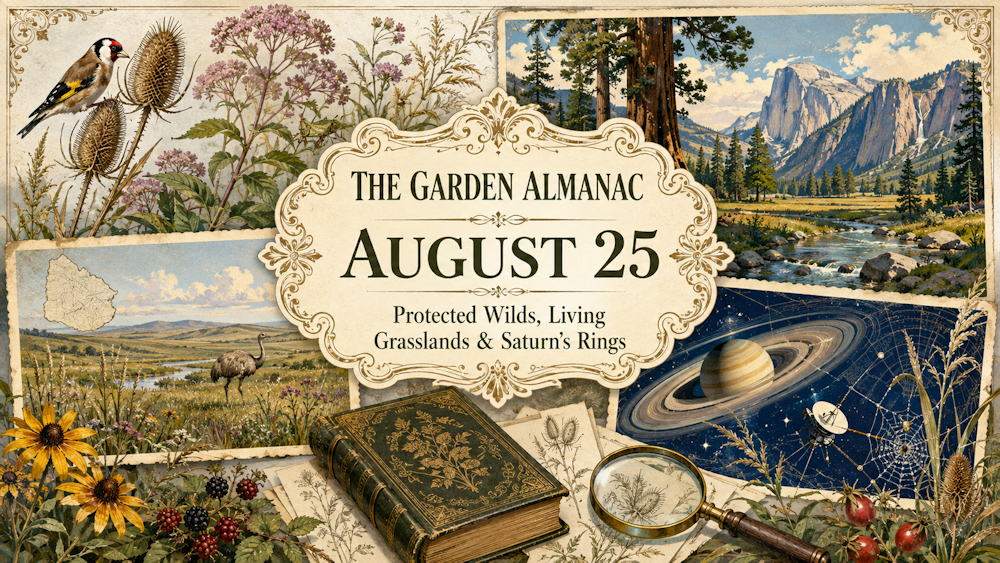
August 25 also opens three remarkably different windows onto the living world. On this date, the United States created an agency charged with protecting its great landscapes, Uruguay commemorates an independence story rooted in the grasslands of South America, and a distant spacecraft revealed the intricate order hidden within Saturn’s rings.
August 25, 1916 – When Wild Landscapes Gained a Guardian
On August 25, 1916, President Woodrow Wilson signed the legislation that created the United States National Park Service. The new agency was given a demanding dual purpose: to make extraordinary landscapes available for public enjoyment while conserving their scenery, wildlife and historic features for future generations.
The parks brought under its care ranged from geothermal basins and giant sequoia groves to deserts, mountains, wetlands and coastal habitats. Their protection helped establish an influential idea – that landscapes are more than picturesque backdrops. They are living systems shaped by soil, water, climate, plants, animals and human activity, and damage to one part can affect the whole.
That principle applies at garden scale too. A mature tree may cool the soil, shelter nesting birds, slow rainwater and support fungi around its roots. A patch of native flowers can feed insects that pollinate nearby fruit and vegetables. Even fallen leaves have ecological work to do, providing winter cover and gradually returning nutrients to the ground.
For gardeners, the most useful lesson of protected landscapes is not that every corner must be left untouched. It is that management should begin with observation. Before cutting, clearing or replacing, ask what already lives there, where water gathers, which plants cope well with the conditions and what seasonal resources wildlife may be using.
Garden Inspiration – Can a Small Garden Work Like a Nature Reserve?
- Keep at least one quiet area with dense planting or leaf litter.
- Grow several locally native species suited to your soil and climate.
- Provide flowers across as much of the growing season as possible.
- Allow some hollow stems and seed heads to remain through winter.
- Avoid pesticides where physical removal or tolerance will solve the problem.
A garden does not need to imitate wilderness. It simply needs enough connected food, water, shelter and undisturbed space to function as a small habitat.
August 25, 1825 – Uruguay’s Independence and the Overlooked Wealth of Grasslands
Uruguay celebrates Independence Day on August 25, marking the declaration made in 1825 during the country’s long struggle between regional powers. Its national story developed on the eastern bank of the Uruguay River, in a landscape dominated not by dense forest but by open plains, rolling grasslands, streams and wetlands.
These grasslands may appear simple from a distance, yet they contain intricate communities of grasses, flowering herbs, soil organisms, birds and grazing animals. Different species occupy slightly different niches, sending roots to varying depths and responding differently to heat, rain, grazing and seasonal change. The result is a resilient living mosaic rather than an empty expanse waiting to be planted.
Uruguay’s landscape offers a timely correction to the idea that environmental value depends on trees. Natural grasslands store much of their carbon below ground, protect soil with dense root systems and provide habitat for specialised wildlife. In gardens, the corresponding lesson is to treat ornamental grasses and meadow plants as structural vegetation: combine species of different heights, retain their roots, and avoid cutting the whole area at once. Staggered mowing leaves refuges for insects while allowing plants to flower and set seed.
Garden Science – Why Are Grasslands So Resilient?
Many grasses keep their growing points close to the ground, where they are less easily damaged by grazing, wind or cutting. Their fibrous roots bind the upper soil and can create an extensive underground network. When the foliage is disturbed, established plants can often regrow from their crowns, provided they have not been weakened by repeated cutting, severe drought or soil compaction.
August means late summer in the Northern Hemisphere but late winter in Uruguay. That contrast is itself a useful reminder: gardening advice only makes sense when matched to local climate, rainfall and plant growth. A task that suits a European border in August may be entirely wrong for a garden awakening to spring south of the equator.
August 25, 1981 – Voyager 2 Finds Order in Saturn’s Rings
On August 25, 1981, Voyager 2 made its closest approach to Saturn, passing about 41,000 kilometres above the planet’s cloud tops. Its cameras and instruments returned thousands of observations of Saturn, its atmosphere, rings and icy moons, adding fine detail to a planetary system that had previously been seen only from much greater distances.
Among the most fascinating sights were narrow ringlets, changing patterns and small moons whose gravity helped shape nearby ring material. These so-called shepherd moons demonstrated how comparatively small bodies can influence much larger structures. What looked like a few smooth bands from Earth proved to be a dynamic system of particles, gaps, waves and interacting forces.
There is a gentle parallel in the garden. Apparent disorder often becomes intelligible when it is observed closely and over time. A damaged leaf may reveal the feeding pattern of a particular insect; a repeatedly dry patch may trace the rain shadow of a wall; poor fruit set may coincide with a gap in pollinator activity. Before reaching for a remedy, inspect the pattern, compare affected and healthy plants, and note when the change began. Good gardening, like good planetary science, depends on evidence collected at the right scale.
What to Observe Right Now
- Which flowers still attract bees, hoverflies and butterflies late in the day?
- Where are spiders beginning to build more visible webs?
- Which fruits are ripening unevenly because foliage shades one side?
- Are leaves wilting only at midday, or do they remain limp into the evening?
- Which seed heads are already drawing finches or other seed-eating birds?
These observations require no immediate action. Their purpose is to reveal how the garden is responding to shorter days, ageing foliage, changing temperatures and the gradual movement towards autumn.
Wildlife Note – Should Late-Summer Seed Heads Be Removed?
Not all of them. Seed heads can feed birds, while hollow or pithy stems provide shelter for insects. Their silhouettes also give borders structure after flowering has finished.
Remove diseased material and cut back plants that are smothering weaker neighbours, but consider leaving sound stems on coneflowers, teasels, ornamental grasses and other sturdy plants. If self-seeding is a concern, remove selected heads before the seeds mature rather than clearing the entire border.
A shallow water source remains valuable during warm weather. Keep it clean, add stones or a gently sloping edge for safe access, and place it where visiting animals have a clear view of approaching predators.
Garden Reminder – What Should You Do in the Garden in Late August?
Late August is a period of harvest, selective tidying and preparation rather than wholesale clearing.
- Pick beans, courgettes and cucumbers regularly to encourage continued production.
- Harvest tomatoes as they colour, especially if heavy rain could cause ripe fruit to split.
- Water deeply at soil level when needed instead of sprinkling the surface every day.
- Remove badly diseased leaves, but retain healthy foliage that is still feeding roots and ripening fruit.
- Collect seed only from healthy plants once the heads or pods are dry and fully mature.
- Mark gaps in borders now while their size and seasonal appearance are still easy to judge.
- Leave some late flowers untouched for pollinators, particularly where autumn nectar sources are limited.
- Start moving or dividing established perennials only when temperatures moderate and reliable moisture returns.
Container plants may still dry quickly even when nights become cooler. Check the compost below the surface with a finger rather than judging moisture by appearance alone.
Looking Ahead
The stories of August 25 move from protected wilderness to South American grasslands and finally to the rings of Saturn, but each rewards the same habit – attentive observation before intervention. Gardens become more resilient when we recognise existing relationships instead of treating every plant, insect or patch of soil in isolation. Protect a small habitat, learn from the vegetation suited to your region, and watch seasonal patterns closely. Those modest choices allow even an ordinary garden to take part in a much larger living system.